In the high-stakes realms of industrial production and emergency management, the reliability, efficiency, and integration of communication systems can mean the difference between smooth operations and catastrophic losses. Industrial environments—from deep underground mines to bustling rail transit hubs, from hazardous chemical plants to sprawling energy facilities—present unique challenges: extreme noise, harsh weather, potential explosions, and the urgent need for real-time collaboration across multiple systems and teams. Against this backdrop, the Becke BD-156 Single-handset Dispatching Console emerges as a game-changing human-machine interaction terminal, engineered to serve as the operational core of industrial communication and emergency command systems. More than just a communication device, it is a comprehensive solution that unifies control, accelerates response, and enables seamless collaboration, making it an indispensable asset for industries where every second counts.
1. Product Overview: Core Positioning and Strategic Value
The BD-156 Single-handset Dispatching Console is meticulously designed to address the rigorous demands of industrial and emergency communication scenarios. As the central nervous system of dispatch command frameworks, it shoulders three pivotal responsibilities: centralized management and control of scattered communication terminals, rapid and accurate delivery of voice commands, and coordinated scheduling across diverse systems. Unlike consumer-grade communication devices or standard office telephones, which falter in harsh industrial conditions, the BD-156 is built from the ground up with industrial resilience and functionality in mind.
Its versatility is evident in its wide application across critical sectors, including tunneling, mining, chemical engineering, rail transit, energy, and power generation. What sets it apart is its ability to seamlessly integrate with a vast ecosystem of industrial equipment: industrial telephones, emergency broadcasting systems, video surveillance platforms, explosion-proof terminals, gas and hydrological sensors, IPPBX (Internet Protocol Private Branch Exchange) systems, and production management software. By breaking down information silos, the BD-156 achieves the core dispatch goals of unified command, rapid response, and collaborative disposal—directly enhancing the efficiency of emergency handling and ensuring operational continuity in high-pressure environments.
In essence, the BD-156 is not merely a terminal but a strategic tool that empowers organizations to mitigate risks, minimize downtime, and protect personnel and assets. Whether responding to a gas leak in a coal mine, a equipment failure in a smart factory, a traffic accident in a city, or a passenger surge in a transit hub, the console delivers consistent, reliable performance that operators can depend on.
2. Hardware Design: Industrial-Grade Durability and Ergonomic Excellence
2.1 Unique Layout: Balancing Functionality and Usability
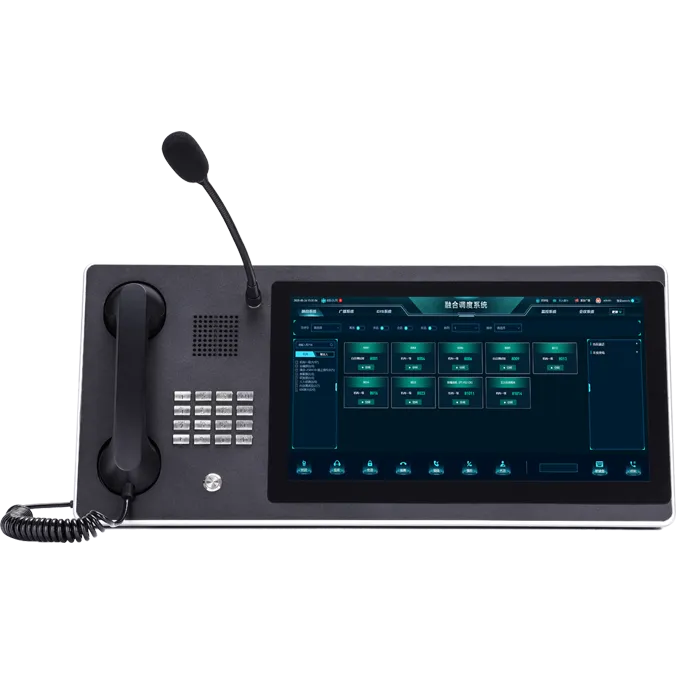
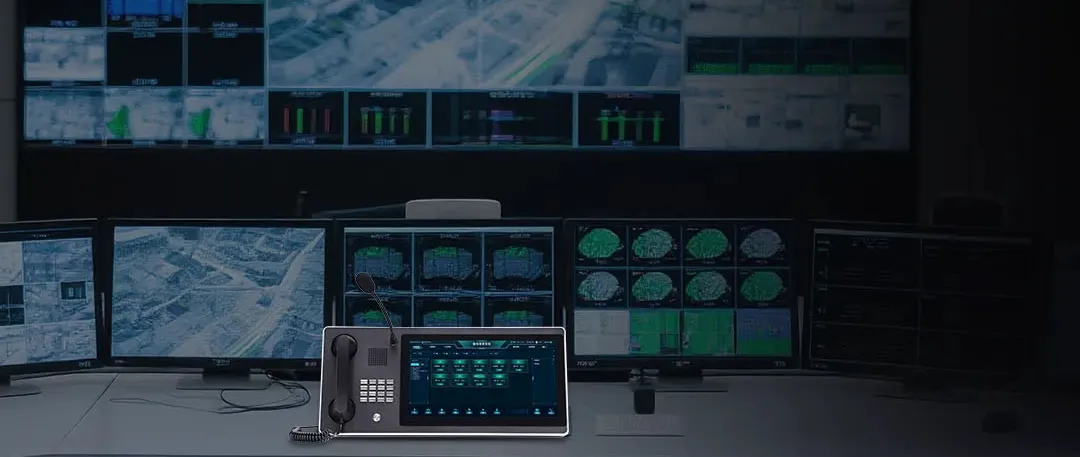
The BD-156’s design stands out in the industry for its thoughtful, asymmetric layout that optimizes workflow for dispatch operators. On the left side, a built-in industrial-grade call handset provides a dedicated channel for voice communication, while the right side features a 15.6-inch touch screen integrated with a gooseneck microphone—creating a dual-operation interface that allows operators to switch seamlessly between voice calls and screen-based tasks. This unique configuration eliminates the need for separate devices, reduces workspace clutter, and streamlines operations, making it a one-of-a-kind solution in the industrial dispatch market.
Every element of the console’s design is guided by the realities of industrial use. The compact yet robust structure ensures it fits into control rooms, underground command centers, and mobile dispatch units alike, while the choice of materials prioritizes durability, resistance to harsh conditions, and long-term reliability. There are no unnecessary frills—each component serves a critical purpose, reflecting a design philosophy centered on performance and practicality.
2.2 15.6-Inch Touch Screen: Intuitive Control at Your Fingertips
The 15.6-inch touch screen is the visual and operational hub of the BD-156, designed to deliver clarity, responsiveness, and ease of use in high-pressure environments. Its large size ensures that critical information—such as system status, contact lists, sensor data, and dispatch logs—is displayed clearly, even for operators wearing protective gear or working in low-light conditions. The touch screen supports multi-touch gestures, allowing operators to navigate menus, select contacts, initiate calls, and configure settings with simple taps and swipes—reducing response time in emergencies.
Engineered for industrial durability, the touch screen features a scratch-resistant, anti-glare surface that minimizes reflections and maintains visibility in bright control rooms or sunlit outdoor facilities. Its high resolution ensures that detailed data, such as real-time video feeds from surveillance cameras or complex system diagrams, is rendered with precision, enabling operators to make informed decisions quickly. The screen’s responsiveness is calibrated to work with gloved hands—a crucial feature in industrial settings where operators often wear safety gloves to protect against hazards.
Beyond basic navigation, the touch screen serves as the central configuration panel for the console. Operators can use it to customize shortcut keys, monitor the status of linked devices, access historical dispatch records, and configure communication protocols. The intuitive software interface is tailored to industrial workflows, with logically organized menus and prominent icons that reduce the learning curve for new users and enhance productivity for experienced operators.
2.3 Industrial-Grade Call Handset: Durability and Clarity in Extreme Conditions
The left-side built-in call handset is a cornerstone of the BD-156’s communication capabilities, engineered to withstand the harshest industrial environments while delivering crystal-clear voice quality. Unlike standard telephone handsets, which are designed for office use and prone to damage in industrial settings, this handset is built with explosion-proof, impact-resistant materials that meet strict industrial safety standards.
The handset’s shell is crafted from composite explosion-proof PC/ABS engineering plastic—a material renowned for its exceptional strength, chemical resistance, and explosion-proof properties. This makes the handset safe for use in environments with flammable gases, dust, or vapors, such as coal mines, oil and gas fields, and chemical plants. The PC/ABS composite also resists UV radiation, moisture, and physical impact, ensuring the handset remains functional even after years of heavy use in harsh conditions.
At the heart of the handset’s performance is a dynamic anti-puncture transmitter. Industrial workplaces are rife with potential hazards—tools, equipment, and debris can accidentally strike the handset, damaging standard transmitters. The anti-puncture design ensures that the transmitter remains intact and functional even after impact, maintaining consistent voice quality over the device’s lifespan. Complementing this is advanced noise reduction technology, which filters out background noise such as machinery hum, engine roar, and crowd chatter—common in industrial environments. This technology isolates the user’s voice, ensuring that instructions and updates are transmitted clearly, even in noise levels exceeding 100 decibels.
The handset’s ergonomic design is another key feature. The comfortable grip, well-positioned earpiece, and balanced weight reduce fatigue during extended calls—a critical consideration in dispatch centers where operators may be on the line for hours at a time. The receiver delivers loud, distortion-free audio, ensuring that operators can hear clearly even in noisy surroundings, while the mouthpiece’s optimal placement captures speech accurately without requiring the user to raise their voice.
2.4 Built-in Gooseneck Microphone: Flexible Hands-Free Communication
In addition to the handset, the BD-156 is equipped with a built-in gooseneck microphone, offering operators a hands-free communication option that enhances multitasking capabilities. This is particularly valuable in scenarios where operators need to monitor the touch screen, access documents, or coordinate with multiple teams simultaneously—all while maintaining voice communication.
The gooseneck design provides exceptional flexibility, allowing operators to adjust the microphone’s angle and position with precision. The flexible neck can be bent into any shape, ensuring the microphone is always close to the user’s mouth, even if the operator shifts position or leans forward to view the screen. When not in use, the microphone can be folded out of the way, keeping the workspace uncluttered and preventing accidental damage.
Like the handset, the gooseneck microphone is integrated into the BD-156’s high-sensitivity sound pickup system. It features a high-quality condenser capsule that captures voice with exceptional clarity and detail, even at low volumes. The microphone also incorporates the same advanced noise reduction technology as the handset, filtering out background noise and delivering clean, intelligible audio. This ensures that hands-free calls are just as clear as handset calls, eliminating the need for operators to choose between convenience and communication quality.

2.5 Industrial-Grade Protective Housing: Shielding Against Harsh Environments
The BD-156’s industrial-grade protective housing is a testament to its durability, constructed from high-quality zinc alloy that provides robust protection against dust, water, physical impact, and corrosion. Zinc alloy is an ideal material for industrial housing due to its unique combination of strength, light weight, and resistance to environmental damage. It withstands rust and corrosion even in humid, chemically aggressive environments—such as coastal energy facilities or chemical plants—and offers excellent impact resistance, protecting internal components from accidental drops, collisions with tools, or debris.
The housing features a sealed design that meets industrial waterproof and dustproof standards, preventing contaminants from entering the console and damaging sensitive internal components such as circuit boards, connectors, and the touch screen. This is particularly critical in mines, where dust levels are extremely high, and outdoor energy facilities, where the console may be exposed to rain, snow, or splashes of water. The sealed design also ensures that the console remains functional in temperature extremes, from freezing underground mines to scorching desert power plants.
The console’s keys are integrated into the protective housing, designed for durability and high-frequency use. Industrial dispatch operators often press keys hundreds of times per shift, and standard consumer-grade keys would quickly wear out under such stress. The BD-156’s keys are made from wear-resistant materials with a tactile design that provides clear feedback when pressed, reducing the risk of accidental key presses. Each key is tested to withstand over 100,000 presses, ensuring reliable performance over the console’s long lifespan. Additionally, the housing supports 4 custom keys, which can be programmed to trigger emergency functions, access frequently used systems, or initiate one-click linkage—further enhancing the console’s responsiveness in critical situations.
2.6 Industrial-Grade Keyboard with Custom Shortcut Keys
Complementing the touch screen and handset is an industrial-grade keyboard, featuring 4 customizable application shortcut keys that boost operator efficiency. The keyboard is designed to withstand the rigors of industrial use, with dustproof, moisture-resistant keys that maintain performance even in harsh environments. The key travel and tactile feedback are optimized for comfortable, accurate typing, reducing fatigue during long shifts, while the familiar layout minimizes the learning curve for operators transitioning from standard keyboards.
The 4 application shortcut keys are a standout feature, allowing users to tailor the console to their specific workflow needs. Operators can program these keys to access frequently used functions such as emergency calls, broadcast activation, department-specific linkage, or critical system data. For example, in a smart factory, a shortcut key could be set to trigger an emergency evacuation broadcast; in a mining environment, it could access real-time gas sensor readings; and in a city emergency command center, it could link directly to the fire department’s communication system. The customization process is simple and intuitive, accessible via the touch screen interface, allowing operators to reassign keys as operational needs change. This flexibility makes the BD-156 adaptable to a wide range of scenarios, ensuring it aligns with the unique workflows of each organization.
3. Communication Capabilities: Clear, Stable, and Versatile
3.1 HD Audio System: Uncompromised Clarity in Noisy Environments
The BD-156’s communication capabilities are anchored by a high-definition (HD) audio system that prioritizes clarity and stability—critical in industrial settings where miscommunication can lead to accidents, delays, or financial losses. The system combines a high-sensitivity sound pickup system, advanced noise reduction technology, and high-fidelity audio output to ensure that every word is transmitted and received clearly, even in the noisiest environments.
The high-sensitivity sound pickup system, integrated into both the handset and gooseneck microphone, captures human speech with exceptional detail, even at low volumes. It is optimized to distinguish between speech and background noise, filtering out non-voice frequencies to enhance intelligibility. The noise reduction technology takes this a step further, using sophisticated algorithms to analyze audio input in real time, identifying and suppressing background noise such as machinery, wind, and crowd chatter. This ensures that the user’s voice remains the focus of the conversation, even in environments with noise levels exceeding 90 decibels.
The audio output system is equally impressive, delivering loud, crisp sound through the handset’s receiver or external speakers (if connected). The output is tuned to reproduce human speech accurately, with balanced frequencies that make conversations easy to understand, even during extended calls. Whether the operator is communicating with a colleague in a noisy factory, a first responder in a disaster zone, or a team member in an underground mine, the audio remains clear and distortion-free.
3.2 Dual Communication Protocols: WebRTC and SIP
The BD-156 supports two industry-leading communication protocols—webRTC and SIP—providing versatile connectivity options that adapt to diverse industrial networks and systems. This dual-protocol support ensures that the console can integrate seamlessly with existing communication infrastructure, eliminating the need for costly overhauls.
WebRTC (Web Real-Time Communication) enables direct audio and video calls between devices via the internet, without the need for additional software or plugins. This makes it ideal for real-time collaboration, allowing dispatch operators to conduct video calls with on-site teams, share live video feeds from surveillance cameras, and coordinate responses visually. WebRTC’s low latency ensures that communication is nearly instantaneous, a critical feature in emergency situations where delays can have severe consequences. It also supports encryption, ensuring that sensitive communication is protected from interception.
SIP (Session Initiation Protocol) is a standard for initiating, maintaining, and terminating telephone calls, making the BD-156 compatible with most industrial telephones, IPPBX systems, and traditional phone networks. SIP registration allows the console to function as a full-featured industrial telephone, enabling voice calls to internal extensions, external phone numbers, and other SIP-enabled devices. This ensures that the BD-156 can integrate with legacy communication systems, providing a bridge between old and new technology.
The combination of webRTC and SIP makes the BD-156 a flexible communication hub that can adapt to the unique needs of each industry. Whether an organization relies on modern internet-based communication or traditional telephone networks, the console delivers reliable, high-quality connectivity.
4. Flexible Configuration: Adapting to Multi-Scenario Needs
4.1 Ergonomic Desktop Stand
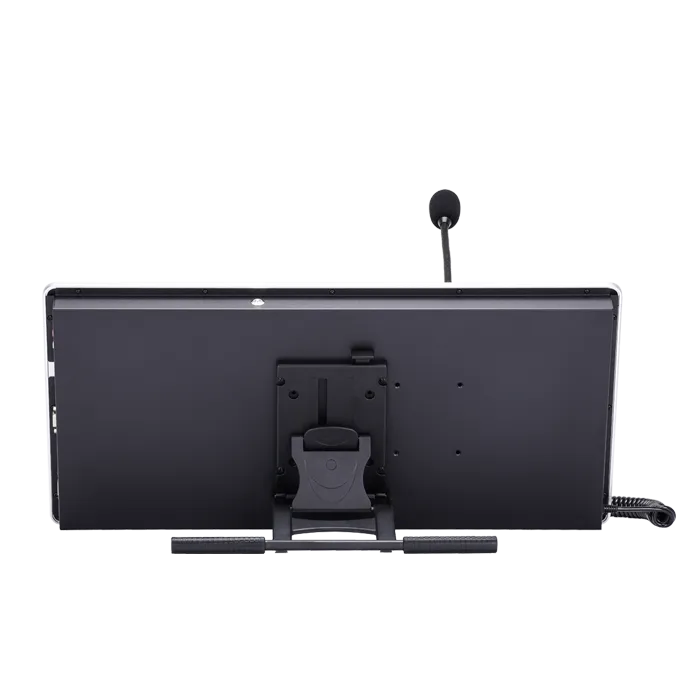
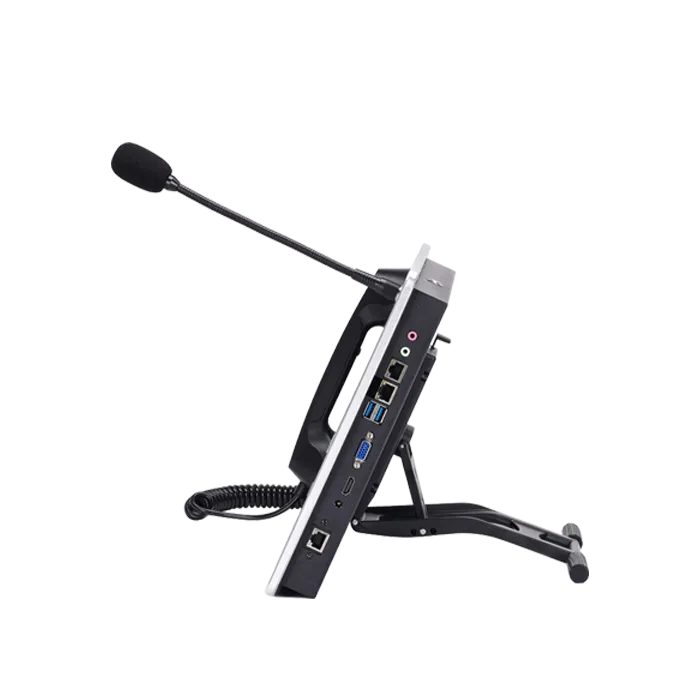
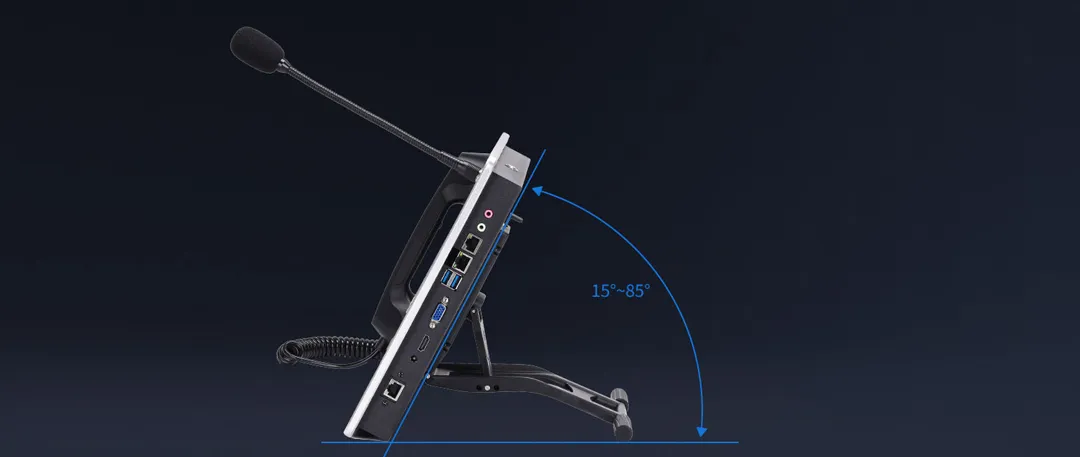
The BD-156 features an ergonomically designed desktop stand that supports 15~85° flip adjustment, allowing operators to customize the console’s angle for optimal comfort and visibility. This is a critical feature in dispatch centers where operators spend long hours at their workstations, as poor posture can lead to fatigue and reduced productivity. The stand’s adjustable design enables operators to tilt the console forward for closer viewing of the touch screen or backward for a more relaxed viewing angle, reducing eye strain and neck fatigue.
The stand is also built for stability, with a wide base that prevents the console from tipping over—even in high-traffic control rooms or mobile dispatch units. It is easy to adjust, requiring only a simple lever to lock the console into the desired position, and can be folded flat for convenient storage or transportation. This makes the BD-156 suitable for both fixed control rooms and temporary command centers, such as those set up during emergency responses.
4.2 Easy Installation and Configuration
The BD-156 is designed for hassle-free installation and configuration, ensuring that it can be deployed quickly in industrial environments. It supports multiple installation methods, including desktop placement and wall mounting, allowing it to fit into diverse workspace configurations. The console’s compact size and lightweight design (facilitated by the zinc alloy housing) make it easy to transport and install, even in hard-to-reach locations such as underground mine control rooms or elevated rail transit hubs.
Configuration is equally straightforward, with an intuitive touch screen interface that guides operators through setup steps such as network connection, SIP registration, webRTC configuration, and shortcut key programming. The console also supports remote configuration and management, allowing IT teams to update settings, install firmware, and troubleshoot issues from a central location—reducing downtime and maintenance costs. This remote management capability is particularly valuable for organizations with multiple dispatch centers or geographically dispersed facilities.
5. Application Scenarios: Delivering Value Across Critical Industries
5.1 Smart Industry
In smart factories and industrial facilities, the BD-156 serves as the central command hub for production and emergency management. It connects seamlessly with explosion-proof terminals, video surveillance systems, IPPBX, and production management software, enabling real-time production linkage. Operators can monitor production lines, receive fault alerts from equipment sensors, and dispatch maintenance teams quickly—minimizing downtime and maximizing productivity.
In emergency situations, such as equipment malfunctions, chemical leaks, or fires, the BD-156’s one-click emergency evacuation feature triggers broadcast alerts across the facility, guiding personnel to safety. It also enables cross-regional linkage, connecting on-site teams with off-site experts, emergency services, and management—ensuring a coordinated response. The console’s ability to schedule personnel and raw materials also streamlines daily operations, ensuring that resources are allocated efficiently and production targets are met.
5.2 Energy and Mining
The energy and mining sector is one of the most demanding industrial environments, with high risks of gas leaks, equipment overload, geological disasters, and extreme weather. The BD-156 is specifically engineered to meet these challenges, connecting with explosion-proof intercoms, gas and hydrological sensors, and underground communication systems. It provides real-time monitoring of critical parameters such as gas concentrations, water levels, and equipment temperature, issuing early warnings when thresholds are exceeded.
When high-risk incidents occur—such as gas over-limit, roof collapses, or equipment failures—the BD-156 enables rapid response. Operators can initiate emergency evacuation orders via broadcast systems, dispatch rescue teams to affected areas, and coordinate repair efforts—all from a single console. The console’s explosion-proof design and noise reduction technology ensure that communication remains reliable even in the harshest mining or energy environments, protecting personnel and minimizing losses. It is suitable for coal mines, oil and gas fields, photovoltaic power stations, and wind farms, adapting to the unique needs of each energy and mining subsector.
5.3 Smart City
In smart cities, the BD-156 integrates public security, fire protection, medical care, municipal services, and transportation systems into a unified command platform. It serves as the central hub for handling urban incidents, from traffic accidents and fires to natural disasters and public health emergencies. The console’s one-click multi-department linkage feature enables rapid response, connecting dispatch operators with police, firefighters, paramedics, and municipal workers—ensuring that resources are deployed quickly and efficiently.
The BD-156 streamlines the entire incident management process, from unified alarm receiving to rapid task dispatching and real-time tracking. Operators can view real-time video feeds from city surveillance cameras, access traffic data to coordinate diversion, and communicate directly with on-site responders. This ensures that urban incidents are handled quickly, minimizing disruption to public life and enhancing public safety. Whether coordinating disaster rescue efforts, managing public events, or responding to medical emergencies, the BD-156 delivers the unified command and rapid response capabilities that smart cities need.
5.4 Smart Transportation
Smart transportation hubs—such as airports, train stations, and bus terminals—require efficient coordination of personnel, vehicles, and passenger flow to ensure smooth operations. The BD-156 connects with security inspection systems, broadcast systems, flight and train dispatch software, and passenger information displays, enabling operators to manage daily operations and respond to emergencies quickly.
In normal operations, the console coordinates personnel scheduling, vehicle rostering, and passenger guidance—ensuring that staff are deployed where they are needed most and passengers receive timely information. When emergencies occur—such as flight or train delays, passenger flow congestion, or equipment failures—the BD-156 enables rapid response. Operators can broadcast updates to passengers, coordinate with security teams to manage crowds, and dispatch maintenance personnel to fix equipment issues. The console’s ability to integrate with multiple transportation systems ensures that all stakeholders are on the same page, minimizing disruption and ensuring the efficient operation of transportation hubs.
6. Conclusion: A Reliable Partner for Industrial Communication and Emergency Command
The Becke BD-156 Single-handset Dispatching Console represents the pinnacle of industrial communication and emergency command technology, combining industrial-grade durability, advanced communication capabilities, and flexible adaptability. Its unique design—featuring a 15.6-inch touch screen, industrial-grade handset, gooseneck microphone, and protective zinc alloy housing—ensures it can withstand the harshest industrial environments while delivering intuitive, efficient operation.
The console’s dual communication protocols (webRTC and SIP), HD audio system with noise reduction, and customizable shortcut keys ensure clear, reliable communication in any scenario, while its ergonomic design and easy installation make it user-friendly for operators across industries. Its versatility across smart industry, energy and mining, smart city, and smart transportation sectors demonstrates its ability to adapt to diverse operational needs, making it a valuable asset for any organization that requires rapid response, unified command, and seamless collaboration.
In an era where industrial operations are becoming increasingly complex and emergency response times are more critical than ever, the BD-156 stands as a reliable partner that empowers organizations to mitigate risks, enhance efficiency, and protect personnel and assets. It is not just a device but a comprehensive solution that redefines industrial communication and emergency command, setting a new standard for performance, durability, and versatility in the industry.

 English
 Deutsch
 한국어
한국어 Русский
 Français
 日本語
日本語 لالعربية
 हिन्दी
 Español
 Português
 繁体中文
繁体中文 简体中文
简体中文