Leading industrial special communication provider with rich global cases. Our explosion-proof & SIP dispatch systems power projects—your reliable partner with proven success.
Leading industrial special communication provider with rich global cases. Our explosion-proof & SIP dispatch systems power projects—your reliable partner with proven success.
PBX vs Traditional Communication Systems Key Differences
PBX vs Traditional Communication Systems Key Differences explained for B2B communication projects, covering architecture, business workflow, deployment logic, selection priorities, and operational value in corporate & public environments.
Becke Telcom
When companies review their communication infrastructure, the discussion often starts with hardware and quickly turns into a question of business process. Who answers the main number, how are calls transferred, what happens after hours, and how do branches work like part of one organization? Those are the practical issues behind PBX vs Traditional Communication Systems Key Differences.
For business users, integrators, and operations teams, PBX should be understood as the control layer behind internal extensions, outside lines, queues, time conditions, permissions, and service continuity. In environments spanning office, branch office, reception, service desk, that control layer determines whether voice communication behaves like an organized business service or just a collection of disconnected endpoints.
This article approaches the topic through the lens of benefits, while keeping the wider project picture in view. The aim is to explain what buyers, planners, and site operators actually need to know: how PBX works, where it adds value, what should be checked before deployment, and how to choose a system that still makes sense after the first year of real use.
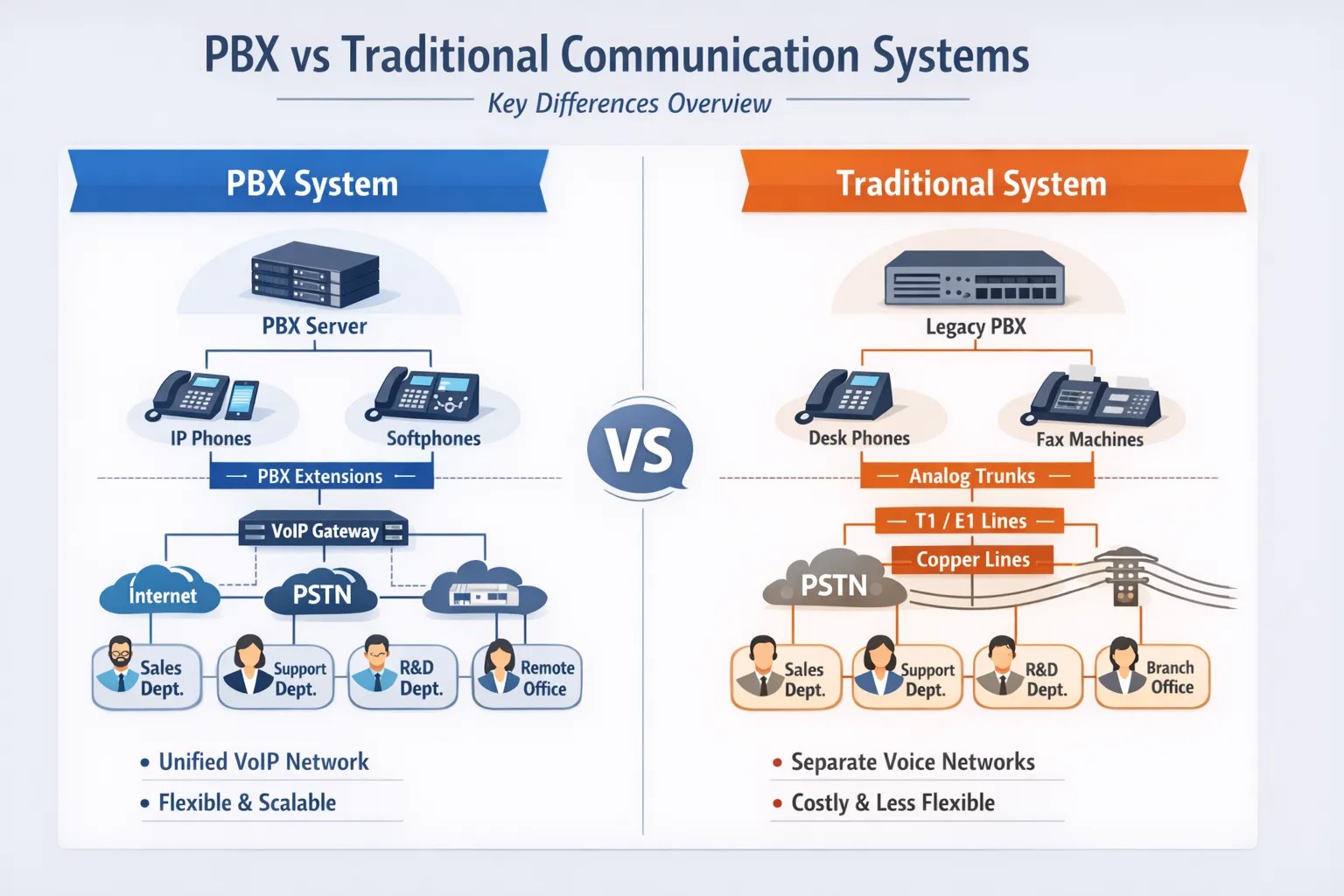
PBX overview for corporate & public environments with centralized call control, mixed endpoints, and shared outside connectivity.
PBX as Part of Communication Architecture
The platform sits between users and outside networks
A PBX, or Private Branch Exchange, is the platform that organizes how voice communication moves inside an organization and between the organization and the public network. It manages extensions, controls outside access, applies schedules, supports groups and queues, and determines what should happen when a user or caller initiates communication. That central control is what allows a business to behave like one communication system instead of a collection of unrelated numbers and devices.
In practical terms, this means one published business number can support several departments, internal users can operate under a consistent numbering plan, and the organization can enforce route policy instead of relying on manual habits. For organizations in Corporate & Public, that matters because communication influences customer access, internal coordination, after-hours response, and service continuity.
PBX is therefore not only a telecom product category. It is an operating framework that lets businesses define how communication should behave under normal conditions, busy periods, organizational growth, and unexpected disruption.
Shared numbering and permissions are business tools
Even in SIP and IP-based environments, the need for PBX logic does not disappear. In fact, the move to more endpoints, more access paths, and more distributed users often increases the need for a stable control layer. Without that layer, departments tend to keep independent practices, numbers multiply without structure, and caller treatment becomes inconsistent.
PBX prevents that drift by centralizing route policy, permission classes, schedules, and call handling behavior. It turns separate devices and trunks into one manageable voice environment. That is why modern PBX selection still matters in office, industrial, healthcare, logistics, transportation, and public-service projects alike.
PBX becomes most valuable when the organization stops treating telephony as isolated devices and starts managing it as a shared service layer.
How Calls Move Through the System
Inbound and outbound policy both depend on the PBX
The simplest way to understand PBX operation is to look at extensions, trunks, and routing rules. Extensions represent internal users or devices. Trunks provide connectivity to external networks. Routing logic sits in the middle and decides how calls should move according to source, destination, time, permissions, and business policy.
When an internal user dials another extension, the PBX keeps the call inside the private system. When that user places an outside call, the PBX checks permissions and selects the appropriate external path. When an incoming call reaches the business, the PBX determines whether it should ring reception, enter a queue, pass through an auto attendant, or reach a direct extension or group.
This is what makes features such as department groups, overflow rules, forwarding, voicemail, and time-based routing work consistently across the organization rather than as isolated handset settings.
Map real call flows before comparing platforms.
Separate mandatory integrations from later-phase options.
Plan for growth in users, sites, and concurrent calls.
Review continuity expectations location by location.
Schedules and escalation paths change the caller experience
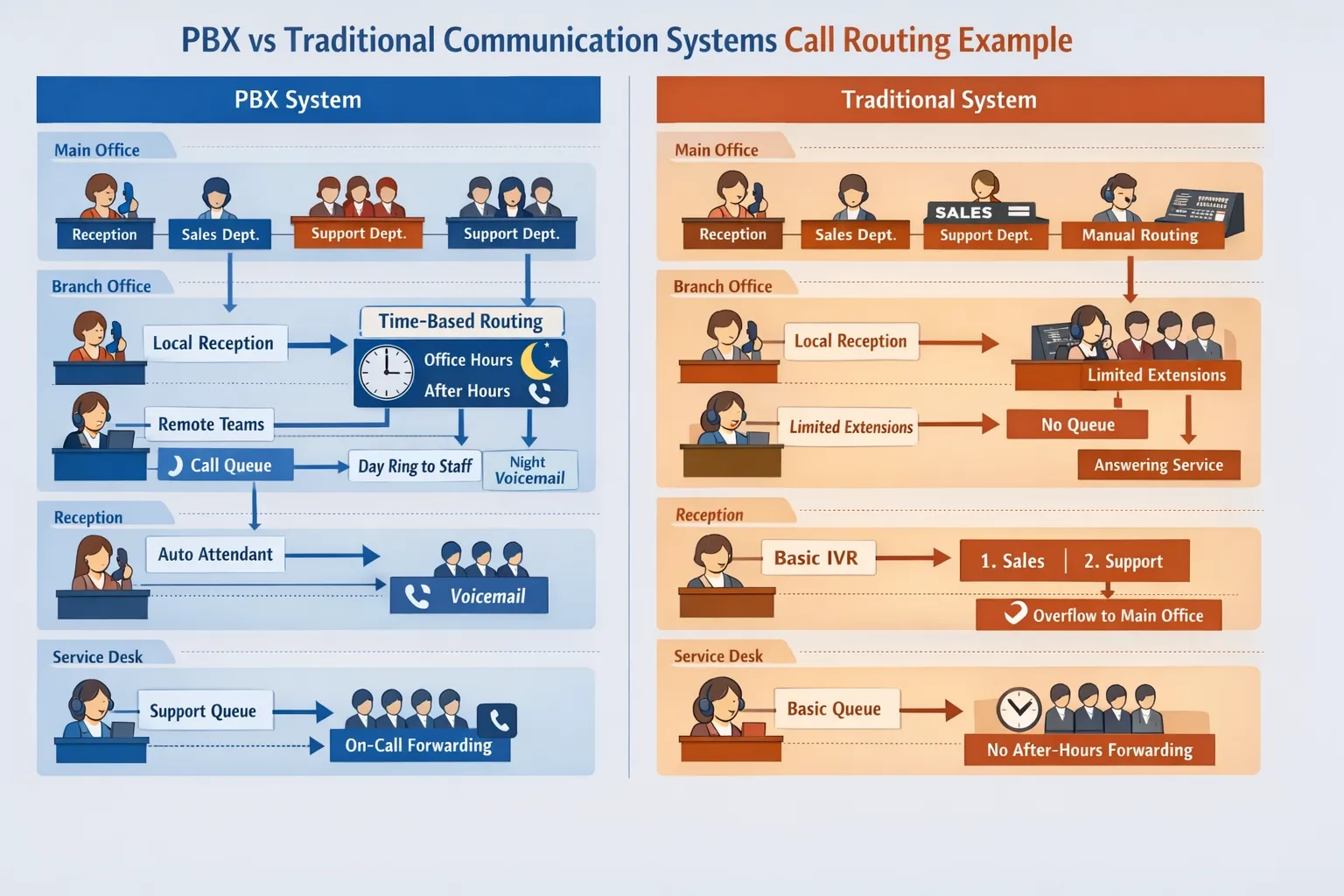
Take a typical customer call to the company main number. The carrier delivers that call to the PBX through a SIP trunk or another access method. The PBX checks the schedule and route design, then decides how the call should be handled. During working hours, that may mean a receptionist, an IVR, or a department queue. Outside working hours, the same number may route urgent traffic to an on-call path and ordinary traffic to voicemail or recorded guidance.
This is one of the clearest reasons businesses deploy PBX. A single external number can support several workflows without forcing every caller through manual transfer. The system creates consistency for the organization and a more orderly contact experience for the caller.
Illustrative routing flow across office, branch office, reception, service desk, including department handling, escalation, and schedule-based behavior.
Buying Priorities for Corporate & Public
Compare platforms through risk, workflow, and support boundaries
The right PBX for a front-desk office environment may not be the right PBX for an industrial or resilience-sensitive site. In corporate & public projects, selection should begin with the operating model. Who uses the system, which routes are critical, what happens during business peaks, which endpoints must be preserved, and what continuity level is required at each location?
That process reveals whether the project should prioritize queue handling, gateway support, branch consistency, local survivability, or simplified remote administration. It also reveals whether the business is choosing a PBX for office convenience, structured customer contact, specialist site workflow, or a combination of all three.
In environments spanning office, branch office, reception, service desk, that distinction matters because not every endpoint or location plays the same role. The system has to reflect those differences rather than flatten them into one generic configuration.
Endpoint diversity should be planned, not discovered later
PBX quality depends on more than the PBX itself. Network design, trunk strategy, power planning, administrative ownership, and backup procedures all affect how well the system performs under real conditions. Many disappointing PBX deployments are really cases of weak project preparation rather than weak software.
Buyers should therefore check what happens if the primary trunk fails, if a branch loses connectivity, if the PBX host needs restoration, or if route changes must be made outside normal hours. These questions are not secondary details. They are part of product fit, because a system that only works in ideal conditions is not a strong business communication solution.
If the system does not reflect real operating rules, people end up adapting to the PBX instead of the PBX supporting the business.
Why Good PBX Projects Age Well
The right decision still looks right after the first year of use
It is easy to shortlist PBX platforms by user interface, vendor familiarity, or broad claims about being modern, scalable, or enterprise-ready. Those labels are not useless, but they are far less reliable than direct workflow fit. The better question is whether the platform matches the call paths, user roles, site structure, and service obligations the business actually has today and is likely to have soon.
That is why disciplined PBX selection starts with documented call flows and environment assumptions. Once those are visible, vendor comparison becomes much more meaningful. Without them, the project team is often comparing presentation quality rather than operational suitability.
Selection also improves when mandatory requirements are separated from later-phase ambitions. A business may need clear route control, trunk resilience, and manageable administration immediately, while broader integrations can wait until the basic communication model is stable.
Weak preparation usually causes more pain than limited features
Most underperforming PBX projects have one of three weaknesses: call paths were not defined clearly, network assumptions were not validated, or support ownership was left vague. In those situations, even a technically capable platform can feel disappointing because it was asked to fit a business model that the project never described properly.
To avoid that, buyers should verify endpoint and trunk behavior against real use cases, document how changes will be made after go-live, and make sure the administrative model remains workable over time. PBX projects rarely fail because the idea of PBX is wrong. They fail because clarity was postponed for too long.
For organizations planning structured communication across offices, warehouses, hospitals, campuses, control rooms, transport sites, industrial facilities, or public-service environments, that discipline is often what separates a usable deployment from a corrective redesign.
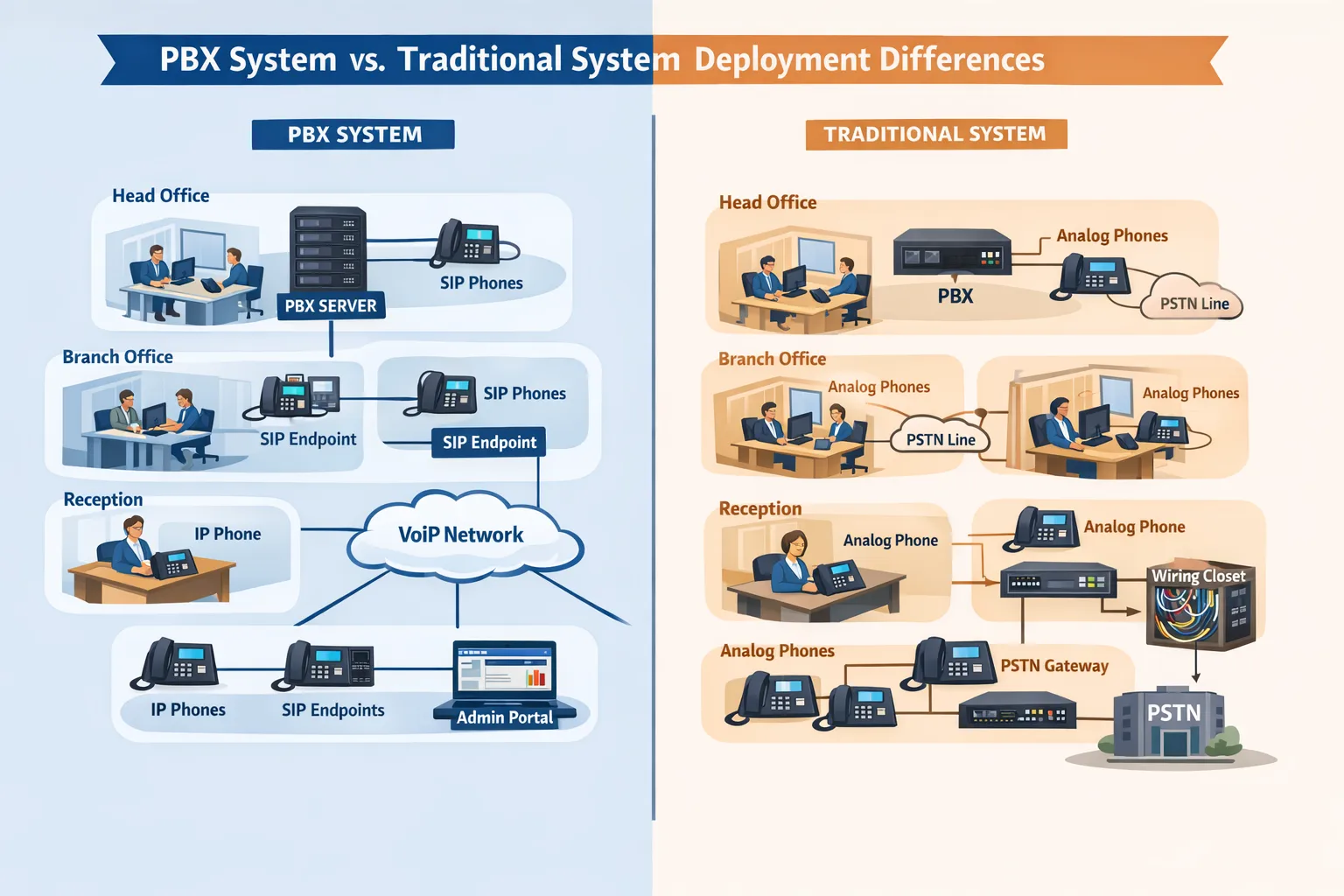
Typical deployment view for PBX across office, branch office, reception, service desk, including user devices, supporting gateways, and management access.
FAQ
Does a PBX only improve internal calling?
No. It also improves inbound call handling, outbound control, department routing, after-hours treatment, and visibility over how communication is working.
Can PBX work with analog or legacy equipment?
Yes. Many projects preserve analog phones, hotline circuits, or other retained devices through gateways while modernizing the wider communication architecture.
Is cloud PBX always better than on-premise PBX?
Not always. Some office environments benefit from hosted models, but industrial, resilience-sensitive, or mixed-estate projects may be better served by on-premise or hybrid designs.
What should buyers define before comparing vendors?
They should define users, sites, call flows, business hours, critical routes, integration needs, and support boundaries first.
If your organization is evaluating PBX for offices, factories, hospitals, campuses, warehouses, control rooms, transport sites, or other business-critical environments, Beck Telcom can help assess call flow, endpoint fit, deployment priorities, and long-term maintainability from a practical project-first perspective.
Becke Telcom specializes in industrial explosion-proof comms for rail, tunnel, oil & gas, and marine sectors, offering PAGA, SOS, and IP telephones with integrated PA, intercom, and calling.
If you have any suggestions or questions for us, please feel free to contact us!
We use cookie to improve your online experience. By continuing to browse this website, you agree to our use of cookie.
Cookies
Please read our Terms and Conditions and this Policy before accessing or using our Services. If you cannot agree with this Policy or the Terms and Conditions, please do not access or use our Services. If you are located in a jurisdiction outside the European Economic Area, by using our Services, you accept the Terms and Conditions and accept our privacy practices described in this Policy. We may modify this Policy at any time, without prior notice, and changes may apply to any Personal Information we already hold about you, as well as any new Personal Information collected after the Policy is modified. If we make changes, we will notify you by revising the date at the top of this Policy. We will provide you with advanced notice if we make any material changes to how we collect, use or disclose your Personal Information that impact your rights under this Policy. If you are located in a jurisdiction other than the European Economic Area, the United Kingdom or Switzerland (collectively “European Countries”), your continued access or use of our Services after receiving the notice of changes, constitutes your acknowledgement that you accept the updated Policy. In addition, we may provide you with real time disclosures or additional information about the Personal Information handling practices of specific parts of our Services. Such notices may supplement this Policy or provide you with additional choices about how we process your Personal Information.
Cookies
Cookies are small text files stored on your device when you access most Websites on the internet or open certain emails. Among other things, Cookies allow a Website to recognize your device and remember if you've been to the Website before. Examples of information collected by Cookies include your browser type and the address of the Website from which you arrived at our Website as well as IP address and clickstream behavior (that is the pages you view and the links you click).We use the term cookie to refer to Cookies and technologies that perform a similar function to Cookies (e.g., tags, pixels, web beacons, etc.). Cookies can be read by the originating Website on each subsequent visit and by any other Website that recognizes the cookie. The Website uses Cookies in order to make the Website easier to use, to support a better user experience, including the provision of information and functionality to you, as well as to provide us with information about how the Website is used so that we can make sure it is as up to date, relevant, and error free as we can. Cookies on the Website We use Cookies to personalize your experience when you visit the Site, uniquely identify your computer for security purposes, and enable us and our third-party service providers to serve ads on our behalf across the internet.
We classify Cookies in the following categories: ● Strictly Necessary Cookies ● Performance Cookies ● Functional Cookies ● Targeting Cookies
Cookie List A cookie is a small piece of data (text file) that a website – when visited by a user – asks your browser to store on your device in order to remember information about you, such as your language preference or login information. Those cookies are set by us and called first-party cookies. We also use third-party cookies – which are cookies from a domain different than the domain of the website you are visiting – for our advertising and marketing efforts. More specifically, we use cookies and other tracking technologies for the following purposes:
Strictly Necessary Cookies These cookies are necessary for the website to function and cannot be switched off in our systems. They are usually only set in response to actions made by you which amount to a request for services, such as setting your privacy preferences, logging in or filling in forms. You can set your browser to block or alert you about these cookies, but some parts of the site will not then work. These cookies do not store any personally identifiable information.
Functional Cookies These cookies enable the website to provide enhanced functionality and personalisation. They may be set by us or by third party providers whose services we have added to our pages. If you do not allow these cookies then some or all of these services may not function properly.
Performance Cookies These cookies allow us to count visits and traffic sources so we can measure and improve the performance of our site. They help us to know which pages are the most and least popular and see how visitors move around the site. All information these cookies collect is aggregated and therefore anonymous. If you do not allow these cookies we will not know when you have visited our site, and will not be able to monitor its performance.
Targeting Cookies These cookies may be set through our site by our advertising partners. They may be used by those companies to build a profile of your interests and show you relevant adverts on other sites. They do not store directly personal information, but are based on uniquely identifying your browser and internet device. If you do not allow these cookies, you will experience less targeted advertising.
How To Turn Off Cookies You can choose to restrict or block Cookies through your browser settings at any time. Please note that certain Cookies may be set as soon as you visit the Website, but you can remove them using your browser settings. However, please be aware that restricting or blocking Cookies set on the Website may impact the functionality or performance of the Website or prevent you from using certain services provided through the Website. It will also affect our ability to update the Website to cater for user preferences and improve performance. Cookies within Mobile Applications
We only use Strictly Necessary Cookies on our mobile applications. These Cookies are critical to the functionality of our applications, so if you block or delete these Cookies you may not be able to use the application. These Cookies are not shared with any other application on your mobile device. We never use the Cookies from the mobile application to store personal information about you.
If you have questions or concerns regarding any information in this Privacy Policy, please contact us by email at . You can also contact us via our customer service at our Site.

 English
 Deutsch
 한국어
한국어 Русский
 Français
 日本語
日本語 لالعربية
 हिन्दी
 Español
 Português
 繁体中文
繁体中文 简体中文
简体中文