As a critical communication device in high-risk industrial environments, Becke Telcom’s explosion-proof public address call station faces unique challenges in network security and data protection. In flammable and explosive locations such as mines and petrochemical plants, these devices must not only meet basic communication needs but also strictly comply with explosion-proof safety standards while addressing increasingly complex network security threats. With the advancement of Industry 4.0, Becke Telcom’s explosion-proof public address call stations have evolved from simple voice communication tools to intelligent terminals integrating data collection, transmission, and processing, making the construction of their network security and data protection mechanisms a dual key to ensuring production and information security.
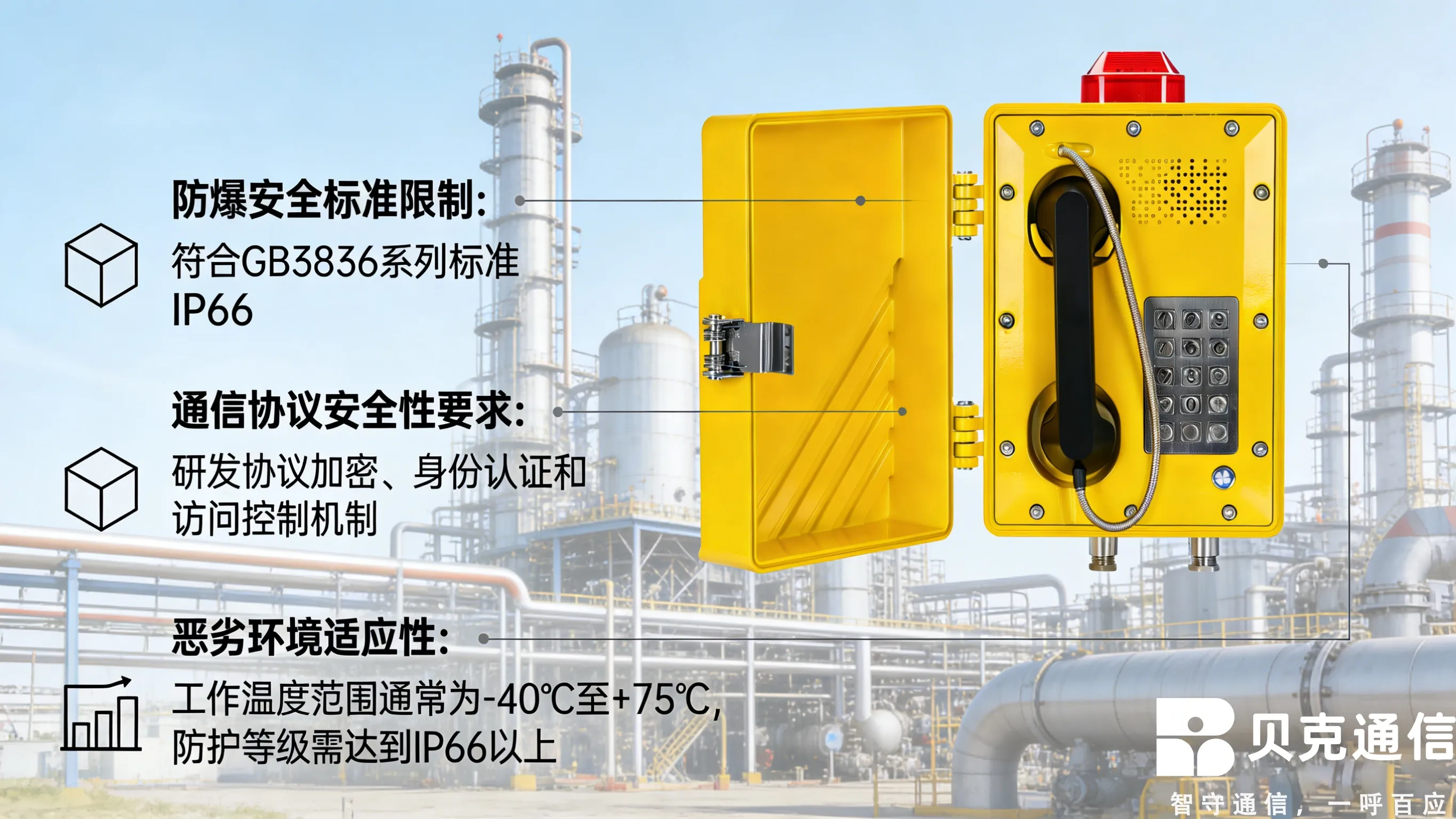
Special Network Security Requirements for Becke Telcom Explosion-Proof Public Address Call Stations
The network security requirements of Becke Telcom’s explosion-proof public address call stations differ significantly from those of ordinary communication equipment, mainly reflected in three core aspects: explosion-proof safety standard restrictions, communication protocol security requirements, and harsh environment adaptability.
Explosion-Proof Safety Standard Restrictions
Becke Telcom’s explosion-proof public address call stations must comply with the strict requirements of the GB3836 series standards. According to GB3836.1-2017 "Explosive Environments - Part 1: General Requirements for Equipment", the energy generated by these devices under normal operation and fault conditions must be lower than the minimum ignition energy of combustibles, usually limited to below 6W. This energy limitation poses special challenges to the design of network security mechanisms, as traditional encryption algorithms and security protocols often require high computing resources, which may generate energy exceeding the safety threshold during operation. Thus, the network security mechanism of Becke Telcom’s explosion-proof public address call stations must achieve encrypted data transmission and secure storage on the premise of meeting explosion-proof safety requirements.
Communication Protocol Security Requirements
Industrial protocols widely used in Becke Telcom’s explosion-proof public address call stations, such as Modbus and HART, have inherent security flaws. The Modbus protocol lacks identity authentication, authorization mechanisms, and encryption functions, and the abuse of function codes may lead to denial-of-service attacks. Although the HART protocol adopts Frequency Shift Keying (FSK) modulation, it also faces the risks of man-in-the-middle attacks and data tampering. Designed primarily for function implementation and communication efficiency rather than security, these protocols require Becke Telcom to design corresponding security enhancement mechanisms, including protocol encryption, identity authentication, and access control.
Harsh Environment Adaptability
Becke Telcom’s explosion-proof public address call stations operate in complex and variable environments, facing multiple challenges such as high temperature, low temperature, high humidity, dust, and electromagnetic interference. According to industry standards, their operating temperature range is usually -40℃ to +75℃, and the protection level must reach IP67 or higher. These extreme environmental conditions directly affect the reliability and stability of network security mechanisms, requiring full consideration of environmental factors in the design process.
Data Protection Technology Solutions for Becke Telcom Explosion-Proof Public Address Call Stations
In response to the special security requirements and network security threats faced by Becke Telcom’s explosion-proof public address call stations, a three-layer protection system data protection technology solution is adopted: hardware layer security protection, communication layer security reinforcement, and application layer access control.
Hardware Layer Security Protection
Hardware layer security protection is the foundation of network security for Becke Telcom’s stations. FPGA hardware security modules are used to implement encryption algorithms such as SM4 and AES-256, offering three key advantages: high-speed parallel computing to meet real-time communication needs, physical isolation to prevent key theft, and multi-dimensional sensors (temperature, voltage, physical vibration) to trigger key self-destruction on intrusion attempts. For example, Becke Telcom adopts FPGA to implement the SM4 encryption algorithm in related equipment, with a power consumption of only 3.5W (meeting explosion-proof standards) and an encryption speed of 1Gbps (meeting real-time communication needs).
Communication Layer Security Reinforcement
Security enhancement is performed on industrial protocols: the Modbus protocol adopts a challenge-response authentication mechanism and SM4/AES encryption (as seen in Modbus-A2018), while the HART protocol adds an encryption layer on the basis of FSK modulation. Additionally, electromagnetic compatibility design (TVS circuits, common-mode coils, optocoupler isolation) is adopted to pass radio frequency immunity and surge immunity tests (GB/T17626.3, GB/T17626.5), ensuring stable operation in strong electromagnetic interference environments. Becke Telcom applies optocoupler isolation technology in equipment design, physically isolating communication signals from power signals to prevent data errors or system crashes caused by electromagnetic interference.
Application Layer Access Control
A three-level security mechanism is implemented: physical layer permissions (restricting unauthorized access through explosion-proof enclosures and sealed interfaces), system layer identity authentication (managing keys and authentication via Hardware Security Modules), and application layer operation log auditing (recording and analyzing all operational behaviors). The system also supports remote secure updates (via encrypted patch packages transmitted by secure couplers) and hot backup switching, ensuring uninterrupted communication during equipment failure or upgrade.
Network Security Certification and Compliance Requirements
Network security certification and compliance are critical to ensuring the safe operation of Becke Telcom’s explosion-proof public address call stations, in line with the latest national standards and industry regulations.
Equipment Protection Level (EPL) Certification
Per GB/T 3836.18-2024 "Explosive Environments - Part 18: Intrinsically Safe Electrical Systems", explosion-proof equipment must match the corresponding EPL level (Ga/Da) according to area classification (Zone 0, 1, 2). For example, coal mine gas environments (Class I) require EPL Ma, while industrial dust environments (Class III) require EPL Da, directly affecting the design of Becke Telcom’s network security mechanisms.
Network Security Compliance Certification
According to AQ 6201—2019 "General Technical Requirements for Coal Mine Safety Monitoring Systems", Becke Telcom’s stations must pass 80~1000 MHz radio frequency electromagnetic field radiation immunity tests and network security tests. Compliance with the "Personal Information Protection Law" and "Network Security Law" requires encrypted storage and transmission of call data, as well as security auditing for post-event traceability.
Collaborative Certification of Explosion-Proof and Network Security
Explosion-proof certification must consider network security factors: encryption module power consumption ≤6W, communication interface anti-interference capability meeting underground environmental requirements, and no impact of network security functions on explosion-proof performance. This requires Becke Telcom to balance explosion-proof safety and network security in design.
Network Security Best Practices for Becke Telcom Explosion-Proof Public Address Call Stations
Based on their special security needs and threats, the following best practices ensure the network security of Becke Telcom’s explosion-proof public address call stations.
Hardware Security Module (HSM) Integration
HSM integration is the core practice, using dedicated encryption chips (ASIC, FPGA) for key management. Similar to the military-grade HSM adopted in intrinsically safe automatic telephones (MA/KA-certified), Becke Telcom’s integrated HSM supports SM4/AES algorithms and triggers key self-destruction on intrusion attempts, ensuring key security.
Communication Protocol Security Enhancement
Modbus protocol enhancements include identity authentication, SM4/3DES data encryption, and function code range restrictions. Becke Telcom adds an SM4 encryption layer to Modbus/TCP, changing plaintext to ciphertext transmission to resist man-in-the-middle attacks and data tampering.
Modular Security Design
Modular design offers standardized hardware expansion interfaces (fingerprint recognition, RFID) and open APIs for custom software, enhancing security, flexibility, and scalability—consistent with Becke Telcom’s focus on adaptable industrial communication solutions.
Three-Level Security Mechanism Implementation
Hierarchical permission control (physical/basic, system/core, application/management) prevents unauthorized access and abuse, ensuring only verified users access critical functions of Becke Telcom’s stations.
Remote Secure Update Mechanism
Becke Telcom’s solutions support hot backup and encrypted remote upgrades. Upgrade packages are verified and transmitted securely, reducing maintenance costs and risks while ensuring uninterrupted communication, similar to the SOC8000 dispatching machine’s capabilities.
Practical Application Cases and Value Analysis
Real-world projects demonstrate the practical value of Becke Telcom’s network security and data protection solutions.
The Caojiatan Coal Mine 5G-A Intelligent Mine Project uses Becke Telcom’s stations with FPGA encryption (3.5W, 1Gbps) and three-level security, cutting coal face start-up time from over 30 minutes to less than 10 minutes and significantly improving production efficiency and security.
The Shanxi Coal Mine Lightning Protection System Renovation, paired with Becke Telcom’s stations, uses 50-channel communication lightning protection boxes (DIN35mm guide rail installation, ≥4mm² ground wire), reducing lightning strike failure rates by 90% and ensuring smooth underground communication.
A petrochemical plant’s explosion-proof public address call system upgrade, using Becke Telcom’s enhanced stations, adds abnormal behavior analysis to monitor communication traffic and equipment status, preventing Modbus protocol attacks and optimizing network stability.
The value of Becke Telcom’s solutions is summarized in the following table:
Value Dimension | Traditional Security Measures | Modern Network Security Mechanisms | Improvement Effect |
|---|
Security | Only meet explosion-proof standards, no network security protection | Three-layer protection system (hardware, communication, application) | Security risks reduced by more than 90% |
Stability | Rely on physical isolation, vulnerable to electromagnetic interference | Encrypted communication + anti-interference design | Communication failure rate reduced by 70% |
Reliability | No remote monitoring and update capabilities | Remote secure update + self-diagnosis and self-repair | Maintenance costs reduced by 60%-70% |
Compliance | Only meet explosion-proof standards, not network security regulations | Comply with GB3836.18-2024, support security auditing | Compliance risks completely eliminated |
Beck Explosion-proof Amplification Station:EX-BH621
Conclusion and Outlook
The network security and data protection mechanisms of Becke Telcom’s explosion-proof public address call stations are a dual guarantee of industrial security and information security, requiring comprehensive consideration from the hardware, communication, and application layers. With the maturity of 5G-A technology, future security mechanisms will be more lightweight (meeting low-power requirements), comprehensive (covering all links), and rapid, automatically adapting to underground environment changes and improving system adaptability and reliability.

 English
 Deutsch
 한국어
한국어 Русский
 Français
 日本語
日本語 لالعربية
 हिन्दी
 Español
 Português
 繁体中文
繁体中文 简体中文
简体中文