In the tide of economic globalization, ports serve as the vital bridges of international trade. Their operational efficiency and safety levels directly impact the stability of the global supply chain. As container ships become larger and terminal automation accelerates, the complexity of port operational environments has reached unprecedented levels. Amidst the roar of massive quay cranes, dense container yards, and hazardous goods handling areas, a high-reliability communication system is not just a "baton" for production dispatching, but a "lifeline" for the safety of personnel.
Becke Telcom is a leader in the industrial communication field, specializing in customized solutions for harsh industrial environments. This article provides a deep dive into the application of explosion-proof paging stations in port container operations, analyzing how technological innovation solves industry pain points.
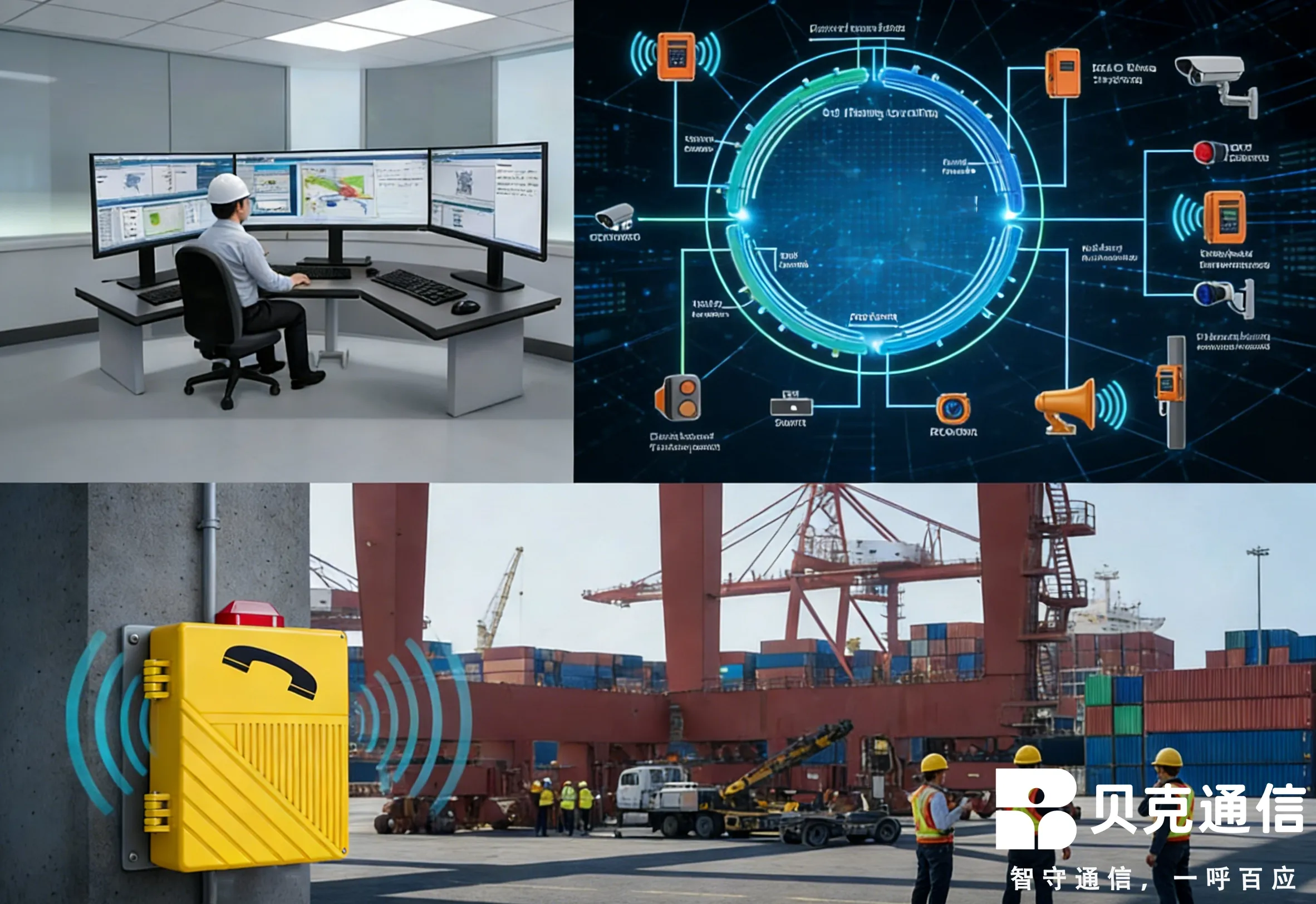
1. Communication Dilemmas at Container Terminals: More Than Just "Hard to Hear"
To understand the necessity of explosion-proof paging stations, one must analyze the extreme challenges posed by the port operational environment:
1.1 Challenges of Extreme Acoustic Environments
At ship-to-shore (STS) cranes and rail-mounted gantry (RMG) crane sites, the clanging of metal, the hum of large motors, and the whistling of sea winds create background noise levels often between 85dB and 105dB. In such environments, standard walkie-talkies often fail due to insufficient volume or poor noise filtering, leading to distorted instructions and dangerous "unheard" situations.
1.2 Strict Control of Explosive Hazardous Areas
Container terminals handle not only general cargo but also the transshipment of large volumes of chemicals and liquefied gases. According to International Electrotechnical Commission (IEC) standards, hazardous goods areas are classified as Zone 1 or Zone 2. Any electronic equipment operating in these areas must have strict explosion-proof certification to prevent catastrophic explosions caused by electrical sparks or overheating.
1.3 Corrosion and Destruction from Marine Climates
Ports are perpetually subjected to high salt spray, high humidity, strong UV radiation, and typhoons. Standard industrial telephone casings oxidize and become brittle, while circuit boards are prone to short-circuiting due to moisture. This means communication terminals must possess protection ratings of IP66 or even IP67 and utilize special anti-corrosion coatings.
2. Core Technical Analysis of Becke Telcom Explosion-Proof Paging Stations
Becke Telcom has developed a new generation of high-performance explosion-proof paging stations(EX-BH621) to address these issues. Their core advantages are reflected in three dimensions:
2.1 High-Gain Amplification and Active Noise Cancellation (ANC)
The stations feature built-in Digital Signal Processors (DSP). These processors analyze the environmental frequency spectrum in real-time, using adaptive noise reduction algorithms to suppress steady mechanical noise while enhancing human speech. Paired with high-efficiency Class-D power amplifiers, the external explosion-proof speakers can produce sound pressure levels as high as 110dB-120dB.
Key Point: This ensures that even directly under a crane, operators can clearly receive dispatch broadcasts without putting down their tools.
2.2 Rugged Physical Architecture and Intrinsically Safe Design
Our stations are housed in high-strength LM6 die-cast aluminum alloy, treated with multiple layers of electrostatic spraying for superior impact and corrosion resistance. The circuit design strictly follows both Intrinsic Safety (IS) and Flameproof standards, ensuring stable operation even in mixed flammable gas environments.
2.3 Flexible Networking: From Analog to Full IP
With the construction of "Smart Ports," Becke Telcom offers a full range of products from traditional analog links to modern VoIP/SIP protocols.
Analog Systems: Ideal for long-distance wiring and expanding existing legacy systems.
IP Systems: Support standard SIP 2.0 protocols, allowing voice, data, and monitoring integration over a single fiber or network cable. They support PoE (Power over Ethernet), greatly simplifying on-site construction.
3. Full-Scenario Application Solutions for Port Operations
3.1 Precise Command in Quay Crane (STS) Areas
The quay crane is the busiest node in a port. Becke Telcom stations are installed on the support columns, in the operator's cabin, and on spreader maintenance platforms.
3.2 Human-Machine Collaboration in Automated Yards (ARMG)
In highly automated yards, there are few fixed workers on-site. However, during maintenance or emergency stops, communication is vital.
Feature Highlight: Becke Telcom IP stations support self-diagnostic functions. The control room can monitor the online status and speaker loop of every station in real-time. If unauthorized entry into a danger zone is detected, the system can link with AI vision and automatically trigger pre-recorded warning broadcasts.
3.3 Emergency Response in Hazardous Goods Areas
In dedicated Dangerous Goods (DG) zones, Becke Telcom stations are equipped with prominent red/blue flashing beacons.
Scenario Simulation: If a sensor detects a toxic gas leak, the station immediately enters "Paging Priority" mode, overriding normal calls to play evacuation instructions. Simultaneously, the handset serves as an emergency terminal directly connected to the port's fire control center.
4. "Invisible Contributions" to Port Operational Efficiency
Choosing Becke Telcom is an investment in both safety and economic benefit:
| Dimension | Traditional Communication | Becke Telcom Solution |
| Operational Efficiency | Frequent interference; repeated commands | High clarity; commands executed correctly the first time |
| Equipment Lifespan | Replaced every 1-2 years in salt spray | Rugged anti-corrosion; design life >10 years |
| Maintenance Cost | Requires manual on-site inspections | Remote monitoring & self-test; rapid response |
| Safety | Explosion-proof blind spots; poor coverage | Full certification; 100% coverage of hazardous zones |
5. How to Plan a Port Explosion-Proof Communication System?
Becke Telcom suggests focusing on three key points during the planning phase:
Acoustic Mapping: Calculate speaker spacing based on terminal length, crane distribution, and noise levels to avoid the "reverb effect" caused by overlapping sound fields.
Redundancy Design: Core switches and backbone cables should use a ring topology. If a cable is accidentally severed by a truck, Becke Telcom’s smart ring technology switches paths within 50ms to ensure uninterrupted communication.
Multi-System Integration: Integrate paging stations with the port's TOS (Terminal Operating System) and CCTV. For example, when the TOS issues a high-priority loading task, the station in that specific area can automatically announce the task ID.
Conclusion
Port container operation is a race against time, and reliable communication is the lubricant of that race. Becke Telcom Explosion-Proof Paging Stations, with their superior performance in extreme environments, are becoming the preferred choice for global port operators looking to upgrade safety and move toward smart operations.
In the future, we will continue to deepen industrial IP communication technology, integrating AI noise reduction and IoT sensing to safeguard every busy terminal.

 English
 Deutsch
 한국어
한국어 Русский
 Français
 日本語
日本語 لالعربية
 हिन्दी
 Español
 Português
 繁体中文
繁体中文 简体中文
简体中文