Underground mining environments are highly complex and volatile. The presence of gas, coal dust, and flammable or explosive substances determines that communication equipment must meet extremely high standards of safety and reliability. As the only communication terminals capable of stable operation underground, mining explosion-proof telephones serve as a true “lifeline” for safeguarding personnel safety and improving production dispatch efficiency.
With the acceleration of intelligent mine transformation and increasingly stringent safety regulations, demand for mining explosion-proof telephones continues to grow. At the same time, a large number of brands have entered the market, intensifying competition. While the low-end market is trapped in homogeneous price competition, the high-end market focuses on technological innovation and scenario adaptation. How to accurately identify core competitiveness and build distinctive advantages has become the key for enterprises seeking market leadership.
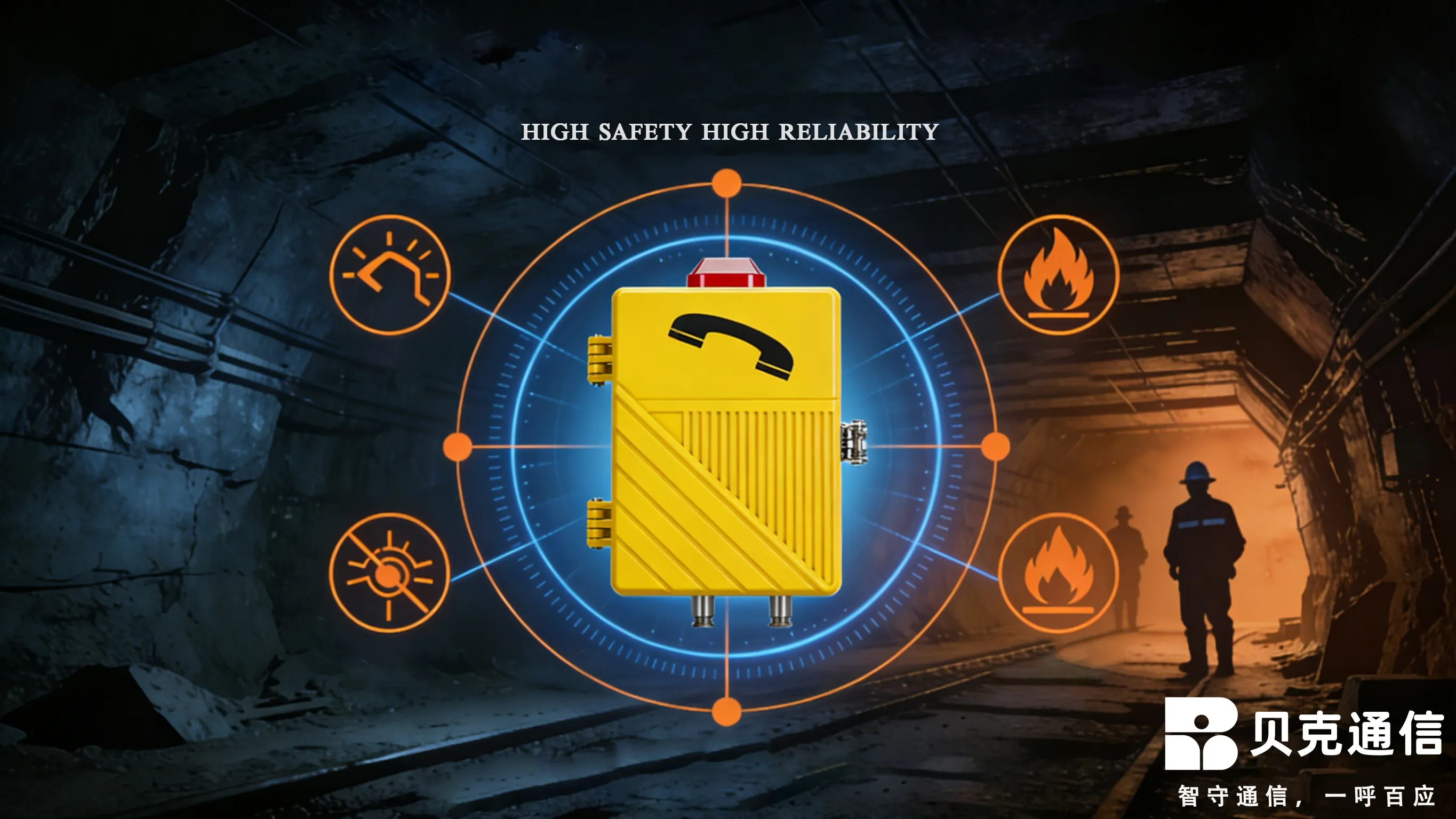
1. Market Status and Competitive Landscape of Mining Explosion-Proof Telephones
1.1 Market Size and Development Trends
In recent years, stricter safety supervision in the mining industry has significantly driven demand. Regulations such as the Coal Mine Safety Regulations explicitly require compliant explosion-proof communication equipment in underground mines. Meanwhile, the advancement of intelligent and digital mine transformation has created an urgent need for communication network upgrades, directly promoting steady market growth.
From an application perspective, large integrated mines, high-gas mines, small and medium-sized coal mines, and remote mountainous mines all have rigid demand for mining explosion-proof telephones. Among the2.3m, high-gas mines and intelligently upgraded mines show particularly strong demand for high-end, customized solutions.
Looking ahead, with the deep integration of 5G, IoT, and mining communication systems, mining explosion-proof telephones will continue evolving toward intelligence, integration, and lightweight deployment. Market demand will keep expanding, industry concentration will gradually increase, and enterprises with core technologies and differentiated advantages will take a leading position.
1.2 Key Market Players and Competitive Focus
The current competitive landscape can be broadly divided into three categories:
Established mining equipment manufacturers
Leveraging mature supply chains and strong brand reputation, these companies focus on full-scenario solutions and mainly serve large energy groups.
Specialized explosion-proof communication enterprises
These players concentrate on explosion-proof technology R&D and scenario customization, offering strong advantages in high-risk environment adaptation and multi-system integration. Their solutions are favored by engineers and high-risk mines.
Emerging small and medium-sized enterprises
Cost control is their core strategy. They mainly compete in the low-end market, where product homogeneity is severe and price competition dominates.
Market competition shows clear segmentation. The low-end market focuses on price and basic compliance, with limited functionality and low technical content. The mid- to high-end market emphasizes technological innovation, scenario adaptation, service quality, and long-term value. Compliance, safety performance, intelligent functions, and customized services have become decisive factors, with differentiation serving as the key to competitive breakthroughs.
2. In-Depth Analysis of Differentiated Advantages: From “Connectivity” to “Intelligence”
In a highly homogeneous market, true differentiation is often found in the following three dimensions.
2.1 Deep Integration of Communication Protocols (SIP and Full-IP Architecture)
Traditional analog mining telephones are rapidly being replaced by IP-based solutions. Competitive products support standard SIP protocols and can seamlessly integrate with mainstream IP-PBX dispatch systems from vendors such as Huawei, ZTE, and Cisco.
Key differentiation point:
Does the device support direct fiber connections? Mining telephones with built-in optical switching modules reduce intermediate conversion equipment and lower link failure rates—offering significant cost and reliability advantages in long-distance galleries and deep mines.
2.2 Self-Healing and Anti-Interference Capabilities in Harsh Environments
Underground mines suffer from severe electromagnetic interference and complex network topologies.
Ring network redundancy: Devices supporting dual-port ring network protection can automatically switch paths within milliseconds if a fiber link is damaged, ensuring uninterrupted communication.
EMC performance: Highly differentiated products incorporate specialized shielding designs to counter harmonic interference generated by inverters and high-power motors, preventing noise and call drops.
2.3 Value-Added Functions and Emergency Linkage
Advanced mining explosion-proof telephones are no longer isolated devices but integrated sensor and communication nodes.
One-button alarm and group calling: In emergencies such as flooding or gas accidents, one-button all-call functions can be life-saving.
Broadcast integration: With built-in amplifiers, devices can connect to explosion-proof loudspeakers, enabling combined calling and broadcasting while simplifying wiring and deployment.
3. Extracting Core Differentiated Advantages
3.1 Technological Differentiation: Precise Scenario Adaptation
The essence of technological differentiation lies in precise adaptation to specific mining scenarios. Geological conditions and operational requirements vary widely, and generic products cannot meet all needs.
Deep mines: Enhanced signal transmission and penetration capabilities address communication blind spots.
High-gas mines: Reinforced explosion-proof structures and integrated high-precision gas sensors enable automatic alarms and emergency call linkage when gas concentrations exceed thresholds.
Remote mountainous mines: Lightweight deployment solutions based on public networks and cloud platforms reduce cabling costs while dual power supply designs accommodate unstable power conditions.
Some enterprises have further introduced intrinsically safe mining explosion-proof telephones, suitable for the most hazardous underground zones such as excavation faces and gas extraction areas, creating clear differentiation from conventional explosion-proof products.
3.2 Functional Differentiation: Integrated Communication and Safety
Functional differentiation is key to escaping low-end competition, shifting from “single-function calling” to “integrated services.”
High-end products integrate multiple capabilities:
Beidou positioning for precise underground personnel tracking
Video calling for visual dispatch between underground and surface
Call recording and monitoring for traceability and management
PoC public network push-to-talk and PDT/DMR trunked radio integration for team communication
Some advanced solutions also integrate IoT technologies, enabling seamless connection with intelligent mine systems for remote monitoring, fault prediction, data collection, and analysis—significantly improving management efficiency and reducing maintenance costs.
3.3 Service Differentiation: Customized Solutions and Rapid After-Sales Support
Service differentiation centers on user needs through customization and fast response.
Large mines: Integrated “product + network + maintenance” solutions tailored to mine layouts, combined with long-term operation and maintenance services.
Small and medium mines: Cost-effective customized solutions that meet compliance and performance requirements while controlling budgets.
Rapid after-sales response is critical. Communication interruptions underground can lead to severe safety incidents. Some enterprises provide 24/7 emergency support teams offering on-site repair and remote diagnostics, minimizing downtime and reinforcing brand trust.
3.4 Cost Differentiation: High Cost-Effectiveness and Long-Term Value
Cost differentiation is not about low prices alone, but about achieving high cost-effectiveness and long-term operational value.
For small and medium mines: Optimized supply chains and simplified designs reduce upfront costs while extending product lifespan.
For large mining groups: Lower failure rates and long-term maintenance services reduce total cost of ownership. Although initial investment may be higher, long-term operational costs are significantly lower.
4. Industry Outlook: New Differentiation Paths Driven by AI and 5G
With the advancement of smart mine construction, mining explosion-proof telephones are entering a new phase of innovation:
5G explosion-proof terminals: Leveraging high bandwidth and low latency for 4K video calls and real-time inspection data uploads.
Edge computing: Local voice and noise analysis at the device level, enabling automatic alerts when abnormal environmental sound patterns are detected.
Conclusion
The core competitiveness of mining explosion-proof telephones lies in compliance, technological innovation, cost optimization, and service capability. Differentiated advantages—whether through technical adaptation, functional integration, customized services, or long-term cost efficiency—are the decisive factors for standing out in an increasingly competitive market.
For B-end procurement professionals, engineers, and non-technical users alike, clearly defining application needs and focusing on core product value and differentiation are essential for selecting the right mining explosion-proof telephone—ultimately enhancing underground communication safety and improving mining production efficiency.

 English
 Deutsch
 한국어
한국어 Русский
 Français
 日本語
日本語 لالعربية
 हिन्दी
 Español
 Português
 繁体中文
繁体中文 简体中文
简体中文