In modern fusion communication projects, audio fusion has become a core component of unified dispatch and communication architecture, with the seamless access and scheduling of existing traditional analog broadcast systems emerging as a critical requirement for enterprises, public institutions, and industrial sectors. Integrating legacy analog broadcast amplifier systems into SIP-based IP broadcast dispatch systems unlocks the ability to initiate broadcast announcements and audio transmissions effortlessly via dispatch consoles, IP phone terminals, and mobile devices—expanding the functional scope of traditional broadcast systems while building a unified, intelligent audio communication ecosystem. The key to achieving this seamless integration lies in a dedicated hardware solution designed for audio protocol conversion: the Becke Telcom Broadcast Gateway. This compact, industrial-grade audio device streamlines the connection between digital SIP IP communication systems and analog broadcast infrastructure, eliminating complex technical reconfiguration and enabling a plug-and-play integration experience. Below is a detailed breakdown of the core functions, networking design, connection methods, and practical application value of the Becke Telcom Broadcast Gateway, explaining how it transforms traditional analog broadcast systems into a scalable part of modern fusion communication networks.
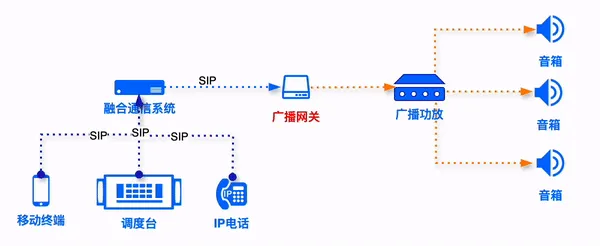
Core Function: SIP VOIP to Analog Audio Signal Conversion
The fundamental value of the Becke Telcom Broadcast Gateway lies in its specialized audio protocol conversion capability, which serves as the technical bridge between digital SIP-based fusion communication systems and analog broadcast hardware. At its core, the gateway is engineered to convert digital SIP VOIP audio signals into analog audio signals that are natively compatible with traditional broadcast amplifier systems— the single critical step required to integrate legacy analog broadcast into modern IP dispatch networks.
The integration logic is intuitive and efficient: the fusion communication system transmits digital SIP audio signals to the Becke Telcom Broadcast Gateway, which immediately decodes and converts these signals into analog audio outputs. Once the conversion is complete, the analog signals are fed into the traditional broadcast amplifier, which then distributes the audio to connected speakers across the broadcast network. This one-way yet high-fidelity conversion process ensures no loss of audio quality and minimal latency, making it suitable for real-time broadcast announcements, emergency alerts, and daily scheduling communications—scenarios where timeliness and clarity are non-negotiable.
Notably, the conversion process is triggered by a simple SIP call within the fusion communication system. When a user initiates a call to the dedicated SIP number assigned to the broadcast gateway, a communication link is established automatically, and the SIP VOIP audio signal is converted and transmitted to the analog broadcast system in real time. This means operations such as live broadcast announcements and pre-recorded audio playback can be executed just like a standard SIP call, eliminating the need for specialized training or complex manual operation of the analog broadcast hardware.
Simplified Networking Design for Broadcast Gateway Integration
The Becke Telcom Broadcast Gateway features a streamlined, industrial-grade networking architecture that is optimized for easy deployment in existing fusion communication and broadcast systems, requiring no major overhauls of the original infrastructure. The gateway’s networking design centers on standard IP network connectivity and direct analog audio output to the broadcast amplifier, creating a low-complexity, high-reliability integration framework that can be implemented by on-site technical teams with basic IP communication and audio equipment knowledge.
The core components of the integrated network include the Becke Telcom Broadcast Gateway, the traditional analog broadcast amplifier, connected speakers, and the SIP-based fusion communication system (including dispatch consoles, IP phones, mobile communication terminals, etc.). The gateway is connected to the fusion communication system’s IP network via a standard network port, enabling real-time SIP signal transmission. On the analog side, the gateway is directly connected to the broadcast amplifier via custom audio cables, and the amplifier is linked to the existing speaker array—preserving the entire original analog broadcast transmission chain.
This networking approach offers two key advantages: first, it maximizes the utilization of existing analog broadcast hardware (amplifiers, speakers, wiring), eliminating the need for costly full-system upgrades to IP-based broadcast equipment and reducing integration costs significantly. Second, the IP-based connection between the gateway and the fusion communication system supports flexible network deployment, allowing the gateway to be installed in the broadcast equipment room while the dispatch and control terminals (dispatch consoles, IP phones) can be located in any area with network access—enabling remote broadcast control and scheduling across different physical locations.
In practical application, this network architecture operates as a unified system: any authorized terminal on the fusion communication system (dispatch console, IP phone, mobile terminal) can initiate a broadcast by calling the gateway’s SIP number, and the audio signal is transmitted through the IP network to the gateway, converted to analog, and broadcast via the traditional amplifier and speaker system. The entire process is fully automated, with no manual intervention required for the analog broadcast equipment.
Hardware Connection: Adapting Phoenix Terminals to Traditional Amplifier Interfaces
A key consideration for integrating digital hardware with legacy analog equipment is interface compatibility, and the Becke Telcom Broadcast Gateway addresses this challenge with a flexible audio output design that adapts to the standard interface types of traditional broadcast amplifiers. Most legacy analog broadcast amplifiers use RCA (phono) jacks for audio input, a widely adopted analog audio interface standard, while the Becke Telcom Broadcast Gateway is equipped with Phoenix terminals for audio output—an industrial-grade connection type known for its stability and anti-interference performance, ideal for industrial and commercial communication environments.
The connection between the two interfaces is achieved through a custom-made audio cable, a simple and cost-effective solution that requires no specialized hardware adapters or signal converters. The on-site technical team only needs to fabricate a cable that terminates in Phoenix terminals on one end (for connection to the gateway) and RCA jacks on the other (for connection to the broadcast amplifier), with proper wiring for audio left and right channels and signal ground. Once the cable is connected and secured, the gateway’s analog audio output is directly linked to the amplifier’s input, establishing a stable, high-quality audio transmission link.
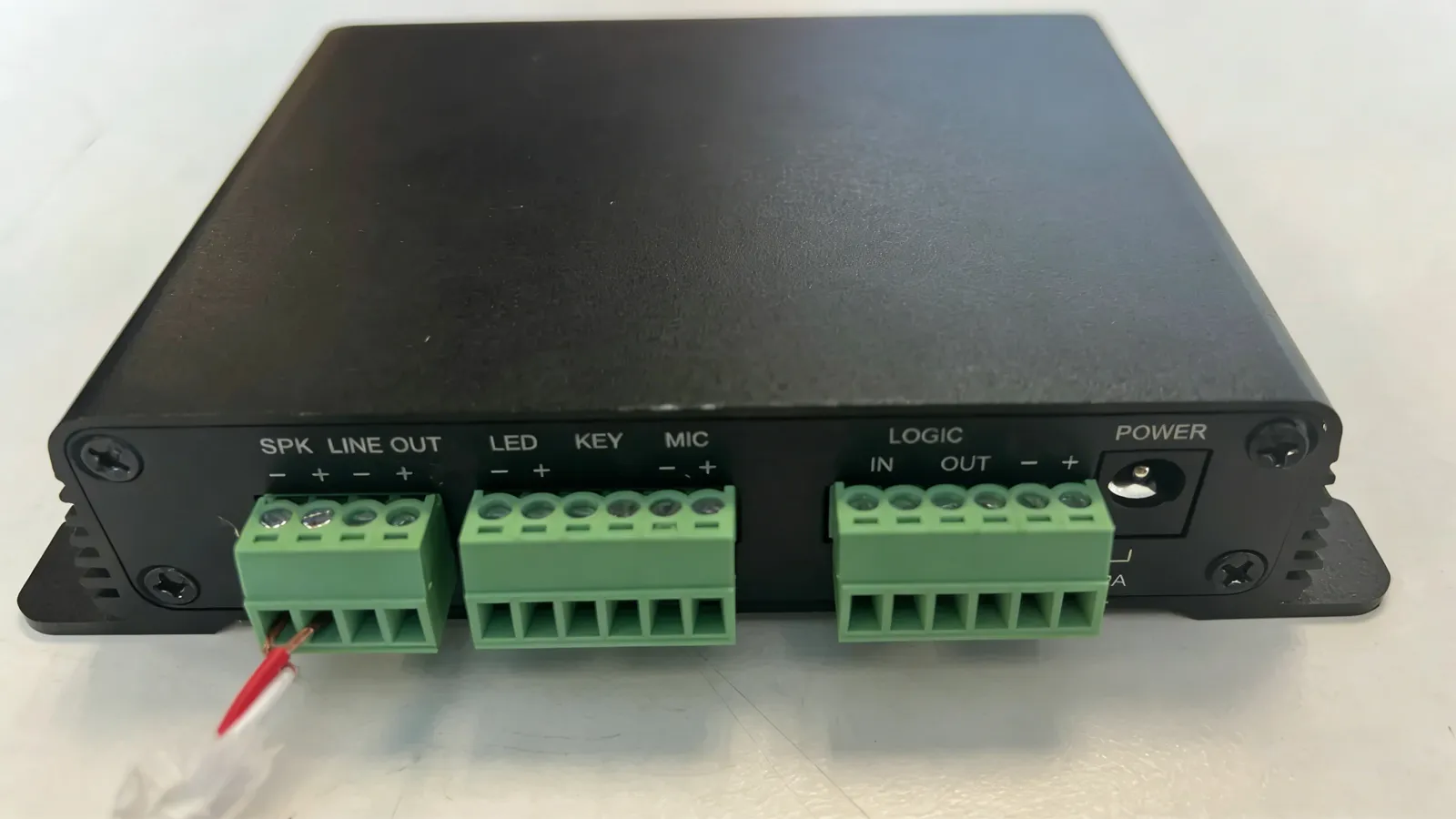
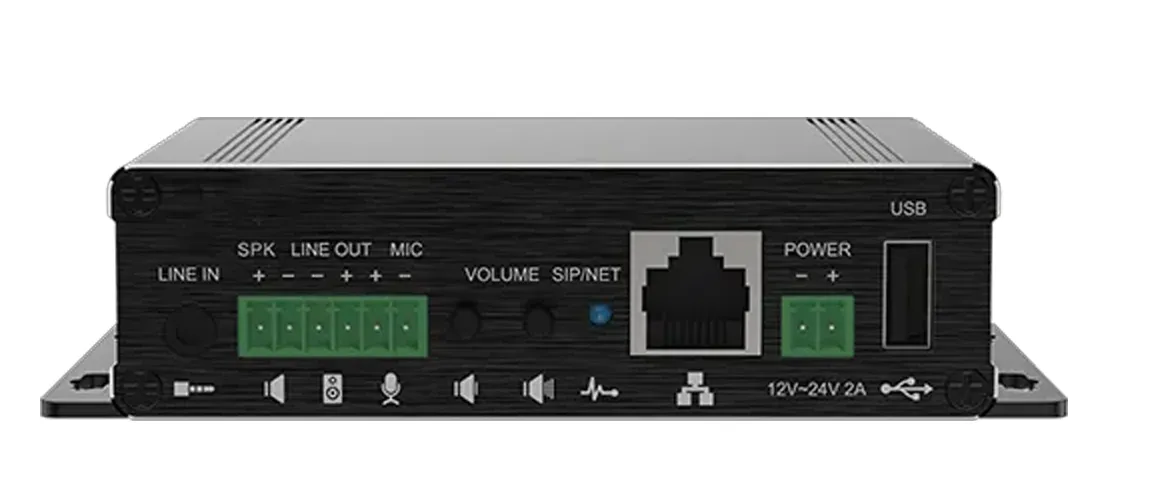
The Becke Telcom Broadcast Gateway features a clearly labeled interface panel, with dedicated ports for SIP network connection (Ethernet), audio output (Phoenix terminals), power supply, and additional functional ports such as MIC IN and LINE OUT for extended audio input. This labeled design simplifies wiring and troubleshooting, reducing the risk of connection errors and ensuring fast on-site deployment. The gateway also incorporates LED status indicators for power, network connection, and SIP registration, allowing technical staff to quickly verify the device’s operational status at a glance—critical for maintaining system reliability in 24/7 operation scenarios such as industrial dispatch and public safety communication.
Configuration and Operation: Same User Experience as IP Phones
One of the most user-friendly features of the Becke Telcom Broadcast Gateway is its configuration and operation logic, which is identical to standard SIP IP phones—eliminating the need for specialized technical training for the IT and dispatch teams responsible for system management and daily operation. This design aligns the gateway with the operational habits of users familiar with SIP IP communication systems, further lowering the barrier to integration and daily use.
The configuration process is straightforward: the Becke Telcom Broadcast Gateway is connected to the fusion communication system’s IP network via an Ethernet cable, and the system administrator assigns a unique SIP number to the gateway in the fusion communication system’s management platform—just as a SIP number is assigned to a standard IP phone or mobile terminal. The gateway then registers to the fusion communication system using this SIP number, and the registration status is displayed via the gateway’s LED indicators. Once registered successfully, the gateway is fully integrated into the SIP communication network and ready for use, with no additional protocol configuration or software installation required.
Daily operation is even more intuitive: to initiate a broadcast, a user simply uses a dispatch console, IP phone, or authorized mobile terminal on the fusion communication system to dial the gateway’s assigned SIP number. The fusion communication system establishes a SIP call with the gateway, triggering the automatic conversion of SIP VOIP audio to analog signals and the transmission of audio to the traditional broadcast system. The user can then speak directly into the terminal’s microphone to make live broadcast announcements, or play pre-recorded audio files via the fusion communication system for automated broadcasting. Hanging up the SIP call terminates the broadcast transmission immediately, returning the analog broadcast system to its standby state.
This IP phone-like operation logic ensures that any user with basic knowledge of SIP phone operation can manage the broadcast function, making the integrated system accessible to a wide range of staff and reducing the reliance on specialized technical personnel for daily operation.
Synergy with Built-in SIP Broadcast Functions: Avoiding Redundant Construction
Many modern SIP-based fusion communication systems come with built-in SIP broadcast functions, designed for IP-based broadcast terminals and IP speaker arrays. The Becke Telcom Broadcast Gateway is engineered to work in perfect synergy with these built-in functions, creating a hybrid broadcast system that leverages both SIP IP broadcast and traditional analog broadcast—eliminating the need for redundant construction of separate broadcast systems and maximizing the value of existing hardware investments.
In this hybrid architecture, the built-in SIP broadcast function of the fusion communication system is used to control IP-based broadcast terminals (e.g., IP speakers) in areas where IP network deployment is convenient, such as office buildings and modern industrial workshops. The Becke Telcom Broadcast Gateway is used to integrate the traditional analog broadcast system, which covers areas where IP network deployment is difficult or costly (e.g., old factory buildings, outdoor industrial sites, and remote campuses). The fusion communication system acts as a unified dispatch center, managing both IP and analog broadcast terminals from a single platform, with the ability to initiate targeted broadcasts to specific areas (either IP or analog) or global broadcasts to the entire network—achieving truly unified audio dispatch and communication.
This synergy not only optimizes the use of existing broadcast infrastructure but also provides a scalable upgrade path for the future. As enterprises and organizations expand or upgrade their facilities, they can gradually deploy IP broadcast terminals in new areas while retaining the analog broadcast system in existing areas—all managed by the same fusion communication system via the Becke Telcom Broadcast Gateway. This phased upgrade approach reduces capital expenditure and minimizes operational disruption, making it a cost-effective solution for organizations of all sizes.
Expanded Application Scenarios and Customizable Audio Fusion Solutions
Beyond its core function of integrating traditional analog broadcast into SIP IP dispatch systems, the Becke Telcom Broadcast Gateway offers versatile audio input and output capabilities that, when combined with its native SIP compatibility, unlock a wide range of expanded application scenarios for audio fusion projects. The gateway’s additional functional ports—including MIC IN for direct microphone input, LINE IN for external audio device input, and multiple LINE OUT ports for analog audio distribution—enable it to adapt to diverse audio communication requirements, supporting the design of customized audio fusion solutions for specific industries and application scenarios.
For example, in industrial dispatch centers, the gateway’s MIC IN port can be connected to a dedicated broadcast microphone in the dispatch room, allowing dispatchers to make emergency announcements directly via the microphone (bypassing the fusion communication terminal) for faster response in critical situations. In campus and commercial building communication systems, the gateway’s LINE IN port can be connected to audio players, public address systems, or video conference equipment, enabling the broadcast of pre-recorded campus notifications, commercial announcements, or video conference audio via the traditional analog broadcast system. In public safety and emergency response scenarios, the gateway can be integrated with alarm systems via its LOGIC OUT port, triggering automatic emergency broadcast announcements when an alarm is activated—creating an intelligent, automated emergency communication system.
The gateway’s compact, industrial-grade design also makes it suitable for deployment in harsh environments, such as industrial workshops, outdoor communication stations, and remote construction sites, with resistance to temperature fluctuations, dust, and electromagnetic interference. This rugged design ensures reliable operation in demanding conditions, making the Becke Telcom Broadcast Gateway a versatile solution for audio fusion in industrial, commercial, educational, and public safety sectors.
Practical Value of Becke Telcom Broadcast Gateway in Fusion Communication
The Becke Telcom Broadcast Gateway delivers tangible, multi-faceted value for fusion communication projects, addressing the key pain points of traditional analog broadcast integration—high costs, complex deployment, and poor compatibility with digital IP systems. Its core value can be summarized in three key areas: cost efficiency, ease of deployment, and scalability.
First, the gateway maximizes the utilization of existing analog broadcast infrastructure, eliminating the need for costly full-system upgrades and reducing integration costs by up to 80% compared to replacing analog broadcast equipment with IP-based alternatives. This is particularly valuable for organizations with large, well-established analog broadcast systems, such as manufacturing enterprises, universities, and public institutions.
Second, the gateway’s simplified networking, plug-and-play connection, and IP phone-like configuration/operation logic enable fast on-site deployment, typically completed within a few hours by a basic technical team. This minimizes operational disruption and shortens the project implementation cycle, allowing organizations to realize the benefits of unified audio dispatch quickly.
Third, the gateway’s synergy with built-in SIP broadcast functions and versatile audio input/output capabilities provide a scalable audio fusion solution that can adapt to the evolving communication needs of organizations. It supports phased upgrades to IP broadcast systems and the design of customized solutions for specific application scenarios, ensuring long-term value and investment protection.
In conclusion, the Becke Telcom Broadcast Gateway is a purpose-built hardware solution for the audio fusion requirements of modern fusion communication projects, enabling the seamless integration of traditional analog broadcast systems into SIP-based IP dispatch networks with minimal cost and complexity. Its core SIP-to-analog audio conversion capability, simplified networking, user-friendly operation, and scalable design make it an essential component of a unified, intelligent audio communication ecosystem—empowering organizations to leverage their existing broadcast infrastructure while embracing the flexibility and intelligence of modern SIP IP communication. As fusion communication continues to evolve, the Becke Telcom Broadcast Gateway will remain a reliable, cost-effective solution for audio fusion, supporting diverse application scenarios and driving the digital transformation of traditional broadcast systems.

 English
 Deutsch
 한국어
한국어 Русский
 Français
 日本語
日本語 لالعربية
 हिन्दी
 Español
 Português
 繁体中文
繁体中文 简体中文
简体中文