Industrial telephones play a crucial role as key communication devices in hazardous environments, where voice clarity and user experience directly impact the safety and efficiency of industrial operations. In high-noise, electrically-interfered environments, standard telephone systems often fail to meet the basic communication needs, leading to issues such as miscommunication of instructions and delayed emergency responses. By analyzing the challenges of voice clarity in industrial environments, exploring hardware and software optimization technologies, and studying multidimensional strategies for improving user experience, this article provides a comprehensive reference for the design and application of industrial telephones. Through an in-depth examination of industry standards, technological innovations, and real-world application scenarios, it has become clear that the optimization of industrial telephone voice clarity has evolved from traditional hardware protection to integrated smart solutions combining hardware and software. User experience improvements are shifting from basic functions to personalized services, and from single devices to system integration.
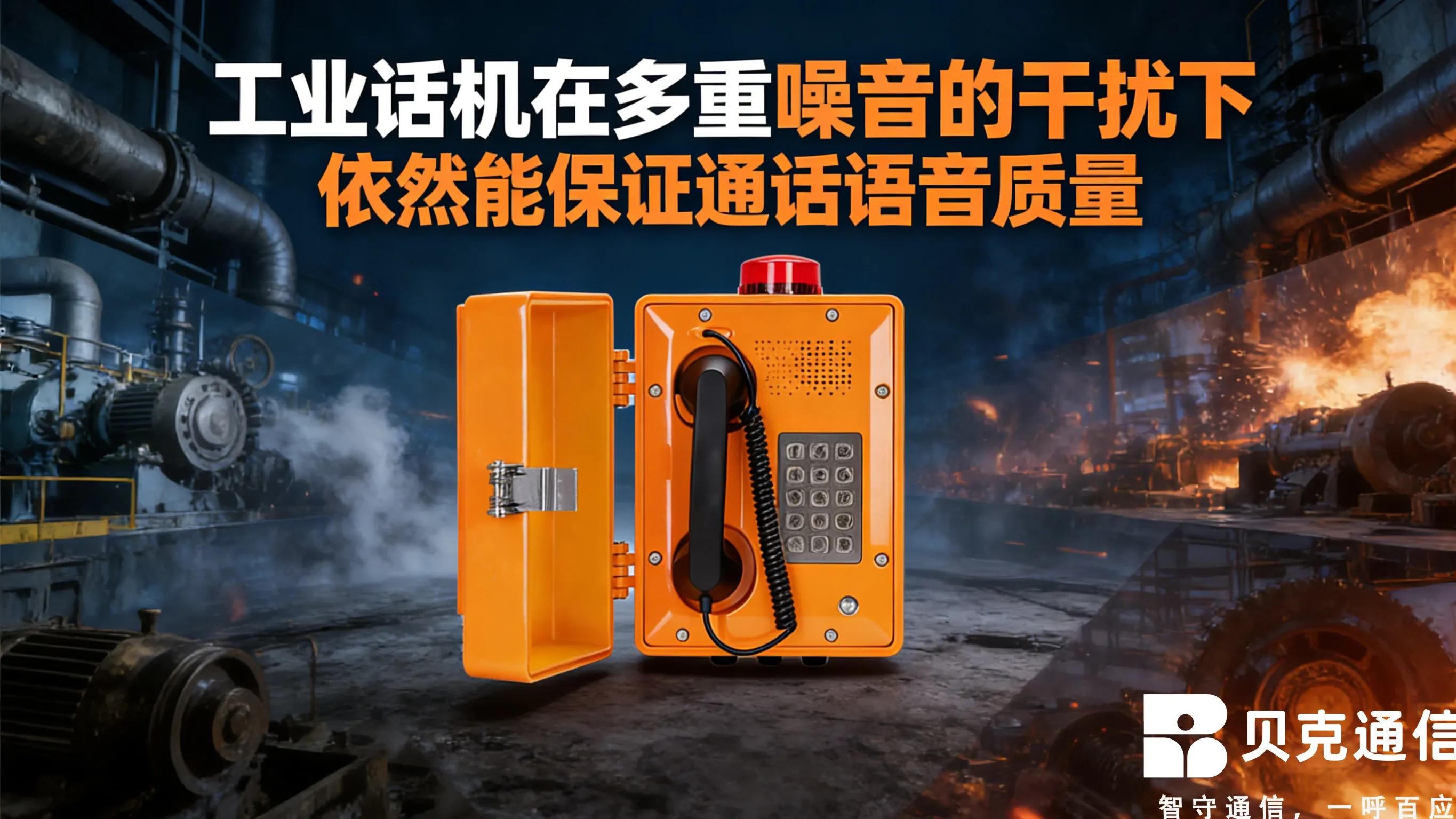
1. Voice Clarity Challenges in Industrial Environments
Industrial environments impact voice clarity in three main areas: noise interference, electromagnetic interference (EMI), and equipment performance limitations. Noise interference is the primary challenge industrial telephones face. Industry data indicates that background noise levels in industrial sites can reach 115-120 decibels, far exceeding the 30-50 decibels typical in office settings. For instance, the noise in underground coal mining can reach 120 dB, and near electric arc furnaces in steel plants, the noise can exceed 130 dB. This high-decibel noise not only masks human speech but also causes voice signal distortion, significantly degrading communication quality.
Noise interference can be categorized into steady-state noise and impulse noise. Steady-state noise, such as low-frequency hums from machinery or continuous operation of equipment, is characterized by persistence and a wide frequency range. Impulse noise, such as metal impacts or sudden noise from equipment startups, is short-lived but energy-intensive. These two types of noise affect voice clarity differently and require tailored solutions. For example, coal mine environments are dominated by steady-state noise, while steel plants experience more impulse noise.
Electromagnetic interference is another significant challenge in industrial settings. According to field measurements, the magnetic field around a 10kV switchgear in a substation can reach 200A/m, which can render standard intercoms ineffective. In textile factories, 200 frequency-controlled motors operating simultaneously can generate interference across a 0.5-10MHz wide frequency band, reducing the signal-to-noise ratio (SNR) of unoptimized intercoms by 15 dB. In port environments, the RFID system works in the 903.5-907MHz range, with a signal strength of up to 70 dBμV, completely overshadowing mobile communications base stations’ uplink signals, resulting in poor connection quality and frequent dropped calls. EMI not only interferes with signal transmission but may also disrupt microphone circuits, distorting voice signals.
The third challenge to voice clarity in industrial telephones is equipment performance limitations. Industrial environments demand high protection ratings for equipment, such as IP65/IP67 waterproof and explosion-proof certifications like Exd ib II BT6 Gb or Ex ib IIC T4 Gb. These stringent protection requirements often limit microphone performance. For example, the sealing structures of explosion-proof telephones may reduce microphone sensitivity, and high temperatures (from -45°C to +60°C) may cause performance degradation or even damage to traditional electret microphones (ECM). Additionally, industrial telephones must support multiple communication protocols (such as SIP2.0, G.723, G.711, and G.729), which poses challenges for signal processing in complex electromagnetic environments.
2. Hardware-Based Voice Clarity Optimization Technologies
To tackle the voice clarity challenges in industrial environments, hardware optimizations focus on microphone selection, shielding design, and signal processing. Microphone selection is fundamental to industrial telephone voice clarity. Test data reveals significant performance differences in industrial environments depending on the microphone type. Dynamic microphones are stable in high-temperature and high-humidity environments but have lower sensitivity. Capacitive microphones have higher sensitivity but are prone to damage in extreme temperatures. MEMS microphones, on the other hand, maintain stable performance across various temperatures, are resistant to vibration, humidity, and time, and can withstand high-temperature soldering processes up to 260°C without affecting performance.
In material testing, high-pressure and high-temperature MEMS microphones operate well in environments with up to 3.5 MPa pressure and 160°C temperature, with harmonic distortion at just 1.31%, significantly outperforming traditional microphones in extreme environments. This feature makes MEMS microphones an ideal choice for industrial telephones, particularly in high-temperature and high-pressure environments such as ports and chemical plants. Additionally, MEMS microphones offer superior EMI and RFI resistance compared to ECMs, enabling better performance in electromagnetically noisy environments.
Shielding design is one of the core hardware optimization technologies for industrial telephones. A dual shielding chamber design is commonly used, adding copper-aluminum composite shielding layers to the external circuit boards to attenuate interference below 1 GHz by up to 40 dB. This design effectively shields external electromagnetic interference, similar to giving the intercom a "radiation-proof suit." For instance, the HL-SPHJ-D-B1 industrial explosion-proof telephone from Hualue Communications features a high-strength aluminum alloy shell, fanless design, low power consumption, and strong anti-interference capabilities, with remote web debugging and centralized network management.
Omnidirectional antenna optimization is another critical technology. Through phase array design, the antenna gain is boosted to 5 dBi while maintaining 360° coverage. Testing has shown that this increases communication range by 60% in crane-dense areas. This design is especially useful in open or metal-reflective environments such as ports and mines, addressing issues related to signal attenuation and multipath effects.
3. Software-Based Voice Clarity Optimization Technologies
Software-based voice clarity optimization focuses on noise reduction algorithms, signal processing protocols, and error correction technologies. Adaptive filtering algorithms are at the core of industrial telephone software optimization. These algorithms can dynamically filter specific frequency band interference based on the real-time analysis of background noise spectra. In a stamping workshop, voice clarity was improved by 82% using this algorithm. It is particularly useful in industrial environments where noise spectra are constantly changing.
Forward error correction (FEC) plays a vital role in industrial telephones by ensuring voice clarity even when packet loss occurs during signal transmission. Industrial telephones typically use FEC technologies, including D-FEC (fixed redundancy rate FEC) and A-FEC (adaptive FEC). A-FEC technology dynamically generates redundant packets based on packet loss information returned from the decoding side, allowing the restoration of speech even when packet loss reaches 30%, similar to a "puzzle where missing pieces can still reveal the image."
Intelligent power control technology automatically adjusts transmission power (adjustable from 0.5 to 5W) based on signal quality, ensuring both communication quality and minimizing interference. This technology is analogous to "adjusting the water flow" in a faucet, automatically adjusting the power based on the level of environmental interference, thus avoiding unnecessary energy consumption and interference.
4. User Experience Optimization Strategies for Industrial Telephones
The optimization of user experience in industrial telephones revolves around ease of operation, interface design, and personalized services. Operational ease is the foundation of user experience. In industrial environments, the physical button layout and anti-mistouch designs are key. Physical buttons in industrial telephone designs typically feature recessed designs (≥2mm deep) to prevent accidental touches, with stainless steel buttons and metal-sheathed cables to ensure stable operation in harsh environments.
Mistouch prevention technologies are widely applied, including mechanical protection designs and electronic anti-interference measures. Mechanical protection includes recessed buttons, protective covers (IP67-rated), and combined operation designs (requiring long-press or double-button confirmation). Electronic protection includes software debounce algorithms (with a response delay of over 200ms), multi-step confirmation mechanisms (requiring two consecutive clicks), and pressure sensing technology (differentiating between adult and child operational force).
Interface design often adopts a simple and intuitive display method. For instance, the Federal Signal FT400BX safety explosion-proof telephone is equipped with illuminated button switches and a two-line alphanumeric display, with a viewing area of approximately 78mm×26mm, adaptable to various lighting conditions. The high-brightness LED backlight design (up to 2000 mcd) supports multi-color status indicators (green for operation, red for failure, blue for standby), with adjustable brightness to adapt to different lighting environments.
Personalized services for industrial telephones are crucial for optimizing user experience. For example, explosion-proof telephones in the petrochemical industry support SIP protocols, sound and light alarms, and 30W PA broadcasting functions. In port environments, industrial telephones support multilingual switching to meet international operational needs.
5. Implementation Path for Optimizing Industrial Telephones
The optimization path for industrial telephones includes spectrum scanning, equipment selection, and network optimization. Spectrum scanning is the first step in optimization, using specialized spectrum analyzers (e.g., Tektronix RSA306B) to map electromagnetic environments and identify major interference sources.
Equipment selection is the core of optimization. Based on identified interference types, appropriate solutions are selected, such as frequency-hopping models for discrete frequency point interference, spread-spectrum models for wideband noise, and high-sensitivity models (e.g., MEMS microphones) for pulse interference.
Network optimization ensures stable operation of industrial telephones in complex environments by building cellular networks through relay stations, achieving seamless coverage in logistics parks up to 500,000 square meters.
6. Future Trends in Industrial Telephone Optimization
The future of industrial telephone optimization is moving toward intelligent, networked, and integrated solutions. The fusion of 5G technology and industrial IoT offers new technological pathways, enhancing real-time, reliable, and secure communication. AI technology is also increasingly being applied, with deep learning-based speech enhancement algorithms improving speech intelligibility in noisy environments.
The digital twin technology for industrial telephone maintenance shows great potential, allowing real-time monitoring, fault prediction, and remote maintenance to reduce costs and downtime.
7. Conclusion
Optimizing the voice clarity and user experience of industrial telephones is a comprehensive engineering task that involves hardware, software, and system integration. With the continuous development of 5G, AI, and edge computing technologies, industrial telephones will achieve even greater breakthroughs in voice clarity and user experience, ensuring safer, more reliable, and efficient communication for industrial operations.

 English
 Deutsch
 한국어
한국어 Русский
 Français
 日本語
日本語 لالعربية
 हिन्दी
 Español
 Português
 繁体中文
繁体中文 简体中文
简体中文