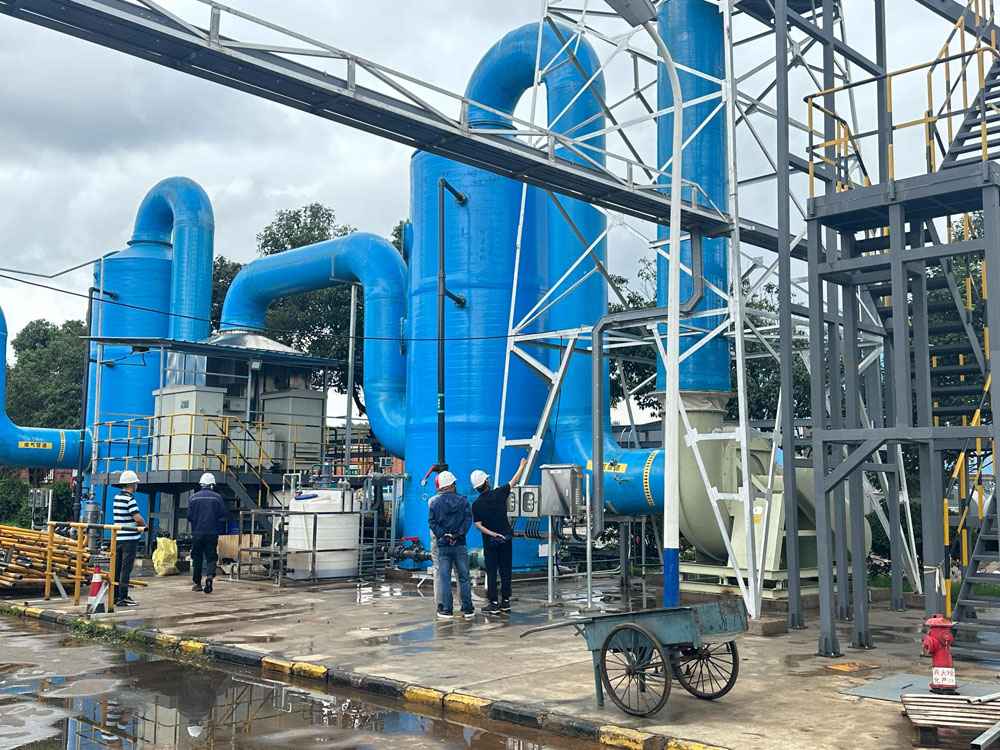
In industrial scenarios, telephones serve as core terminals for production dispatching, emergency command, and data transmission. Their communication security is directly linked to a company’s core assets, production safety, and even public interests. Unlike civilian telephones, industrial telephones are widely deployed in critical sectors such as petrochemicals, electric power, rail transit, and intelligent manufacturing. Call content often involves sensitive information including production parameters, dispatching instructions, and equipment confidentiality. Once security risks such as eavesdropping, tampering, or interception occur, they may lead to production shutdowns, equipment failures, or even safety accidents.
With the deep integration of the Industrial Internet, industrial communication networks are shifting from closed systems to more open architectures. The shortcomings of traditional industrial telephones based on “plaintext transmission” are becoming increasingly apparent, making voice encryption technology a core pillar for ensuring industrial communication security.
I. Core Logic and Necessity of Voice Encryption in Industrial Telephones
1.1 Core Logic: From “Plaintext Transmission” to “End-to-End Encryption”
Voice encryption in industrial telephones essentially refers to encoding voice signals through encryption algorithms, converting plaintext voice into ciphertext that cannot be directly interpreted. Even if intercepted during transmission, eavesdroppers cannot obtain valid information without the corresponding decryption key. Once the ciphertext reaches the receiving end, it is restored to plaintext voice using the same algorithm and key, forming a closed-loop secure communication process of “encryption–transmission–decryption.”
Unlike civilian communication encryption, the core requirements for voice encryption in industrial scenarios are real-time performance and stability. Encryption must be implemented without affecting call quality or delaying dispatching instructions, while simultaneously resisting electromagnetic interference and malicious cracking in complex industrial environments. This determines the uniqueness and specialization of voice encryption technologies for industrial telephones.
1.2 Necessity of Secure Communication: Avoiding Three Core Risks
In industrial environments, the absence of effective voice encryption mechanisms exposes industrial telephones to three critical security risks, which constitute the primary driving forces for enterprises to upgrade to encrypted industrial telephones.
First is the risk of eavesdropping. Industrial communication networks may suffer from tapped wired lines or intercepted wireless signals, especially in key areas such as petrochemical parks and power substations. If sensitive dispatching instructions are intercepted, they may be maliciously exploited, triggering production safety hazards. In 2025, a logistics park in Zhejiang suffered losses after unencrypted communications allowed hackers to intercept dispatching instructions, resulting in the hijacking of goods worth RMB 1.2 million. This case highlights the importance of communication encryption in industrial scenarios.
Second is the risk of tampering. Malicious attackers may intercept and alter voice signals to mislead production dispatching, such as forging equipment shutdown instructions or modifying production parameter notifications, leading to equipment damage and production disorder.
Third is the risk of regulatory non-compliance. Current laws such as the Cybersecurity Law and the Data Security Law impose explicit requirements on the secure transmission of industrial core data. Industrial communications without voice encryption may violate relevant regulations and face penalties.
II. Mainstream Voice Encryption Technologies and Solution Comparison for Industrial Telephones
At present, voice encryption technologies for industrial telephones are mainly divided into two categories: hardware encryption and software encryption. Hardware encryption, with its higher security and stability, has become the mainstream choice in industrial scenarios, while software encryption is suitable for scenarios with lower security requirements and limited budgets. Different encryption solutions vary significantly in technical characteristics and application scenarios. The following provides a detailed comparative analysis based on core algorithms and practical applications.
2.1 Hardware Encryption Solutions: The Preferred Choice for Industrial-Grade Security
Hardware encryption solutions integrate dedicated encryption chips within industrial telephones, solidifying encryption algorithms at the hardware level to achieve real-time encryption of voice signals. Their core advantages include no occupation of host resources, zero latency, strong anti-interference capability, and high resistance to cracking or tampering. Their security level is far superior to software encryption, making them suitable for critical scenarios with extremely high communication security requirements, such as petrochemical, power, and rail transit industries.
Mainstream hardware encryption algorithms and applications include:
SM4 Algorithm: A domestically developed commercial encryption algorithm based on block cipher principles, with a 128-bit key length. It offers high encryption strength and fast processing speed, effectively resisting brute-force attacks and meeting China’s requirements for independently controllable industrial information security. It is widely used in industrial telephones in key domestic industries such as electric power and petrochemicals. A Sinopec oilfield adopted SM4-encrypted communication equipment to prevent oil extraction data theft, reducing annual losses by more than RMB 3 million.
AES Algorithm: An internationally recognized encryption algorithm with key lengths of 128 bits and 256 bits. It features high encryption efficiency and strong compatibility, making it suitable for multinational and foreign-invested enterprises’ industrial communication scenarios. However, AES keys are typically stored in device chips, posing certain physical cracking risks. In 2024, the FBI cracked communication equipment from a certain brand using AES encryption. Therefore, highly sensitive scenarios require additional protective measures.
Quantum Encryption: A cutting-edge encryption technology that encrypts voice transmission through quantum key distribution. Its core advantage lies in the non-replicable and non-eavesdroppable nature of keys. Any interception causes irreversible changes to the key, enabling immediate detection of eavesdropping. Quantum encryption has begun to be applied in industrial scenarios. A petrochemical research institute park on Yanggao South Road in Pudong New Area implemented the nation’s first quantum-encrypted fixed-line telephone system. By embedding encryption media into industrial telephones and developing dedicated SDKs, the project achieved quantum-encrypted point-to-point and small-scale LAN communications, reaching commercial-grade security standards.
2.2 Software Encryption Solutions: Lightweight Security Supplement
Software encryption solutions encrypt voice signals by installing encryption software within the operating system of industrial telephones. Their main advantages are low cost and flexible deployment, without requiring additional hardware investment. They are suitable for office areas and auxiliary production workshops where security requirements are lower and call content does not involve core secrets.
Mainstream software encryption algorithms include DES (56-bit key length) and 3DES (168-bit key length). Their encryption strength is lower than SM4 and AES, and encryption relies on host resources, which may cause latency or stuttering in complex industrial environments. Moreover, software encryption is vulnerable to malware attacks and is therefore not recommended for critical production scenarios.
2.3 Core Comparison of the Two Encryption Solutions
For procurement and technical selection, the following comparison summarizes hardware and software encryption solutions across four dimensions:
Security: Hardware encryption (high, resistant to cracking and tampering) > Software encryption (low, vulnerable to malware attacks);
Stability: Hardware encryption (high, zero latency, strong anti-interference) > Software encryption (average, potential delays);
Cost: Hardware encryption (high, requires dedicated encryption chips) > Software encryption (low, software installation only);
Application Scenarios: Hardware encryption (critical production scenarios, highly sensitive communications); Software encryption (auxiliary scenarios, low-sensitivity communications).
III. Key Selection Points for Voice Encryption and Secure Communication in Industrial Telephones
For B-end procurement personnel and technical engineers, the core of selection lies in “scenario adaptation while balancing security and practicality.” There is no need to blindly pursue high-end encryption technologies. Instead, decisions should be based on industry characteristics, communication requirements, and budget constraints. The following five key points should be emphasized to avoid selection errors.
3.1 Adaptability of Encryption Algorithms
Selection should begin by clarifying industry encryption requirements and compliance obligations. For key domestic industries such as electric power, petrochemicals, and rail transit, industrial telephones using the SM4 algorithm are recommended to meet national requirements for independently controllable information security. Multinational and foreign-invested enterprises may choose AES-based models to ensure compatibility with global communication networks. Highly sensitive scenarios, such as research parks and military-supporting industries, may consider quantum-encrypted models for higher-level protection.
Caution is required regarding the security risks of certain international algorithms. For example, the TEA1 algorithm in the European TETRA standard contains “backdoors” and can be rapidly cracked. It is mainly exported to “non-friendly” EU countries and should be avoided in industrial scenarios.
3.2 Hardware Protection Capability
Industrial environments are complex, often involving high temperatures, humidity, dust, and electromagnetic interference. Hardware protection capabilities directly affect encryption stability. Selection should prioritize devices with protection ratings of IP65 or above, strong electromagnetic interference resistance compliant with GB/T 15279 standards, and anti-tamper enclosure designs capable of triggering self-destruction mechanisms to prevent malicious disassembly and cracking of encryption chips.
3.3 Key Management Capability
Keys are the core of voice encryption and decryption. Their generation, storage, updating, and destruction directly determine communication security effectiveness. High-quality industrial telephones should feature robust key management capabilities: autonomous key generation, periodic automatic updates to avoid long-term reuse risks, hierarchical key management for different user privileges, and key destruction functions to permanently delete keys upon device decommissioning.
Some low-end encrypted models use fixed keys that cannot be updated, posing significant security risks and should be avoided. During the development of quantum-encrypted fixed-line telephones, China Telecom Shanghai initially faced challenges due to inconvenient remote key updates, which were later resolved through technical optimization, highlighting the importance of key management.
3.4 Compatibility and Scalability
In industrial communication networks, telephones must interoperate with switches, dispatching systems, and monitoring platforms. Devices should support mainstream protocols such as SIP and H.323 to ensure seamless integration. Future scalability should also be considered by selecting models that support firmware upgrades and functional expansion, allowing encryption algorithms and key management functions to evolve with security requirements.
Some industrial telephones support multi-terminal access, including industrial IP phones, wireless PTT (PoC mode), and mobile apps, enabling direct connectivity between workshops and offices while maintaining consistent encryption across devices.
3.5 Cost and After-Sales Support
Selection should balance security needs with budget considerations to avoid unnecessary costs from over-encryption. Software encryption may suffice for auxiliary scenarios, while hardware encryption should be prioritized for critical scenarios. Supplier after-sales capabilities are also critical. Vendors with strong technical support and comprehensive service systems should be preferred to ensure timely assistance and minimize production downtime.
Procurement should confirm repair response times, service coverage (such as on-site maintenance), and upgrade guarantees to support future compliance and security enhancements.
IV. Typical Application Scenarios of Voice Encryption and Secure Communication in Industrial Telephones
Voice encryption and secure communication have been widely adopted across key industrial scenarios. Encryption requirements and solution choices vary by industry. The following cases illustrate practical application logic.
4.1 Petrochemical Industry: Preventing High-Risk Eavesdropping and Ensuring Production Safety
Industrial telephones in petrochemical parks are used for production dispatching and emergency command. Calls involve sensitive information such as crude oil extraction parameters, refining processes, and emergency instructions. Any interception or tampering may cause explosions or leaks. Therefore, hardware encryption solutions using SM4 or quantum encryption are widely adopted.
The petrochemical research institute park on Yanggao South Road in Pudong implemented a quantum-encrypted fixed-line solution by integrating traditional telephony with quantum encryption. By embedding encryption media and developing dedicated SDKs, the project achieved comprehensive secure voice communications across the park, with encrypted call indicators in the UI to enhance user security awareness.
4.2 Power Industry: Securing Dispatch Instructions and Preventing Grid Failures
In the power industry, industrial telephones support dispatching in substations and power plants. Calls involve grid load scheduling, maintenance commands, and fault handling. Hardware-encrypted telephones using SM4 algorithms are preferred to meet national security requirements, along with strong electromagnetic interference resistance to ensure stability in high-EMI environments.
Hierarchical key management is required to assign different keys to dispatch centers, substations, and maintenance teams. Some power enterprises also implement encrypted call recording, storing recordings with AES-256 encryption and restricted access to comply with the Personal Information Protection Law.
4.3 Rail Transit Industry: Ensuring Operational Dispatch Security and Passenger Safety
In rail transit systems such as metros and high-speed railways, industrial telephones support operational dispatching across stations, depots, and control centers. Calls involve train scheduling, passenger flow management, and emergency handling. Encryption requirements emphasize real-time performance, stability, and anti-interference capability. Hardware-encrypted models using AES-256 or SM4 and supporting SIP protocols are preferred.
For example, a domestic metro line deployed hardware-encrypted industrial telephones to achieve end-to-end encrypted communications between control centers, stations, and trains, effectively mitigating risks of line tapping and signal interception.
V. Common Issues and Solutions
In practical applications, procurement and technical personnel often encounter issues such as encryption failure, call latency, or key leakage. The following solutions address common problems.
5.1 Issue 1: Encrypted Calls Experience Latency or Stuttering
Solution: This is often caused by software encryption limitations or insufficient hardware configuration. Critical scenarios should adopt hardware-encrypted models with high-speed encryption chips (e.g., 32-bit encryption chips). Network optimization and algorithm parameter tuning can further reduce latency.
5.2 Issue 2: Key Leakage Leading to Encryption Failure
Solution: Improve key management by scheduling regular key updates (every 3–6 months), implementing hierarchical access control, securely destroying keys upon device decommissioning, and strengthening employee training.
5.3 Issue 3: Incompatibility with Existing Dispatch Systems
Solution: Select devices supporting mainstream protocols such as SIP and H.323. If incompatibility exists, firmware upgrades or protocol converters may be used to ensure seamless integration.
5.4 Issue 4: Frequent Encryption Failures in Harsh Industrial Environments
Solution: Replace devices with IP65+ protection and EMI resistance compliant with GB/T 15279. Conduct regular maintenance and inspections to ensure stable operation.
VI. Conclusion
Voice encryption and secure communication in industrial telephones are critical components of industrial information security. Their core value lies in protecting sensitive communications, mitigating risks of eavesdropping, tampering, and interception, and ensuring safe and compliant operations. As the Industrial Internet continues to evolve, the importance of voice encryption will further increase, with advanced technologies such as quantum encryption and domestic SM4 algorithms seeing broader adoption.

 English
 Deutsch
 한국어
한국어 Русский
 Français
 日本語
日本語 لالعربية
 हिन्दी
 Español
 Português
 繁体中文
繁体中文 简体中文
简体中文