Explosion-Proof Telephones as Key Equipment in Industrial Safety Communication.As key equipment in the field of industrial safety communication, explosion-proof telephones integrate the dual protection concepts of intrinsic safety and flameproof protection in their explosion-proof structural design. Through precise material selection, structural design, and circuit control, they ensure that the equipment does not become an ignition source in flammable and explosive environments. With the advancement of Industry 4.0, explosion-proof telephones have continuously achieved breakthroughs in physical structure, materials science, and circuit design, forming a distinctive system of technological innovation. Modern explosion-proof telephones have evolved from simple communication tools into comprehensive safety platforms featuring environmental perception, intelligent linkage, and remote control, providing reliable safety assurance for high-risk industries such as petroleum, chemical processing, and coal mining.
Core Explosion-Proof Principles of Explosion-Proof Telephones
The core explosion-proof principle of explosion-proof telephones is based on the three necessary conditions for an explosion: combustible substances, oxygen, and an ignition source. In hazardous environments, the first two conditions are often difficult to completely eliminate; therefore, the key to explosion-proof design lies in eliminating or limiting the generation of ignition sources. Explosion-proof telephones mainly adopt two explosion-proof technologies—intrinsic safety and flameproof protection—which work synergistically to form dual safety protection.
Intrinsic safety (Ex ib) technology limits voltage, current, and energy within the circuit, ensuring that even in the event of short circuits or internal faults, the electrical sparks or thermal energy generated remain below the minimum ignition energy required to ignite specific hazardous gases. According to GB3836.4 standards, the circuit design of explosion-proof telephones must meet strict parameter limits: maximum DC voltage ≤ 50 V, maximum DC short-circuit current ≤ 28 mA, and the stored energy of capacitors and inductors must also be controlled within safe thresholds. For example, the Zhendé mining intrinsic safety explosion-proof telephone KTH106S has intrinsic safety parameters of Ui ≤ DC60 V / AC90 V and Ii ≤ DC22 mA / AC22 mA, ensuring that no spark capable of igniting methane can be generated under any fault condition.
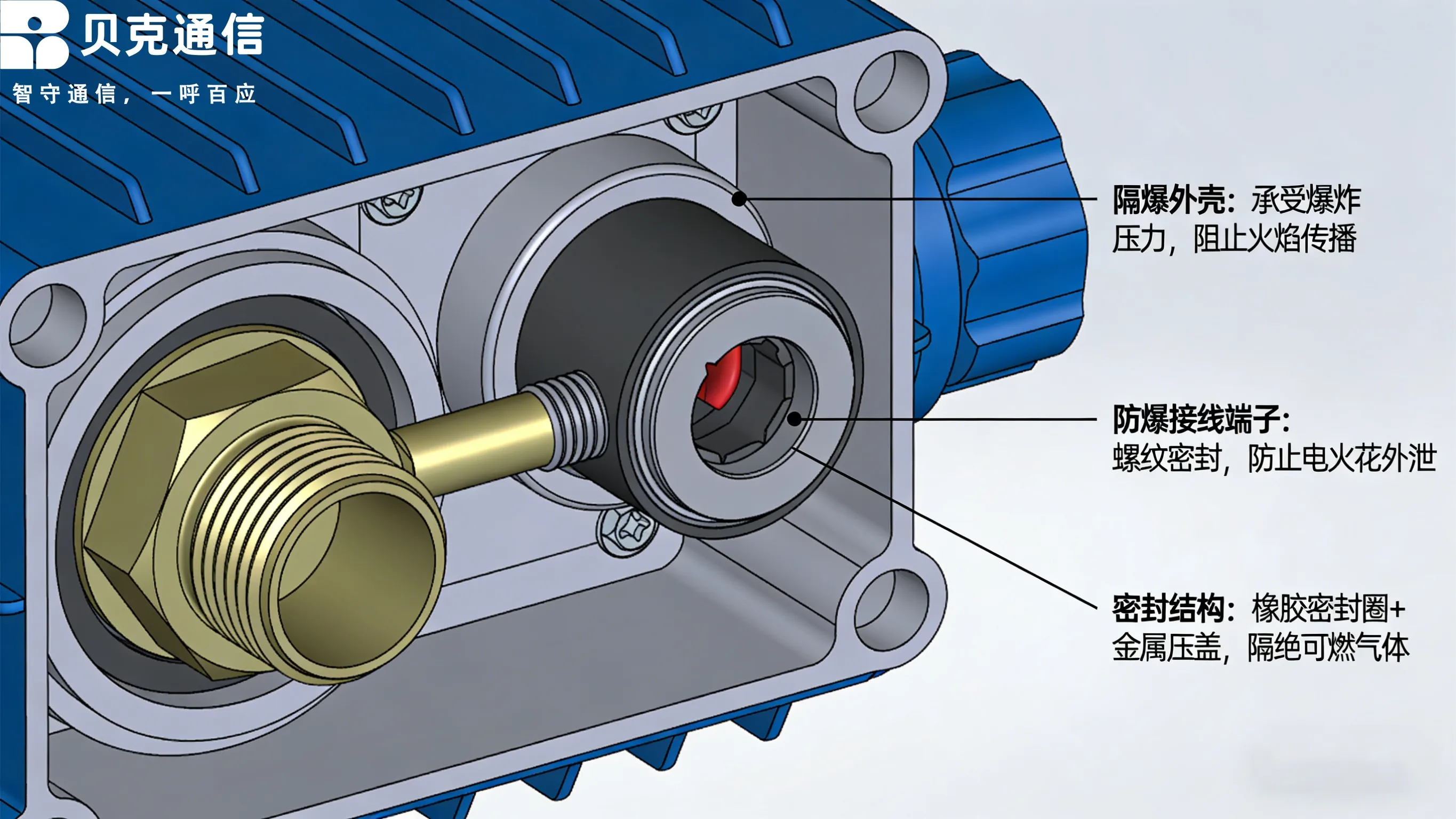
Flameproof (Ex d) technology, on the other hand, relies on physical structural protection by enclosing circuit components that may generate sparks, arcs, or high temperatures within a high-strength metal enclosure. The enclosure joints are designed with precise gap and surface roughness requirements, typically not exceeding 0.1 mm, ensuring that even if an explosion occurs internally, flames and high-temperature gases are effectively contained and cannot propagate into the external hazardous environment. Flameproof enclosures of explosion-proof telephones are usually made of ADC12 aluminum alloy or stainless steel, with wall thicknesses of 6–10 mm, capable of withstanding a drop impact from a height of 1.2 meters, ensuring physical integrity in harsh environments.
The explosion-proof marking of explosion-proof telephones, such as ExdibⅡBT6, represents a dual protection design: “Ex d” indicates flameproof protection, “Ex ib” indicates intrinsic safety protection, “ⅡB” denotes suitability for hydrogen, acetylene, and other high-risk gases, and “T6” indicates that the surface temperature of the equipment always remains below 85 °C, far below the ignition temperature of most combustible gases. This dual protection design enables explosion-proof telephones to be safely used in high-risk environments such as petroleum tank farms, chemical production workshops, and underground coal mines, making them a cornerstone of industrial safety communication.
Innovations in Physical Structure Design of Explosion-Proof Telephones
The physical structure design of explosion-proof telephones has evolved from simple protection to systematic, modular, and intelligent designs, forming a unique technological innovation system. Modern physical structure design has achieved a balance among “protection + functionality + reliability,” providing customized solutions for different industrial environments.
In terms of enclosure materials, explosion-proof telephones employ various innovative material combinations. Traditional designs mainly used cast aluminum or stainless steel, which offered high strength but were heavy and costly. Modern designs introduce antistatic engineering plastics and fiberglass-reinforced composites, significantly improving lightweight performance and corrosion resistance. For example, the Zhendé mining intrinsic safety explosion-proof telephone KTH106S is injection-molded from antistatic flame-retardant ABS plastic, with a surface resistivity ≤ 1×10⁹ Ω and a protection rating of IP54, making it suitable for extremely harsh environments. The Dongfang Junke JREX106 explosion-proof telephone adopts a high-toughness glass-fiber-reinforced polyester enclosure with excellent acid resistance, alkali resistance, and corrosion resistance, making it suitable for chemical plants with strong corrosive environments.
Sealing technology is a critical aspect of physical structure design. Modern explosion-proof telephones adopt multi-layer sealing designs, including epoxy resin sealing of key components and rubber sealing rings at enclosure joints. The sealing groove design combined with joint gap control (≤ 0.1 mm) ensures sealing performance across a wide temperature range of –45 °C to +60 °C and relative humidity up to 95%. For example, the KNEX1 explosion-proof telephone adopts an airtight structural design, with explosion-proof markings including DIP A20, making it suitable for combustible dust environments in Zones 20, 21, and 22. Sealing performance testing follows standards such as GB/T 14571, using helium leak detection methods to ensure normal operation after immersion at a depth of 1.5 meters for 30 minutes.
Keypad layout design has also undergone significant innovation. Traditional explosion-proof telephones used mechanical keys that were prone to failure due to wear or corrosion. Modern designs adopt fully sealed, luminous, light-touch keys with service lives exceeding 2.1 million operations, effectively addressing frequent failures of mechanical switches. The Tuopeng P300 explosion-proof tablet’s keys showed no loosening after 100,000 test cycles, while the KTH106S explosion-proof telephone uses a fully sealed light-touch design, maintaining speech intelligibility of 90% even in environments with noise levels of 90 dB. In addition, explosion-proof telephones are equipped with dedicated function keys such as emergency call, hang-up, and redial to meet rapid operation requirements in high-risk scenarios.
Installation structure design also reflects innovative thinking. Modern explosion-proof telephones support both desktop and wall-mounted installation and feature a unique auxiliary installation chamber, allowing easier external wiring and handset replacement without opening the main enclosure, thus reducing the risk of sealing failure. For example, the KTH106S mining intrinsic safety telephone uses a new non-contact switch design, with no moving parts on the handset, significantly improving reliability and service life.
Innovations in Circuit Design of Explosion-Proof Telephones
Circuit design innovation mainly manifests in refined intrinsic safety circuit design and intelligent protection mechanisms. Modern explosion-proof telephone circuit design has realized a three-level protection system of “energy limitation + fault monitoring + intelligent protection,” significantly enhancing safety and reliability.
In intrinsic safety circuit design, modern explosion-proof telephones adopt more precise component selection and layout techniques. By using series current-limiting resistors and parallel voltage-clamping diodes, circuit voltage and current are strictly controlled within safe thresholds. For example, Zener diodes are connected in parallel across contacts that may generate sparks; when voltage exceeds the safe value, the diode breaks down and conducts, dissipating energy into a safe range. Energy storage components such as capacitors and inductors are also designed more rigorously by accurately calculating capacitor energy storage (E = 0.5CV²) and inductive electromotive force, ensuring that released energy during circuit disconnection or short-circuiting is insufficient to ignite explosive mixtures.
PCB layout design has also achieved innovative breakthroughs. Modern explosion-proof telephones use multilayer PCB designs that isolate power circuits from signal circuits, reducing abnormal energy caused by electromagnetic coupling. PCB surfaces are coated with conformal coatings (moisture-proof, mold-proof, and salt-spray-proof) to prevent short circuits caused by environmental corrosion. For example, the Tuopeng A50Ex digital explosion-proof intercom uses unique digital audio codec technology to ensure communication privacy, eliminating crosstalk and interference even on the same frequency, while digital algorithms filter background noise and suppress feedback, improving audio quality.
Thermal management technology is a key innovation in circuit design. Through components such as graphene heat dissipation films and heat pipes, operating heat is evenly dissipated to ensure surface temperatures remain below T4 or T6 classification requirements. For example, one explosion-proof telephone model recorded a surface temperature of only 45 °C, far below safety limits. Heat pipe technology transfers heat by absorbing and releasing latent heat through phase change. In practice, heat pipes connect to the condensation end of the substrate, transferring heat generated by components through radiation or convection to the surrounding environment, effectively preventing overheating hazards.
Fault monitoring and protection mechanisms represent another major innovation. By integrating a Dynamic Energy Monitoring System (DEMS), voltage, current, and energy changes are monitored in real time; once abnormalities are detected, the system immediately cuts off power or reduces output. For example, an intelligent power management system built using the TIBQ25703 chipset achieves real-time current monitoring accuracy of ±0.5 mA and overload response times of 18 μs, effectively preventing sparks or overheating caused by circuit overloads.
Materials Science Innovations in Explosion-Proof Telephones
Materials science innovation in explosion-proof telephones mainly focuses on antistatic materials, corrosion-resistant materials, and thermal management materials, significantly enhancing adaptability and reliability in harsh environments.
Antistatic materials are a major innovation. By adding carbon fibers or conductive fillers (such as D545 fiberglass), enclosure materials achieve good conductivity, with surface resistivity ≤ 1×10⁹ Ω, effectively preventing static accumulation hazards. For example, antistatic ABS plastics have achieved UL94 V-0 flame-retardant ratings and impact strengths ≥ 10 J and are widely used in explosion-proof telephone enclosures. The application of nanomaterials such as nano-TiO₂ and ZnO further enhances antistatic performance, stabilizing surface resistivity at 10⁹–10¹¹ Ω while maintaining excellent mechanical strength and durability.
Corrosion-resistant materials are critical for applications in chemical and marine environments. Metal enclosures typically use epoxy powder electrostatic spraying with coating thickness ≥ 8 mm, effectively isolating corrosive substances and extending service life. For example, motor external fan covers with epoxy powder coatings can achieve service lives of up to 10 years in highly corrosive environments, far exceeding the few months or one year typical of ordinary coatings. Non-metallic materials such as fiberglass further improve corrosion resistance; for instance, the JREX106 explosion-proof telephone’s glass-fiber-reinforced polyester enclosure exhibits excellent acid, alkali, and corrosion resistance.
Thermal management materials are essential innovations for high-temperature environments. The use of graphene heat dissipation films and nano-zinc-oxide/fluoroelastomer composites significantly improves heat dissipation and thermal stability. For example, fluoroelastomer sealing rings containing 25% carbon fiber retain 68% tensile strength after 1,000 hours of continuous operation at 250 °C, far exceeding the 15% retention of ordinary nitrile rubber. Nano-zinc-oxide filling increases thermal conductivity by 200%, effectively reducing localized overheating risks.
Cold phosphating technology is an important innovation in flameproof surface treatment. By forming a 2–3 mm thick phosphate layer on metal surfaces, corrosion resistance is enhanced, preventing enclosure failure due to external corrosion. The phosphating process strictly controls temperature (20 °C ± 5 °C), time (3 hours), and cleaning procedures (gasoline degreasing + anti-rust oil coating), ensuring flameproof surfaces remain effective. After phosphating, surface roughness reaches Ra ≤ 3.2 μm, significantly improving corrosion resistance and enabling long-term stable operation in highly corrosive environments.
Applications of Explosion-Proof Telephones in Typical Industrial Environments
Explosion-proof telephones are widely and deeply applied in typical industrial environments such as petroleum, chemical processing, and coal mining, providing reliable safety assurance through their explosion-proof structural design and technological innovations.
In petroleum tank farms, explosion-proof telephones face challenges such as high temperatures, salt spray corrosion, and flammable gases. Through wide operating temperature ranges (–45 °C to +60 °C) and corrosion-resistant coatings (epoxy powder ≥ 8 mm), these challenges are effectively addressed. For example, the KNEX1 explosion-proof telephone, with explosion-proof marking Exde[ib]ib IIB T6, is suitable for explosive gas environments in Zones 1 and 2 and IIA and IIB gas categories, and can operate stably for 1,000 hours in desert oil fields at temperatures up to 70 °C. In Middle Eastern oil and gas fields, explosion-proof telephones maintain normal communication functions in environments with H₂S concentrations of 300 ppm, providing safe and reliable communication for workers.
In chemical production workshops, explosion-proof telephones face strong acids, alkalis, and toxic gases. By adopting high-toughness glass-fiber-reinforced polyester enclosures and polyurethane waterproof metal keypads, corrosion resistance is significantly improved. For example, the JREX106 explosion-proof telephone enclosure can withstand immersion in 98% concentrated sulfuric acid for 72 hours with a surface corrosion rate ≤ 0.02 mm/year, far exceeding the corrosion resistance of ordinary metal materials. In addition, explosion-proof telephones integrate environmental sensing networks (gas sensors + thermal imaging) to predict hazards and dynamically adjust communication power, ensuring safe and reliable operation in highly corrosive environments.
In underground coal mines, explosion-proof telephones face challenges such as high humidity, coal dust accumulation, and methane concentration monitoring. By adopting IP67 protection ratings and BeiDou dual-mode positioning technology, these challenges are effectively addressed. For example, the KTH106S mining intrinsic safety telephone maintains 90% speech intelligibility in 90 dB noise environments, meeting underground communication requirements. Explosion-proof telephones also feature built-in methane sensor interfaces that monitor gas concentration in real time, triggering audiovisual alarms and synchronously notifying surface dispatch centers when thresholds are exceeded, providing critical safety assurance. One coal mine successfully avoided a gas overlimit risk at a mining face through this system, effectively preventing a gas explosion accident.
At natural gas extraction sites, explosion-proof telephones face high-risk gases such as methane and acetylene. By adopting Exd ib IIB T6 Gb explosion-proof ratings and dynamic energy monitoring systems, these challenges are effectively managed. For example, Dongfang Junke’s explosion-proof industrial telephones have passed ATEX, IECEx, and CNEx certifications, ensuring safe and reliable operation in environments with methane and acetylene. In addition, integrated GPS/BeiDou positioning provides location information for emergency response, significantly improving rescue efficiency and safety.
Technological Development Trends of Explosion-Proof Telephones
With the deepening of industrial intelligence and digital transformation, the technological development of explosion-proof telephones shows trends of diversification, integration, and intelligence. Future explosion-proof telephones will evolve from single communication tools into comprehensive safety platforms integrating safety monitoring, intelligent control, and emergency response.
First, materials science will continue to drive innovation. The application of nanomaterials such as carbon nanotubes and nano-TiO₂ will further enhance antistatic, corrosion-resistant, and thermal management performance. For example, the introduction of microencapsulated DCPD self-healing agents will enable autonomous repair of enclosure cracks, greatly extending service life. Ceramic metal composite armor (CMCA) structures will further improve impact resistance and corrosion resistance, enabling stable operation in harsher environments.
Second, circuit design will become more intelligent and refined. The introduction of Dynamic Energy Monitoring Systems (DEMS) will enable real-time monitoring and dynamic adjustment of circuit energy to ensure intrinsic safety under all conditions. For example, intelligent power management systems based on the TIBQ25703 chipset achieve ±0.5 mA current monitoring accuracy and 18 μs overload response times. Multilayer PCB protection designs will be further optimized, reducing EMI radiation by 42 dB through serpentine routing and shielding ring structures, improving electromagnetic compatibility and reliability.
Third, communication technology will evolve toward 5G and quantum encryption. Integration of 5G will greatly enhance communication capabilities in complex environments, supporting higher data rates and lower latency. For example, 5G full-network explosion-proof phones can achieve stable connectivity in signal blind zones such as reactor areas and tank farms, enabling real-time data uploads to control rooms. Quantum encrypted communication based on the BB84 protocol for intrinsic safety quantum key distribution will further enhance communication security.
Fourth, intelligent protection systems will become more comprehensive. Multi-sensor fusion systems will provide enhanced environmental perception, including MEMS gas sensors (0.1% LEL accuracy), infrared thermal imaging modules (20–550 °C), and ultrasonic cavity monitoring (0.01 mm³ resolution). Hazard prediction algorithms based on LSTM neural networks with prediction accuracy of 92.3% will enable early warning of potential hazards.
Finally, human–machine interaction will become more user-friendly and intelligent. Flexible explosion-proof display technologies such as IGZO flexible screens with bending radii down to 3 mm will enable more adaptable display forms. Voice recognition and AI technologies will further enhance intelligent interaction, reducing operational errors, improving efficiency, and enhancing safety.
Conclusion
As key equipment in industrial safety communication, explosion-proof telephones provide reliable safety assurance for high-risk industries such as petroleum, chemical processing, and coal mining through their explosion-proof structural design and technological innovations. Modern explosion-proof telephones achieve synergistic operation of intrinsic safety and flameproof protection, ensuring they do not become ignition sources under any fault conditions through precise material selection, structural design, and circuit control. Continuous innovation in physical structure, materials science, and circuit design has formed a unique technological system, providing comprehensive solutions for industrial safety communication.
With the advancement of industrial intelligence and digital transformation, explosion-proof telephones will continue evolving toward diversification, integration, and intelligence. Future explosion-proof telephones will transform from single communication tools into comprehensive safety platforms integrating safety monitoring, intelligent control, and emergency response, playing an increasingly important role in ensuring industrial safety and improving operational efficiency. Through continuous technological innovation and standard upgrades, explosion-proof telephones will inject new vitality and momentum into the development of industrial safety communication.

 English
 Deutsch
 한국어
한국어 Русский
 Français
 日本語
日本語 لالعربية
 हिन्दी
 Español
 Português
 繁体中文
繁体中文 简体中文
简体中文