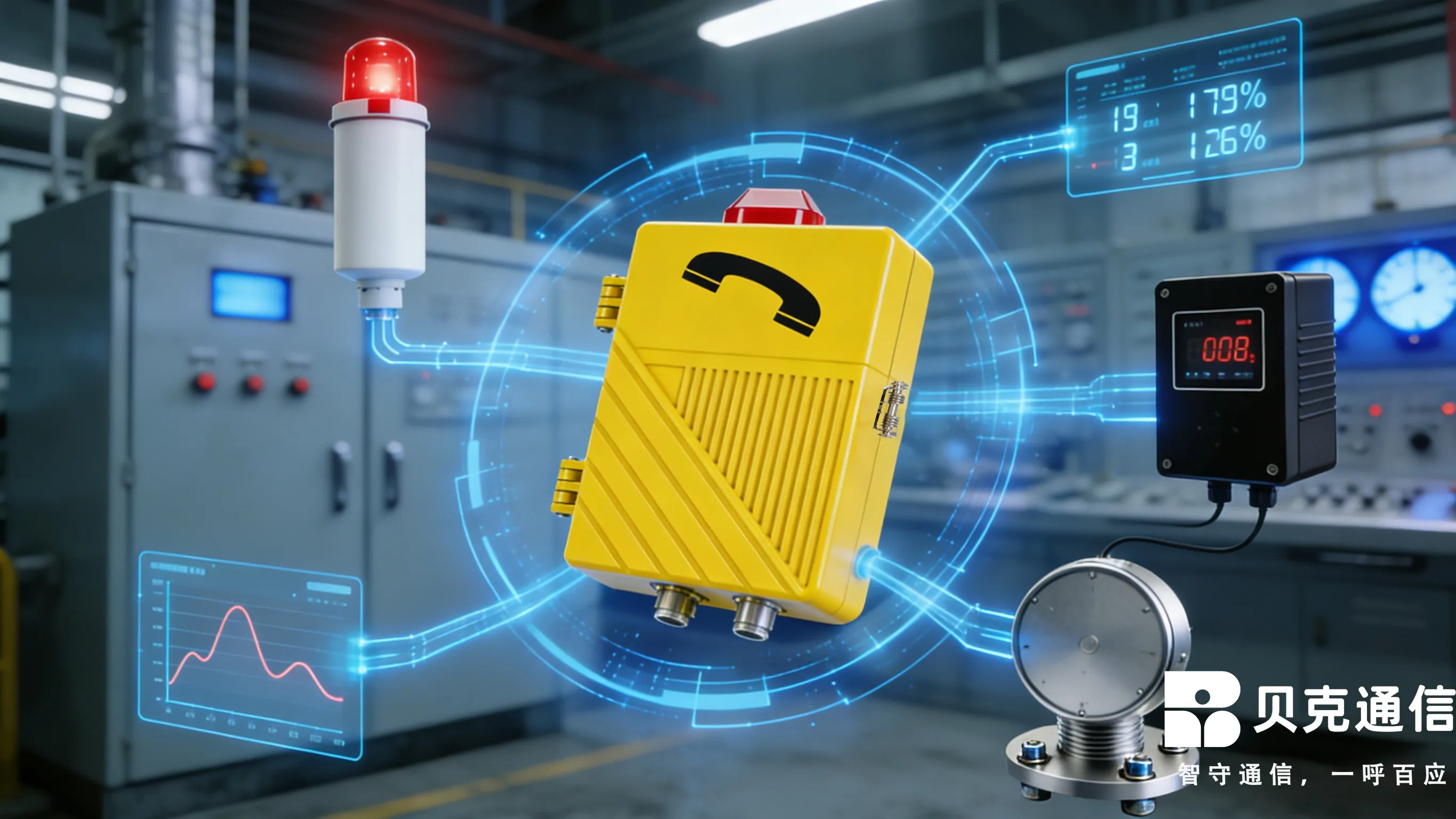
Explosion-proof telephones have evolved far beyond their original role as simple voice communication tools. In modern high-risk industrial environments, they have become intelligent safety hubs that integrate environmental monitoring, early hazard warning, emergency response, and coordinated command functions. In flammable and explosive locations such as petrochemical plants and underground coal mines, explosion-proof telephones now play a critical role in preventing accidents, protecting personnel, and ensuring stable production operations.
Driven by the rapid advancement of Industry 4.0, industrial digitalization, and intelligent transformation, explosion-proof telephones are increasingly equipped with multi-parameter sensor networks, AI-based data analysis, and high-precision positioning technologies. These capabilities enable real-time monitoring of combustible gas concentrations, temperature and humidity, dust levels, and electrostatic conditions, allowing risks to be detected early and addressed proactively rather than reactively.
By shifting from passive communication devices to active safety management platforms, explosion-proof telephones are redefining their value boundaries in industrial safety systems.
1. Technical Principles and Implementation of Environmental Monitoring Functions
The environmental monitoring capabilities of explosion-proof telephones are built on a combination of intrinsically safe circuit design and multi-sensor integration technology. Through strict energy limitation and specialized sealing processes, these devices ensure safe operation in explosive atmospheres while continuously monitoring environmental parameters in real time.
From a standards perspective, explosion-proof telephones comply with GB 3836.4-2021, Explosive Atmospheres – Part 4: Equipment Protection by Intrinsic Safety “i”. This standard strictly limits voltage, current, and stored electrical energy within safe thresholds. For example, the minimum ignition energy of methane is approximately 0.2 mJ. Explosion-proof telephone circuits are designed so that even under fault conditions, the energy released remains below this threshold, effectively eliminating ignition risks caused by electrical sparks.
Three-Layer Sensor Protection Architecture
Modern explosion-proof telephones typically adopt a three-layer protection system for sensor integration:
Intrinsically Safe Sensors
Low-power, high-precision components such as electrochemical gas sensors, MEMS temperature and humidity sensors, and dust concentration sensors are selected to minimize energy consumption while maintaining accuracy.
Safety Barriers Between Sensors and Control Circuits
Intrinsic safety barriers limit current, voltage, and transient energy during signal transmission, ensuring that energy levels remain within safe limits at all times.
Epoxy Resin Sealing and High Ingress Protection
Sensors are encapsulated with epoxy resin to prevent explosive gases from entering internal circuits, while enhancing ingress protection ratings—typically IP67 or IP68.
This architecture enables explosion-proof telephones to operate reliably in extreme conditions ranging from –45°C to +60°C, relative humidity up to 95%, and environments with high dust concentrations.
2. Data Acquisition, AI Processing, and Cloud Collaboration
Modern explosion-proof telephones employ a “local preprocessing + cloud analysis” architecture. Embedded AI edge computing chips perform preliminary analysis on sensor data, identify abnormal trends, and trigger local alarms in real time. At the same time, data is transmitted via 5G/4G private networks or industrial fieldbuses to centralized platforms for deeper analysis.
For example, intelligent explosion-proof terminals equipped with AI algorithms can analyze multi-parameter trends to predict equipment failure risks up to 48 hours in advance, significantly improving preventive maintenance effectiveness. This hybrid architecture ensures fast response times while reducing data transmission risks and enabling intelligent management of massive datasets.
3. Safety Warning Mechanisms and Technical Characteristics
The safety warning mechanisms of explosion-proof telephones are designed around multi-parameter, multi-level monitoring and intelligent analysis. Based on GB 3836 standards and industry safety regulations, dynamic and adjustable safety thresholds are configured for different hazards.
Typical warning thresholds include:
When monitored parameters exceed preset thresholds, the system immediately initiates a warning sequence that includes local audible and visual alarms, data uploads, and emergency linkage actions.
Three-Stage Warning Workflow
Real-Time Data Collection
Sensors continuously monitor combustible gases (methane, CO, H₂S), temperature, humidity, and dust levels.
AI-Based Data Analysis
Intelligent algorithms correlate multiple parameters to detect abnormal patterns and predict potential hazards.
Alarm Triggering and System Linkage
Using standardized protocols such as SIP, Modbus, and CAN bus, explosion-proof telephones automatically link with fire suppression systems, ventilation equipment, and emergency command platforms.
In terms of response speed, these systems can complete the entire process—from data acquisition to alarm activation—in as little as 0.3 seconds, far outperforming traditional manual inspections.
4. Application Value in Underground Coal Mine Environments
Underground coal mines represent a typical Class I explosive environment, where methane gas and coal dust are continuously present. Methane concentrations between 5% and 16% can form explosive mixtures, while accumulated coal dust can also explode when ignited.
Traditional communication devices may generate electrical sparks of 0.5 mJ, far exceeding the methane ignition threshold. Explosion-proof telephones eliminate this risk through intrinsic safety design and MA coal safety certification, limiting circuit energy to below 0.2 mJ and using intrinsically safe batteries with triple protection against overcharge, over-discharge, and short circuits.
Practical Monitoring Functions Underground
Methane concentration monitoring with instant alarms
Temperature and humidity monitoring to prevent equipment overheating or moisture-related failures
Coal dust concentration monitoring to reduce explosion risks
Field data shows that deployment of explosion-proof telephones in coal mines can increase inspection efficiency by 200% and reduce accident rates to 0.03 incidents per million working hours. Integrated BeiDou/GPS dual-mode positioning enables centimeter-level personnel tracking, reducing emergency response time by up to 70% during collapse or gas incidents.
5. Application Value in Petrochemical Environments
Petrochemical facilities are characterized by the presence of flammable gases (methane, hydrogen), vapors, and dust. Statistics indicate that approximately 70% of petrochemical accidents are related to gas leaks or electrostatic ignition.
Explosion-proof telephones provide comprehensive monitoring through:
Combustible gas detection using electrochemical or catalytic sensors
Temperature and humidity monitoring in tank farms and reactors
Electrostatic charge monitoring to prevent spark ignition
Personnel positioning and trajectory tracking
When gas concentrations exceed 10 ppm, systems can automatically close valves or activate ventilation, while transmitting location data to control centers. Case studies show that such deployments have successfully prevented multiple potential leakage incidents and reduced emergency handling time by several hours.
6. Standardization, Compliance, and Economic Value
Explosion-proof telephones must comply with GB 3836 series standards and international certifications such as ATEX and IECEx. The introduction of Equipment Protection Levels (EPL)—Ga, Gb, and Gc—allows devices to be precisely matched to Zone 0, Zone 1, and Zone 2 environments.
From a compliance perspective, the use of certified explosion-proof telephones helps enterprises avoid penalties of up to RMB 200,000, production shutdowns, and legal liabilities. Economically, proactive monitoring and rapid response significantly reduce accident-related losses and downtime.
In real-world applications, enterprises have reported:
30% reduction in annual accident rates
87% reduction in incidents caused by communication failures
Significant improvements in maintenance efficiency and production continuity
7. Future Development Trends
The environmental monitoring functions of explosion-proof telephones are evolving toward:
Deeper integration of AI and edge computing
Multi-parameter sensor fusion, including thermal imaging and advanced dust detection
High-precision positioning, combining BeiDou/GPS with UWB for indoor localization
Modular design and remote maintenance, enabling predictive maintenance with accuracy rates exceeding 90%
These advancements will further transform explosion-proof telephones into centralized intelligent safety platforms, supporting both safety management and digital transformation.
Conclusion
Explosion-proof telephones have become indispensable components of modern industrial safety systems. By integrating intrinsic safety design, multi-parameter environmental monitoring, AI-driven analysis, and system-level linkage, they significantly enhance risk detection, emergency response speed, evacuation efficiency, and rescue success rates.
As Industry 4.0 and intelligent manufacturing continue to advance, explosion-proof telephones will play an increasingly critical role in building safer, smarter, and more resilient industrial operations.

 English
 Deutsch
 한국어
한국어 Русский
 Français
 日本語
日本語 لالعربية
 हिन्दी
 Español
 Português
 繁体中文
繁体中文 简体中文
简体中文