Leading industrial special communication provider with rich global cases. Our explosion-proof & SIP dispatch systems power projects—your reliable partner with proven success.
Leading industrial special communication provider with rich global cases. Our explosion-proof & SIP dispatch systems power projects—your reliable partner with proven success.
What Is a Cleanroom Telephone? SIP Communication for Controlled Area
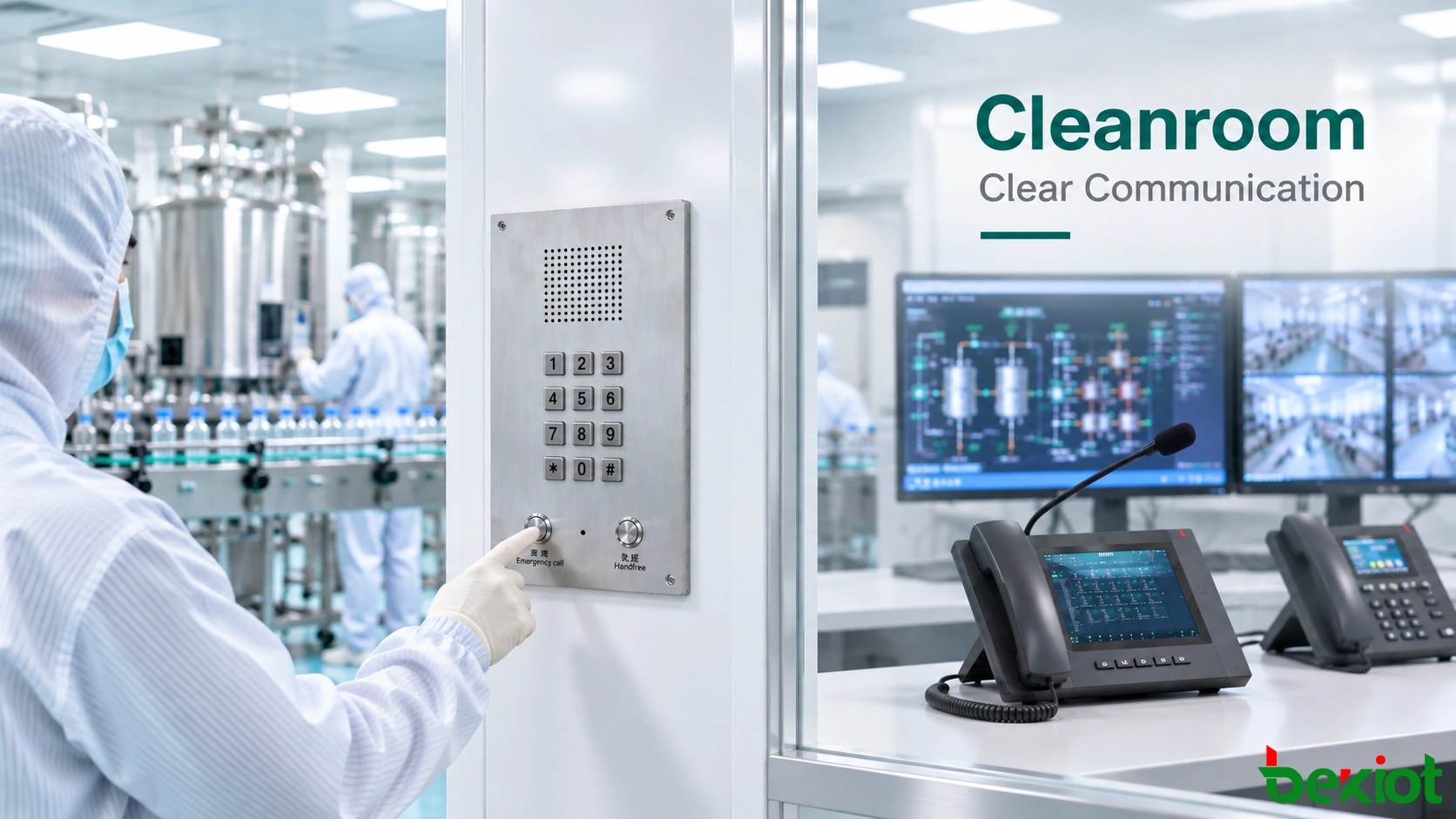
A cleanroom telephone provides fixed voice communication across controlled production boundaries, connecting pharmaceutical, semiconductor and laboratory areas with control rooms, supervisors and maintenance teams through SIP-based plant communication systems.
Becke Telcom
A cleanroom telephone is a fixed voice communication terminal used inside cleanrooms and other controlled production areas. It provides a defined voice path between personnel working inside the controlled space and the control rooms, supervisors, maintenance teams or technical positions responsible for supporting that operation.
Unlike a telephone assigned primarily to an individual employee, a cleanroom telephone is normally associated with a location and operational function. A terminal installed in a filling room, laboratory, clean corridor or another process area remains available even when personnel and shifts change.
In an IP-based plant, the telephone can also operate as a SIP endpoint. The local terminal provides the voice interface at the point of work, while the plant network and communication platform connect that location with authorized positions elsewhere in the facility. This makes the cleanroom telephone part of the production communication infrastructure rather than an isolated device used only for occasional calls.
Communication Across Controlled Areas
Clean production areas are physically separated from many of the people and resources needed to support daily operations. Production control may be located outside the clean zone, maintenance personnel may support several process areas, and supervisors may coordinate multiple rooms from a central position.
The production process, however, continues to depend on communication between these locations.
A formulation room may need confirmation from production control before material moves to the next stage. Personnel in a filling area may need to report a machine condition. Laboratory staff may need to provide a result before another process continues.
Typical communication relationships include:
Formulation Room ↔ Production Control;
Filling Area ↔ Control Room;
Laboratory ↔ Production Supervisor;
Clean Process Area ↔ Maintenance;
Controlled Room ↔ Duty Position.
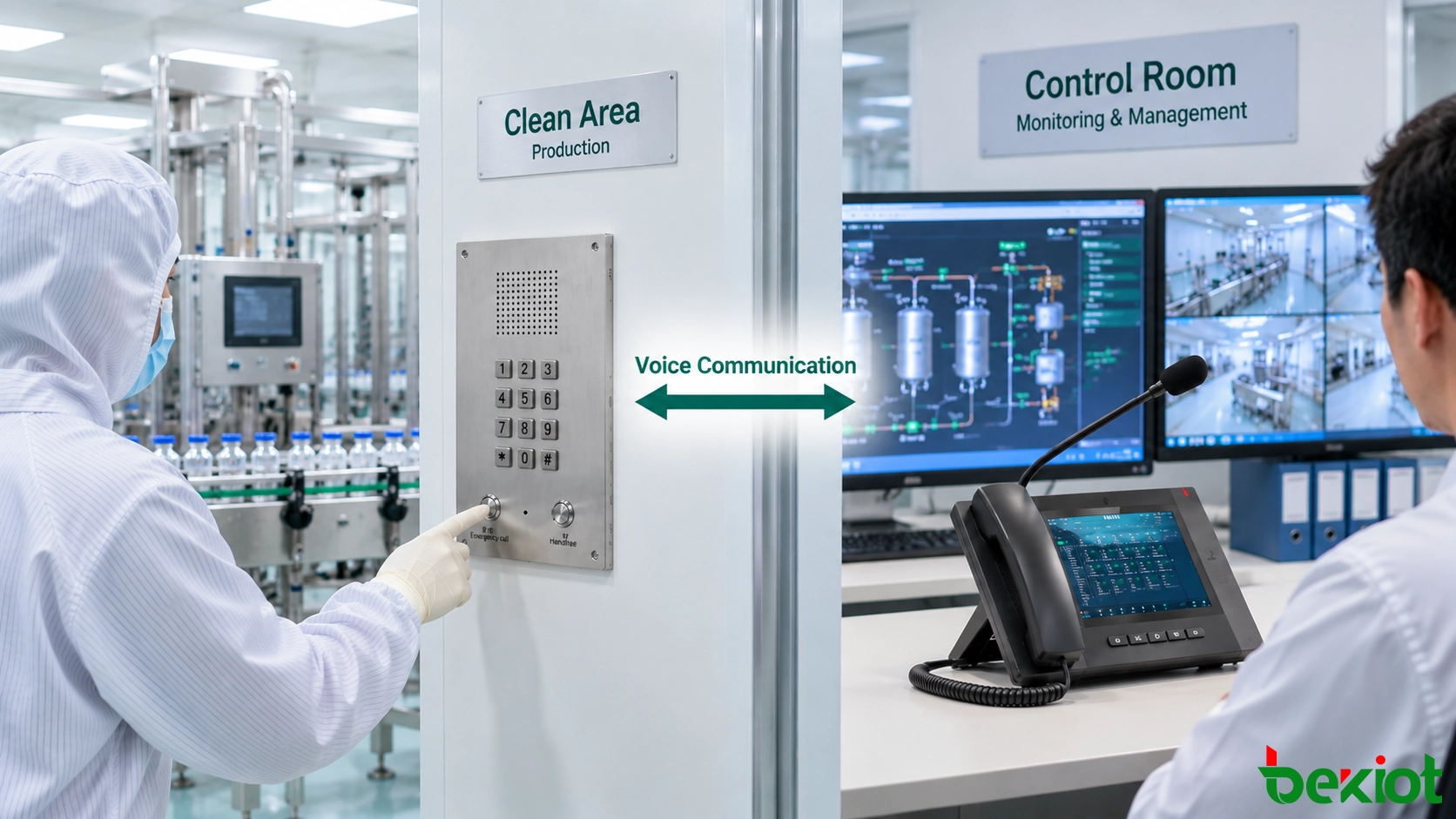
A cleanroom telephone provides a fixed two-way voice path between personnel inside the controlled area and the control room, supervision or technical support positions outside it.
A cleanroom telephone establishes a known voice location across this physical boundary. Personnel inside the room know where communication is available, while operators outside the area can reach the room without first identifying which individual employee is currently working there.
This becomes particularly useful in multi-shift production. Employees change, but the communication relationship between a filling room and the control room, for example, remains.
Communication is also bidirectional. A production operator may call the control room to report a condition, while the control room may call the clean area to confirm whether a process step has been completed, request a status update or provide an operating instruction.
The telephone therefore gives the location a consistent communication identity rather than functioning simply as another personal telephone extension.
How the Telephone Is Used
At the user level, a cleanroom telephone needs to make routine voice communication straightforward. Personnel should be able to initiate or receive the calls required by their work without depending on an office telephone outside the controlled area.
A fixed hands-free terminal can integrate the microphone, loudspeaker and operating controls into one local interface. The controls themselves should reflect how communication is actually handled at that location.
Where personnel regularly need to contact several internal positions, a numeric keypad can provide access to authorized extensions. A production operator might call production control for process coordination, maintenance for equipment support or another internal position for routine communication.
Where the communication path is more predictable, predefined call keys can provide direct access to frequently used destinations. Depending on the terminal and project requirements, flexible dialing and dedicated keys can also be used together.
Hands-free voice operation allows personnel to communicate through the integrated microphone and loudspeaker without relying on a conventional handset. The telephone remains installed at its assigned location while different personnel use it as required.
Incoming communication is equally important. If production control needs an update from a particular clean area, the operator can call the telephone associated with that room. Personnel currently working there can answer from the same local terminal.
The appropriate interface therefore depends on the operating workflow. A laboratory that regularly communicates with several departments may require a different calling arrangement from a process room that primarily communicates with one central operating position.
The objective is not to reproduce every feature of an office telephone inside a cleanroom. It is to provide the voice functions required at that specific point in the production process.
Routine Calls and Technical Support
Cleanroom telephones are sometimes associated primarily with emergency communication, but much of their actual use can involve normal production and technical coordination.
During production coordination, personnel may need to confirm material status, process timing, work instructions or the readiness of an upstream or downstream operation.
A filling operation, for example, may depend on completion of an earlier process. Personnel inside the filling area can contact production control to confirm whether the required conditions have been met before proceeding.
During laboratory coordination, staff may need to communicate sample status, request additional process information or provide a result that affects the next production stage.
During equipment support, an operator may need to describe an alarm, unexpected stop or abnormal equipment condition to the control room or technical team.
This demonstrates why voice communication remains useful even when equipment monitoring systems are already installed.
A machine interface can report a fault code. An alarm system can indicate that a condition has occurred. The person standing near the equipment can add information that those signals may not contain: what happened immediately before the fault, what is physically visible and whether another part of the process appears to be affected.
A typical communication path may be:
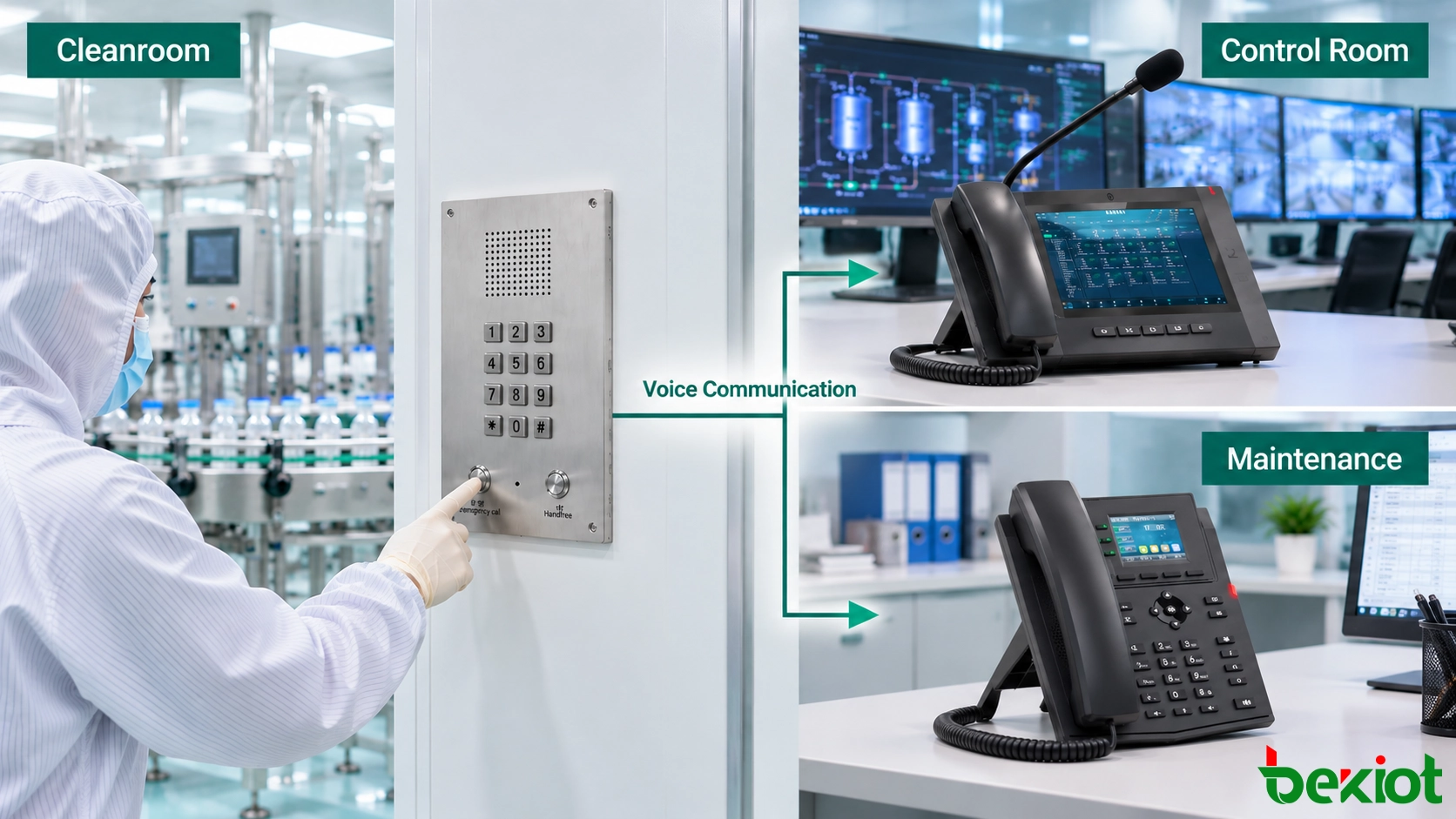
Cleanroom Operator → Control Room → Maintenance
The initial conversation allows the control room to establish the affected location and understand the basic condition. Technical personnel can then request specific observations from the operator before deciding what action is required.
The telephone does not replace equipment monitoring, alarms or maintenance systems. It provides the human voice layer needed to interpret technical information in its operating context.
A sensor reports a condition; voice communication allows personnel to establish what that condition means for the production process.
Communication During Abnormal Conditions
When an abnormal condition begins to affect production, communication changes from routine coordination to situation confirmation and response.
The first objective is not necessarily to contact every department. It is to establish reliable information from the affected location.
The initial report may need to identify:
The room or process area affected;
The equipment or operation involved;
What personnel observed;
Whether the process has stopped;
Whether another production area may be affected;
What type of support appears to be required.
Once the receiving position understands the situation, communication can progress through the site's operating procedure:
Report → Confirm → Coordinate → Respond → Update
Personnel in the affected clean area can report the condition to the control room, where information is confirmed before maintenance, supervision or another responsible position is contacted.
The return path is important. Personnel inside the affected area may need to know whether production should remain stopped, whether another check is required or what action has been authorized.
This creates an ongoing voice relationship between the location where the condition is observed and the positions responsible for managing it.
Not every abnormal condition is a site-wide emergency. An equipment problem may remain a maintenance issue, while a process deviation may require production supervision. More serious incidents may activate separate alarm, paging, emergency-notification or incident-response procedures.
The cleanroom telephone should therefore be viewed as a direct two-way voice channel at the affected location, not as a replacement for the wider emergency communication system.
Communication Between Process Areas
Controlled production rooms rarely operate as completely independent spaces. The output, status or readiness of one area may determine what can happen in another.
A formulation process may prepare material required by a filling line. Laboratory confirmation may be needed before production continues. Packaging may depend on the release status of an upstream process, while maintenance activity in one area may temporarily affect connected operations.
Communication between these locations is therefore driven by process dependency as much as by organizational structure.
Consider a delay in formulation. The issue may not remain within the formulation room. Filling personnel may need to postpone preparation, production control may need to adjust the sequence, and a supervisor may need an updated status.
A laboratory result can create a similar dependency. If production cannot continue until a result is confirmed, the communication path between the laboratory and production control becomes part of the operating workflow.
Typical information paths may include:
Formulation → Production Control → Filling
Laboratory → Production Control → Production Area
Maintenance → Control Room → Affected Process Area
A fixed cleanroom telephone does not need to connect every process area directly with every other area. It provides a known local voice terminal that participates in the communication structure defined for the facility.
In many plants, production control or the control room acts as the coordination position. Information from one controlled area can be confirmed there and then communicated to the people responsible for the next process decision.
Fixed and mobile communication can also complement one another. A cleanroom telephone remains associated with a production location, while a mobile radio or other portable terminal can follow maintenance or supervisory personnel moving between areas.
Role in the SIP Communication Architecture
In an IP-based plant, the cleanroom telephone can be integrated into the wider SIP communication environment instead of operating on a dedicated point-to-point circuit.
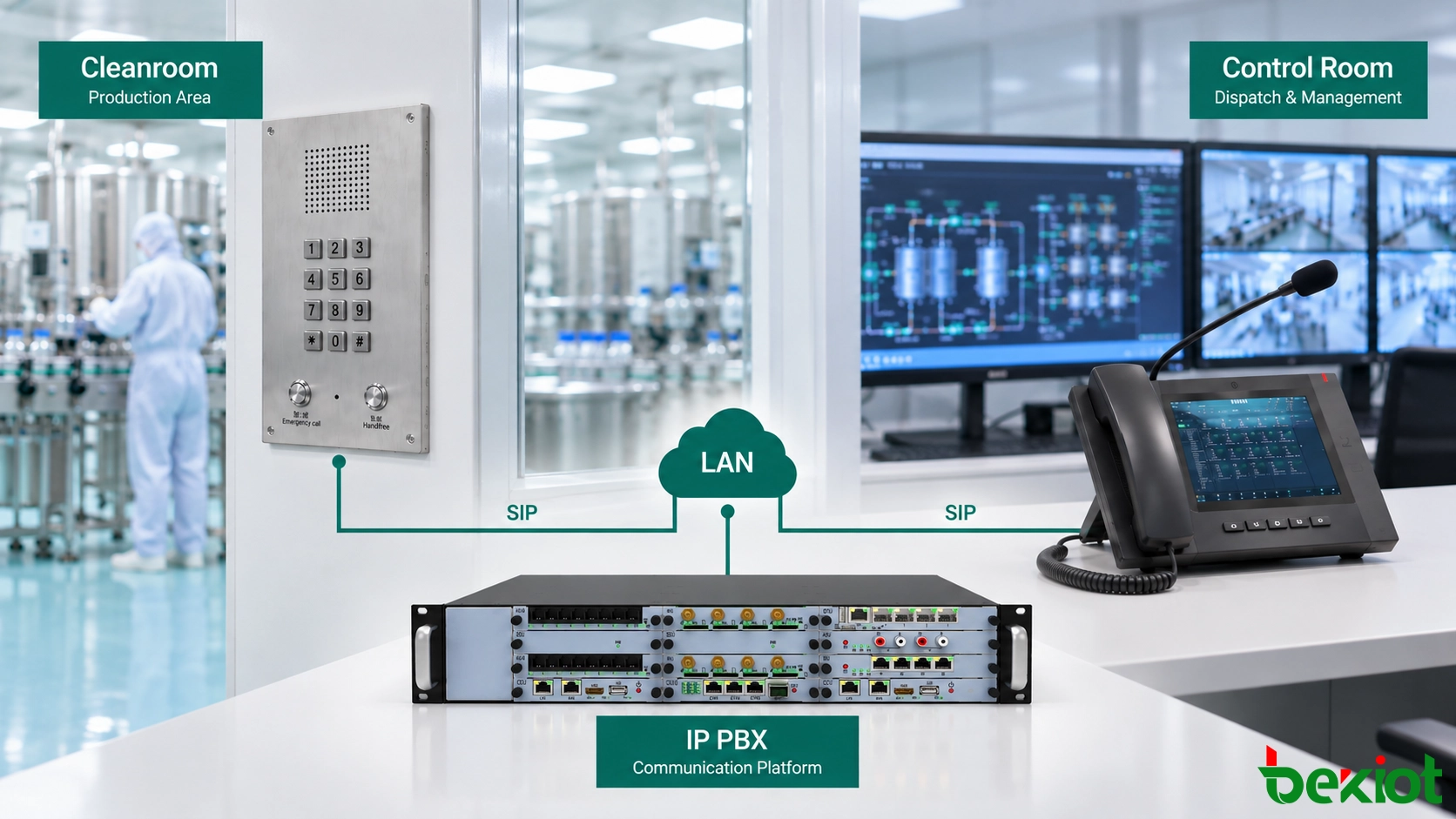
Each part of this architecture performs a distinct function. The field telephone provides the local user interface, the network transports communication traffic, the IP PBX handles call control, and the receiving terminal provides the voice position for personnel outside the clean area.
This separation allows each location to use equipment appropriate to its operating role.
Inside the controlled area, the Becke Telcom BT26 Cleanroom IP Handsfree Telephone can serve as the local SIP voice terminal. Its role is to provide the cleanroom-side communication interface for personnel working at that location.
At the communication core, the BU2000 IP PBX Server can provide the SIP call-control layer between authorized endpoints according to the project configuration.
In the control room, a GP320i dispatch telephone can provide the operator-side voice position for receiving calls from controlled areas and initiating calls back to selected locations.
The relationship can be represented as:
BT26 → IP Network → BU2000 IP PBX → GP320i
The BT26 provides the cleanroom-side voice interface, the BU2000 provides the SIP call-control layer, and the GP320i provides the control-room communication position.
Each product has a defined role:
BT26: cleanroom-side voice interface;
BU2000: SIP call-control layer between authorized endpoints;
GP320i: control-room voice and dispatch position.
A maintenance or engineering office can use another compatible SIP telephone where required. The physical terminals do not need to be identical because they serve different operating environments.
This is one of the practical characteristics of a SIP-based plant communication architecture. Specialized field equipment can retain its own form and operating role while communicating with control-room and office endpoints through a common voice system.
The cleanroom does not need an office telephone, and the control room does not need a cleanroom terminal. The communication platform provides the relationship between devices designed for different roles.
Applications in Controlled Production
Cleanroom telephones can serve different communication relationships depending on the production environment.
In pharmaceutical manufacturing, a fixed terminal may connect formulation, filling or other controlled process rooms with production control, supervision and technical support. Communication can involve process readiness, batch coordination or equipment conditions. Site-specific GMP, material and cleaning requirements should be evaluated separately from the telephone's communication role.
In semiconductor and precision electronics manufacturing, large clean production floors may contain several process zones. Fixed voice terminals allow individual locations to remain reachable from central operations even when personnel and shifts change.
In laboratories, personnel inside the controlled room may need a direct voice path to colleagues outside for sample coordination, technical support, process information or other routine communication.
Similar requirements can occur in medical production, research and other controlled manufacturing environments, although environmental and regulatory requirements can differ substantially between sites.
A product described as a cleanroom telephone should therefore not automatically be assumed to satisfy a specific cleanroom classification, GMP requirement, chemical-cleaning requirement or other site standard without supporting technical documentation.
From a communication perspective, the requirement is more consistent: personnel inside the controlled area need an identifiable two-way voice path to the people responsible for supporting the work outside it.
A cleanroom telephone provides that path at the point of work. The people using it may change, the reason for calling may change and the destination may change, but the local voice terminal remains associated with the controlled area where production is taking place.
Becke Telcom specializes in industrial explosion-proof comms for rail, tunnel, oil & gas, and marine sectors, offering PAGA, SOS, and IP telephones with integrated PA, intercom, and calling.
If you have any suggestions or questions for us, please feel free to contact us!
We use cookie to improve your online experience. By continuing to browse this website, you agree to our use of cookie.
Cookies
Please read our Terms and Conditions and this Policy before accessing or using our Services. If you cannot agree with this Policy or the Terms and Conditions, please do not access or use our Services. If you are located in a jurisdiction outside the European Economic Area, by using our Services, you accept the Terms and Conditions and accept our privacy practices described in this Policy. We may modify this Policy at any time, without prior notice, and changes may apply to any Personal Information we already hold about you, as well as any new Personal Information collected after the Policy is modified. If we make changes, we will notify you by revising the date at the top of this Policy. We will provide you with advanced notice if we make any material changes to how we collect, use or disclose your Personal Information that impact your rights under this Policy. If you are located in a jurisdiction other than the European Economic Area, the United Kingdom or Switzerland (collectively “European Countries”), your continued access or use of our Services after receiving the notice of changes, constitutes your acknowledgement that you accept the updated Policy. In addition, we may provide you with real time disclosures or additional information about the Personal Information handling practices of specific parts of our Services. Such notices may supplement this Policy or provide you with additional choices about how we process your Personal Information.
Cookies
Cookies are small text files stored on your device when you access most Websites on the internet or open certain emails. Among other things, Cookies allow a Website to recognize your device and remember if you've been to the Website before. Examples of information collected by Cookies include your browser type and the address of the Website from which you arrived at our Website as well as IP address and clickstream behavior (that is the pages you view and the links you click).We use the term cookie to refer to Cookies and technologies that perform a similar function to Cookies (e.g., tags, pixels, web beacons, etc.). Cookies can be read by the originating Website on each subsequent visit and by any other Website that recognizes the cookie. The Website uses Cookies in order to make the Website easier to use, to support a better user experience, including the provision of information and functionality to you, as well as to provide us with information about how the Website is used so that we can make sure it is as up to date, relevant, and error free as we can. Cookies on the Website We use Cookies to personalize your experience when you visit the Site, uniquely identify your computer for security purposes, and enable us and our third-party service providers to serve ads on our behalf across the internet.
We classify Cookies in the following categories: ● Strictly Necessary Cookies ● Performance Cookies ● Functional Cookies ● Targeting Cookies
Cookie List A cookie is a small piece of data (text file) that a website – when visited by a user – asks your browser to store on your device in order to remember information about you, such as your language preference or login information. Those cookies are set by us and called first-party cookies. We also use third-party cookies – which are cookies from a domain different than the domain of the website you are visiting – for our advertising and marketing efforts. More specifically, we use cookies and other tracking technologies for the following purposes:
Strictly Necessary Cookies These cookies are necessary for the website to function and cannot be switched off in our systems. They are usually only set in response to actions made by you which amount to a request for services, such as setting your privacy preferences, logging in or filling in forms. You can set your browser to block or alert you about these cookies, but some parts of the site will not then work. These cookies do not store any personally identifiable information.
Functional Cookies These cookies enable the website to provide enhanced functionality and personalisation. They may be set by us or by third party providers whose services we have added to our pages. If you do not allow these cookies then some or all of these services may not function properly.
Performance Cookies These cookies allow us to count visits and traffic sources so we can measure and improve the performance of our site. They help us to know which pages are the most and least popular and see how visitors move around the site. All information these cookies collect is aggregated and therefore anonymous. If you do not allow these cookies we will not know when you have visited our site, and will not be able to monitor its performance.
Targeting Cookies These cookies may be set through our site by our advertising partners. They may be used by those companies to build a profile of your interests and show you relevant adverts on other sites. They do not store directly personal information, but are based on uniquely identifying your browser and internet device. If you do not allow these cookies, you will experience less targeted advertising.
How To Turn Off Cookies You can choose to restrict or block Cookies through your browser settings at any time. Please note that certain Cookies may be set as soon as you visit the Website, but you can remove them using your browser settings. However, please be aware that restricting or blocking Cookies set on the Website may impact the functionality or performance of the Website or prevent you from using certain services provided through the Website. It will also affect our ability to update the Website to cater for user preferences and improve performance. Cookies within Mobile Applications
We only use Strictly Necessary Cookies on our mobile applications. These Cookies are critical to the functionality of our applications, so if you block or delete these Cookies you may not be able to use the application. These Cookies are not shared with any other application on your mobile device. We never use the Cookies from the mobile application to store personal information about you.
If you have questions or concerns regarding any information in this Privacy Policy, please contact us by email at . You can also contact us via our customer service at our Site.

 English
 Deutsch
 한국어
 Русский
 Français
 日本語
 لالعربية
 हिन्दी
 Español
 Português
 繁体中文
 简体中文