Introduction
Modern contact centers handle a vast volume of customer inquiries daily, spanning industries from healthcare to retail, logistics to finance. In many scenarios, agents require real-time contextual data to resolve issues efficiently—especially when addressing complex concerns that demand visual verification. Imagine a customer calling to report a service disruption, a facility issue, or a safety concern: if agents can instantly access relevant video surveillance feeds when the call connects, they gain critical insights that streamline problem-solving, reduce resolution time, and enhance customer satisfaction.
Becke Telcom recognizes this critical need for interoperability between call center systems and video surveillance networks. This guide explores the technical foundations of integrating these two systems, the tangible benefits of such integration, and how Becke Telcom’s solutions—including ROIP gateway technology—enable seamless connectivity that drives operational excellence.
Understanding the Core Systems
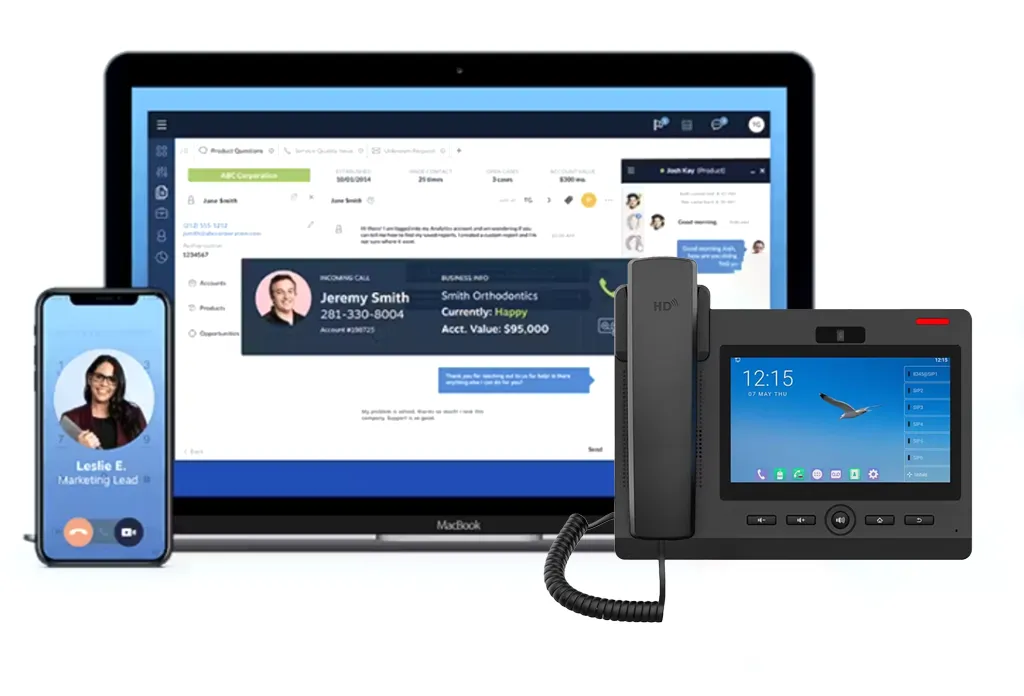
To achieve effective interoperability, it’s essential to first understand the components and functionalities of the two systems involved: call center platforms and video surveillance networks. Each operates independently by design, but their integration unlocks synergies that transform customer service and operational visibility.
Call Center System: The Backbone of Customer Communication
A call center system is a communication infrastructure built around telephone networks, designed to manage inbound and outbound customer interactions at scale. Its core components include:
- Private Branch Exchange (PBX)/ACD (Automatic Call Distributor): Routes incoming calls to the appropriate agents, manages call queues, and optimizes resource allocation.
- Interactive Voice Response (IVR): Automates initial customer interactions, allowing callers to select service categories, verify information, or access self-service options before connecting to a live agent.
- Customer Relationship Management (CRM): Stores customer data, interaction histories, and service records, providing agents with context to personalize support.
- Call Recording & Quality Monitoring: Captures calls for training, compliance, and quality assurance purposes.
- Workforce Management Tools: Includes scheduling software, performance analytics, and reporting systems to optimize agent productivity and service levels.
- Agent Terminals: Phones, headsets, and desktop applications that enable agents to communicate with customers and access backend systems.
Video Surveillance System: The Foundation of Visual Visibility
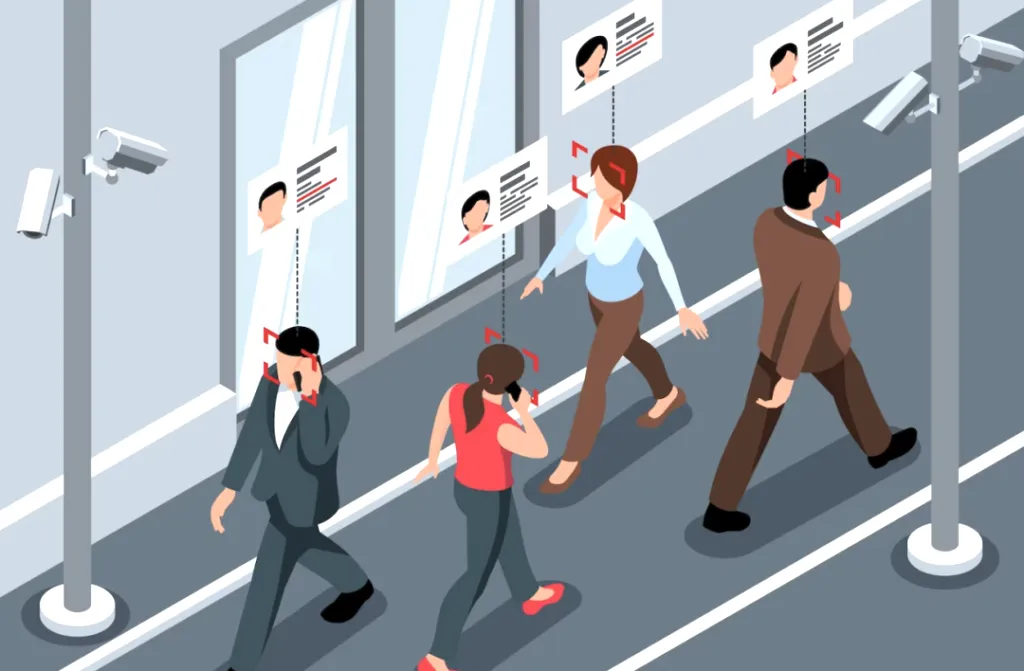
Video surveillance systems are critical for security, safety, and operational oversight across industries. Their standard components include:
- Cameras: IP-based or analog devices deployed across facilities to capture real-time video footage.
- Network Video Recorders (NVRs): Store video data securely, enabling playback and retrieval of historical footage.
- Centralized Surveillance Platform: A software interface that allows users to monitor live feeds, search recordings, and manage camera settings—typically accessed via dedicated workstations.
Historically, video surveillance systems have operated in silos, with access restricted to security teams or facility managers. Integrating them with call centers breaks down these barriers, putting visual data directly into the hands of agents who need it most.
The Business Value of Call Center-Video Surveillance Integration
The case for integrating call centers and video surveillance extends beyond technical curiosity—it delivers measurable business outcomes that impact both operational efficiency and customer experience.
Enhanced Agent Efficiency
Agents often face challenges when resolving issues without visual context. For example, a customer calling about a damaged product delivery, a facility access problem, or a service disruption may struggle to articulate details clearly. With instant access to relevant video feeds, agents can verify conditions in real time, eliminating back-and-forth questions and reducing call duration. Studies show that contextual data—including video—can reduce average handle time (AHT) by up to 30%, allowing agents to handle more calls while maintaining quality.
Improved Customer Satisfaction
Customers expect fast, effective resolutions to their concerns. When agents can quickly validate issues with video, they can provide more accurate information, set realistic expectations, and escalate problems to the right teams faster. This transparency builds trust: 78% of customers report higher satisfaction when they perceive their issue is being addressed with thorough, data-driven support.
Strengthened Security & Compliance
In industries like healthcare, finance, or retail, call center interactions often involve sensitive information or safety-related concerns. Video integration enables contact centers to maintain compliance with regulatory requirements by providing visual documentation of incidents. For example, if a customer reports a security breach at a branch location, agents can flag the issue and share video evidence with security teams immediately, accelerating response times and mitigating risks.
Data-Driven Decision Making
Integrated systems generate valuable insights by combining call data (e.g., call reason, duration, resolution) with video footage. Contact center managers can identify patterns—such as recurring facility issues that drive calls—and work with operations teams to address root causes. This proactive approach reduces future inquiries and improves overall service quality.
Technical Foundations of Interoperability
Achieving seamless communication between call center systems and video surveillance networks requires addressing technical barriers, including protocol compatibility, data access, and real-time connectivity. Becke Telcom’s solutions—built around ROIP gateway technology—overcome these challenges with a robust, scalable architecture.
Key Technical Requirements
For successful integration, the following technical capabilities are non-negotiable:
- Protocol Compatibility: Call centers typically use SIP (Session Initiation Protocol) for voice communication, while video surveillance systems rely on RTSP (Real-Time Streaming Protocol) or ONVIF for video transmission. The integration solution must bridge these protocols to enable data exchange.
- Real-Time Data Transmission: Video feeds must be accessible to agents within seconds of a call connecting to maintain relevance. Latency issues can undermine the value of integration, so the solution must prioritize low-latency streaming.
- Secure Access Control: Video footage is sensitive data, so the integration must include role-based access controls (RBAC) to ensure only authorized agents can view specific feeds. Encryption for data in transit and at rest is also critical to compliance.
- Scalability: The solution must grow with the contact center, supporting additional agents, cameras, and locations without compromising performance.
The Role of ROIP Gateway in Integration
Becke Telcom’s ROIP (Radio over IP) gateway plays a pivotal role in enabling call center-video surveillance interoperability. Unlike traditional gateways that limit connectivity, ROIP gateway acts as a universal bridge, facilitating seamless communication between the two systems while maintaining protocol integrity.
The ROIP gateway’s core functions include:
- Protocol Translation: Converts SIP-based voice signals from the call center into a format compatible with video surveillance systems (and vice versa), eliminating communication barriers.
- Centralized Management: Provides a unified interface for configuring access rules, mapping calls to specific camera feeds, and monitoring integration performance.
- Secure Data Routing: Ensures video and voice data are transmitted securely, with end-to-end encryption and compliance with industry standards like GDPR, HIPAA, and PCI DSS.
- Interoperability with Legacy Systems: Works with existing call center and video surveillance infrastructure, reducing the need for costly hardware replacements.
Becke Telcom’s Integration Solution: Technical Overview
Becke Telcom’s call center and video surveillance interoperability solution is designed to be flexible, secure, and easy to implement—regardless of the size or complexity of your existing systems.
Architecture Design
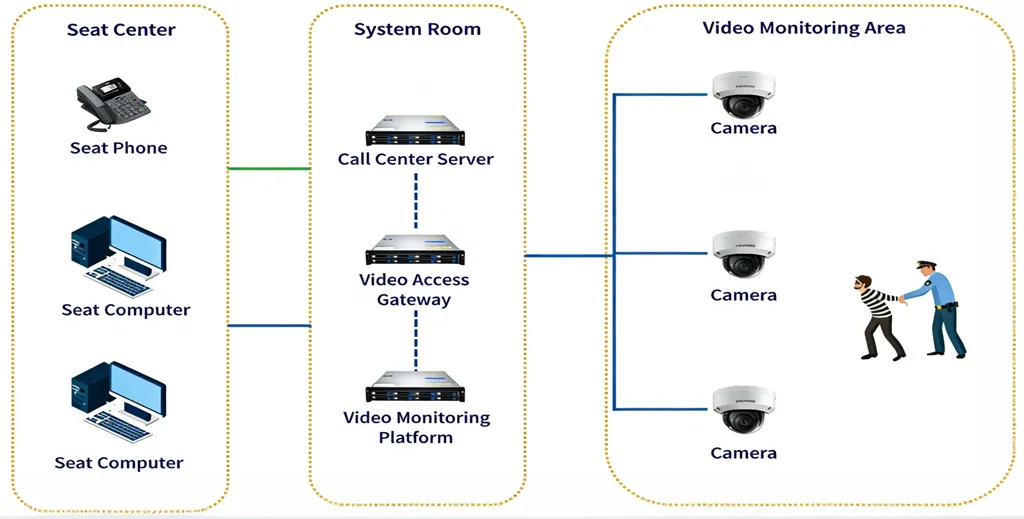
The solution follows a layered architecture to ensure reliability and scalability:
- Terminal Layer: Includes call center agent workstations, IP phones, surveillance cameras, and NVRs.
- Gateway Layer: Becke Telcom’s ROIP gateway serves as the core, handling protocol translation, data routing, and access control.
- Platform Layer: Integrates with the call center’s CRM and the surveillance system’s management platform, enabling automatic data synchronization (e.g., linking customer call data to relevant camera feeds).
Key Features of Becke Telcom’s Solution
- Automatic Video Retrieval: When a customer call connects, the system uses CRM data (e.g., customer location, service address) to pull up relevant camera feeds automatically. Agents can view live footage or access recent recordings with a single click.
- Dynamic Camera Mapping: Administrators can configure rules to map specific call types, customer segments, or locations to designated cameras. For example, a call about a retail store issue can trigger access to that store’s entrance and service desk cameras.
- Seamless CRM Integration: Customer data from the CRM is overlaid on video feeds, providing agents with context such as past interactions, service history, and issue details.
- Real-Time Alerts: If a call involves a safety concern (e.g., a facility emergency), the system can send alerts to security teams, sharing both the call audio and video footage for rapid response.
- Reporting & Analytics: Tracks metrics like video access frequency, call resolution time, and agent productivity, providing insights to optimize the integration and improve service.
Implementation Process
Becke Telcom’s implementation approach minimizes downtime and ensures a smooth transition:
- Assessment: Evaluate existing call center and video surveillance systems to identify compatibility requirements and integration points.
- Configuration: Deploy the ROIP gateway, configure protocol settings, and set up camera-call mapping rules.
- Integration: Connect the gateway to the CRM and surveillance management platform, enabling data synchronization.
- Testing: Conduct end-to-end testing to verify real-time video access, call routing, and security controls.
- Training: Provide agents and administrators with training on using the integrated system, including video retrieval and access management.
- Monitoring & Support: Offer ongoing monitoring to address performance issues and updates to adapt to evolving business needs.
Application Scenarios Across Industries
Becke Telcom’s interoperability solution delivers value across a range of industries, addressing unique use cases and challenges:
Retail
Retail contact centers often handle calls about store experiences, product availability, or security incidents. With integration, agents can pull up live feeds of specific store locations when a customer reports an issue—whether it’s a long checkout line, a damaged display, or a safety concern. This enables agents to validate the problem and coordinate with store staff for immediate resolution.
Healthcare
Healthcare call centers manage patient inquiries about appointments, facility access, and emergency situations. Integration allows agents to access video feeds of clinic lobbies, waiting areas, or emergency entrances when a patient calls, helping them direct patients to the right location or alert staff to urgent needs.
Logistics & Transportation
Logistics contact centers deal with inquiries about delivery status, warehouse operations, and transportation issues. By integrating with video surveillance systems in warehouses and distribution centers, agents can verify inventory levels, check for delivery delays, or address concerns about package handling—all while on the call with the customer.
Property Management
Property management call centers handle maintenance requests, security concerns, and tenant inquiries. Integration enables agents to pull up video feeds of building entrances, elevators, or common areas when a tenant reports an issue, allowing them to assess the situation and dispatch maintenance or security teams as needed.
Considerations for Successful Integration
While the benefits of call center-video surveillance integration are clear, successful implementation requires careful planning. Here are key factors to consider:
System Compatibility
Before deploying the solution, verify that your existing call center and video surveillance systems support the required protocols (SIP, RTSP, ONVIF). Becke Telcom’s ROIP gateway is designed to work with most leading platforms, but a pre-implementation assessment ensures compatibility.
Bandwidth & Performance
Real-time video streaming requires sufficient bandwidth to avoid latency or buffering. Work with IT teams to assess network capacity and make upgrades if necessary. Becke Telcom’s solution includes bandwidth optimization features to minimize resource usage without compromising video quality.
Security & Compliance
Ensure the integration complies with industry regulations and data privacy laws. Implement role-based access controls to restrict video access, encrypt data in transit and at rest, and maintain audit logs of video viewing activities.
User Adoption
Agents are more likely to embrace the integrated system if it’s intuitive and adds value to their workflow. Provide comprehensive training, highlight efficiency gains, and gather feedback to make adjustments as needed.
Conclusion
Call center and video surveillance interoperability is no longer a luxury—it’s a strategic necessity for businesses looking to enhance agent efficiency, improve customer satisfaction, and strengthen operational visibility. Becke Telcom’s solution, powered by ROIP gateway technology, delivers a seamless, secure, and scalable way to connect these two critical systems, unlocking contextual insights that drive better outcomes.
Whether you’re a small contact center or a large enterprise with multiple locations, Becke Telcom’s technical expertise and flexible architecture ensure a smooth implementation that aligns with your business needs. By breaking down data silos and putting real-time video at agents’ fingertips, you can transform customer service from reactive to proactive—setting your business apart in a competitive landscape.

 English
 Deutsch
 한국어
한국어 Русский
 Français
 日本語
日本語 لالعربية
 हिन्दी
 Español
 Português
 繁体中文
繁体中文 简体中文
简体中文