1. Introduction: Explosion-Proof Mining Telephones as the “Lifeline” of Underground Safety
Explosion-proof mining telephones are widely regarded as the lifeline of mine safety production. Their electromagnetic compatibility (EMC) performance and adaptability to harsh industrial environments directly determine the reliability and safety of underground communications.
In complex underground electromagnetic environments, mining telephones must simultaneously satisfy explosion-proof safety requirements and high-level anti-interference performance, posing severe challenges to product design, materials, and system architecture.
This article systematically analyzes the EMC performance and industrial adaptability of explosion-proof mining telephones from four dimensions:
electromagnetic interference source characteristics,
anti-electromagnetic interference technologies,
industrial environmental adaptability design, and
real-world application cases,
providing a practical technical reference for equipment selection and deployment in mining communication systems.
2. Electromagnetic Interference Sources and Harsh Environmental Parameters in Mining Applications
2.1 Typical Electromagnetic Interference Sources Underground
Underground mining environments are among the most complex electromagnetic interference (EMI) zones in industrial scenarios. The main interference sources originate from three directions:
1. Power-frequency interference
Equipment such as variable-frequency drives, transformers, and motors generate strong 50 Hz electromagnetic fields during operation. Field strength can reach 0.19 μT, approaching hazardous threshold levels.
2. High-frequency interference
Electric welding machines, high-frequency transmitters, and similar devices emit radio-frequency electromagnetic waves, with operating frequencies reaching hundreds of MHz, seriously affecting communication signals.
3. Pulse interference
Transient electromagnetic pulses occur during startup, shutdown, or short-circuit events of high-power equipment. These pulses cover a wide frequency range from low to high frequencies, with extremely high intensity—electric fields up to tens of kV/m and magnetic fields reaching several kA/m.
2.2 Extreme Industrial Environmental Parameters
In addition to electromagnetic interference, explosion-proof mining telephones must withstand extreme physical and chemical conditions:
Temperature: Typical underground operating range is –30 °C to +60 °C, with some deep or special mines reaching –45 °C to +85 °C.
Humidity: Relative humidity usually does not exceed 95%, but can be higher in certain zones.
Ingress protection: Devices typically require IP54 to IP67 protection against dust and water.
Vibration and shock: Vibration frequencies range from 10–500 Hz with acceleration up to 5 m/s², and impact resistance must meet 7 J shock tests.
Corrosive gases: Environments may contain H₂S, Cl₂, SO₂, accelerating material corrosion.
2.3 Differences Across Industrial Scenarios
Electromagnetic interference characteristics vary significantly by industry:
Coal mines: Broad-spectrum interference below 200 MHz, often peaking around 1 MHz due to variable-frequency drives.
Chemical plants: Dominated by radio-frequency and inductive interference from arc discharges and welding equipment.
Steel plants: Strong EMI from electric arc furnaces, with energy concentrated near 20 MHz.
Ports: Harmonic conduction interference caused by non-linear rectifiers in motor drive systems.
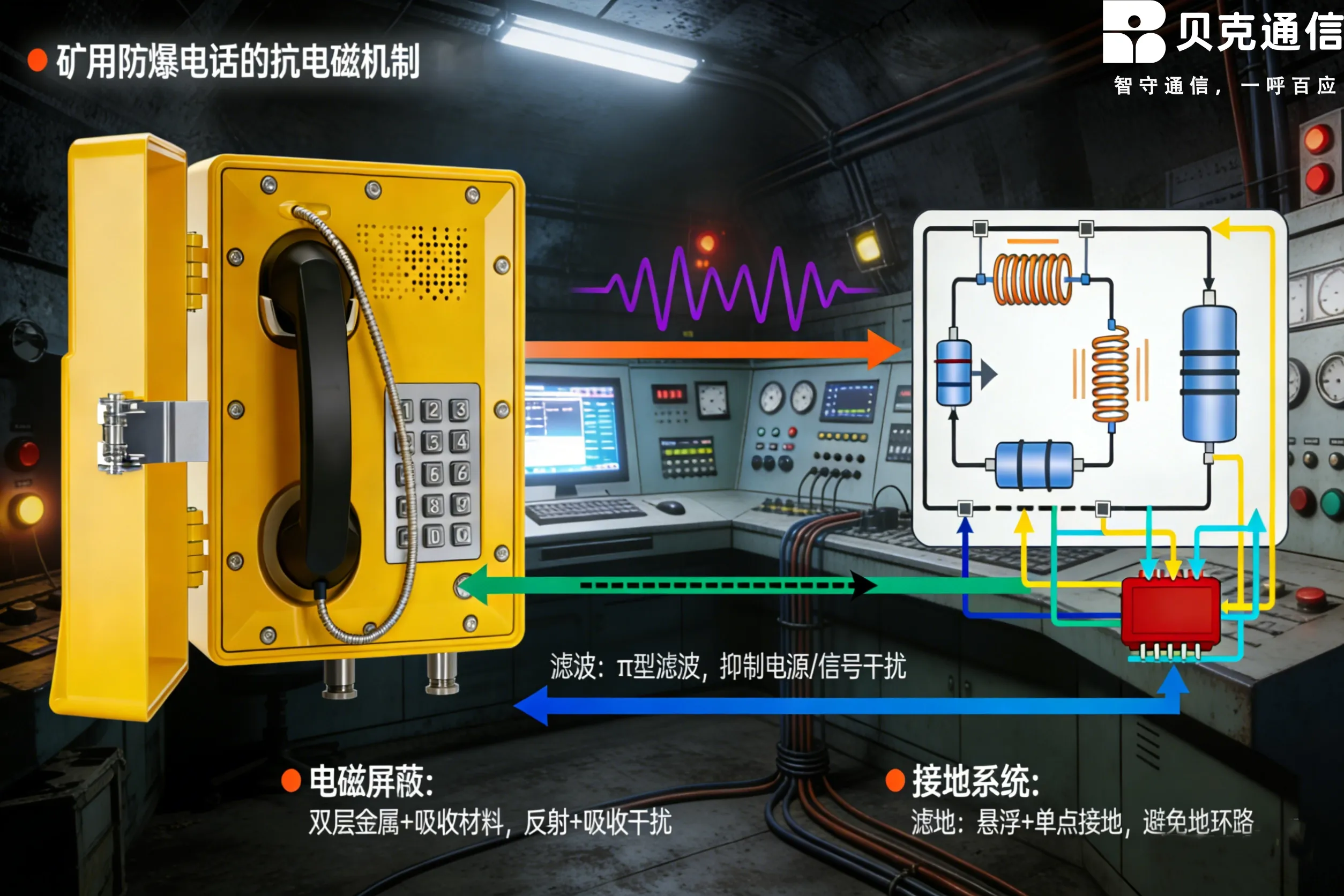
3. Anti-Electromagnetic Interference Technologies in Explosion-Proof Mining Telephones
Explosion-proof mining telephones rely on three core technical pillars: circuit design, shielding technology, and anti-interference algorithms.
3.1 Intrinsically Safe Circuit Design
Intrinsic safety prevents ignition by ensuring circuit energy remains below the minimum ignition energy of combustible gases:
Voltage and current limitation: Spark energy is kept below 0.28 mJ, the minimum ignition energy of methane.
Thermal control: Component temperature rise is strictly limited to remain within Class I temperature group standards.
Component selection: Resistors, capacitors, and tolerances must comply with explosion-proof specifications.
PCB layout optimization: Signal lines are separated to avoid parasitic oscillation; intrinsically safe and non-safe circuits are physically isolated.
Safety margin correction: A typical safety factor of 1.5 is applied to ensure fault-condition safety.
3.2 Multi-Layer Electromagnetic Shielding Technology
Explosion-proof telephones employ advanced multi-layer shielding structures:
Housing: Flameproof enclosures made of 38 mm thick aluminum alloy, certified to IP66/IP67, offering excellent sealing and impact resistance.
Internal shielding layers:
Suppression layer (nano-silver coatings or gradient porous metal foam) for near-field electric field suppression
Absorption layer for high-frequency attenuation
Reflection layer for low-frequency electromagnetic waves
This three-layer structure overcomes limitations of single-layer shielding, thermal accumulation, and narrow frequency coverage.
Cable entries use ≤8 mm diameter two-core cables with ≥0.5 mm² conductors and 1/2″ G sealing glands to ensure shielding continuity.
3.3 Digital Anti-Interference Algorithms
Advanced signal processing enhances communication clarity:
Adaptive Noise Cancellation (ANC): Ensures clear communication even at 120 dB noise levels.
Forward Error Correction (FEC): Detects and corrects transmission errors caused by noise and interference.
Voice compression codecs: Support G.711, G.722, G.729, reducing bandwidth and improving robustness.
Automatic Gain Control (AGC) and Voice Activity Detection (VAD): Dynamically adjust volume and suppress background noise.
4. Industrial Environmental Adaptability Design
4.1 Explosion-Proof Structure Design
Two primary protection types are used:
Flameproof (Ex d):
Withstands internal explosions without flame propagation
Impact resistance ≥ 7 J
Joint clearances and flamepath dimensions strictly comply with standards
Pressure tests up to 0.85 MPa
Non-propagation tests using C₂H₂ (7.5%) and H₂ (27.5%)
Intrinsically Safe (Ex i):
All circuits remain below ignition energy
Electrical isolation using safety barriers and transformers
Mechanical isolation with ≥6 mm spacing and grounding strategies
4.2 Ingress Protection Design
IP54: Protection against dust ingress and water splashes
IP67: Dust-tight and immersion at 1 m for 30 minutes
IP68 (high-end models): 1.5 m immersion for 30 minutes
Achieved through rubber seals, epoxy potting, and precision enclosure design.
4.3 Material Selection
Enclosures: Cast aluminum, stainless steel (e.g., 316L), or reinforced composites with epoxy powder coating
Keypads: Stainless steel
Handsets: Outdoor public telephone grade
Cables: Metal-sheathed handset cords
Plastics: Flame-retardant, anti-static polymers meeting UL94 V-0
Materials are tested for thermal aging, corrosion resistance, and long-term stability.
5. Application Cases and Performance Evaluation
5.1 Coal Mine in Datong, Shanxi
The KTH106-1Z intrinsically safe telephone operated reliably amid strong VFD interference.
Communication distance: 10 km
Ringing level: ≥80 dB
Zero safety incidents over two years
Successfully supported methane monitoring and emergency evacuation
5.2 Yulin Coal Mine, Shaanxi
The KE-FS-EX explosion-proof telephone operated for 12 months at 95% humidity without failure.
Maintenance cost reduced by 65%
Clear communication at 120 dB noise
EMC Level 4 compliance ensured distortion-free audio
5.3 Chemical Plant in Shandong
An Ex d ib II B T6 telephone with IP67 protection resisted H₂S, Cl₂, and SO₂ corrosion.
5.4 Open-Pit Mine in Inner Mongolia
Integrated Beidou + GPS + UWB positioning achieved centimeter-level accuracy.
Operating range: –40 °C to +85 °C
Real-time tracking of over 200 workers
Successfully prevented accidents through early warnings
5.5 Reliability Metrics
MTBF: > 100,000 hours
Startup time at –45 °C: ≤30 seconds
Continuous operation at +60 °C: 24 hours without degradation
Passed IP67 long-term humidity tests
6. Future Development Trends
Key trends include:
Multi-technology EMI suppression combining DSP and AI-based adaptive noise learning
Advanced materials such as nano-reinforced polymers and self-healing coatings
Intelligent integration of gas sensors, video, IoT diagnostics, and remote maintenance
Stricter standards, including EMC testing beyond 1 GHz, wider temperature ranges (–50 °C to +100 °C), and enhanced IP68 requirements
7. Conclusion and Recommendations
Explosion-proof mining telephones play a critical role in underground safety communication. Through intrinsically safe circuit design, multi-layer shielding, and advanced signal processing, they achieve reliable operation in severe electromagnetic environments. Robust structural design, high ingress protection, and specialized materials ensure long-term stability under extreme industrial conditions.
For practical deployment:
Select high-EMC-performance models for VFD-dense areas
Choose wide-temperature-range devices for deep or high-temperature mines
Use corrosion-resistant models in chemical environments
Regular maintenance and operator training are essential to ensure long-term safety and performance. As mining becomes increasingly intelligent, explosion-proof telephones will continue evolving toward smarter, more reliable, and more adaptable solutions—forming a solid foundation for safe, efficient, and intelligent mining operations.

 English
 Deutsch
 한국어
한국어 Русский
 Français
 日本語
日本語 لالعربية
 हिन्दी
 Español
 Português
 繁体中文
繁体中文 简体中文
简体中文