In modern communication system integration projects, two critical technologies dominate professional voice communication: public network PTT and private network PTT. While both leverage Push-to-Talk (PTT) functionality—where users press a button to speak and release to listen—their underlying infrastructures, capabilities, and ideal applications differ significantly. Understanding these differences is essential for organizations seeking to deploy reliable, efficient communication solutions tailored to their specific needs.
PTT communication operates on a half-duplex model, meaning only one user can speak at a time while others listen—a stark contrast to the full-duplex communication of traditional telephone calls. This model is ideal for dispatch, coordination, and real-time collaboration, making it a cornerstone of industries ranging from public safety to logistics. Below is a detailed analysis of public and private network PTT, their core distinctions, and how Becke Telcom’s ROIP gateway bridges these systems for unified communication.

What Is Public Network PTT (PoC)?
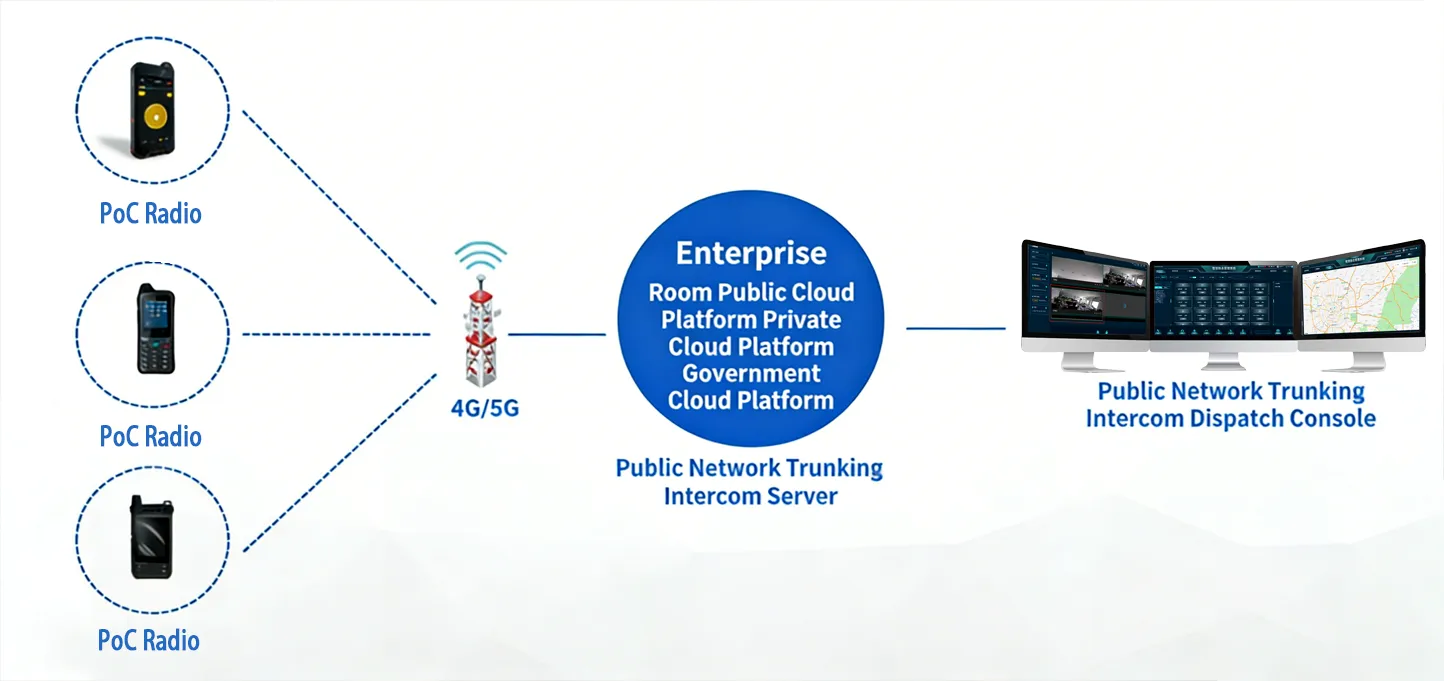
Public network PTT, also known as PoC (Push-to-Talk over Cellular), is a professional communication technology that leverages existing cellular networks (4G/5G) provided by telecom operators to deliver PTT functionality. Unlike traditional narrowband walkie-talkies, which are limited to voice-only communication, public network PTT operates on broadband mobile internet, enabling a rich suite of multimedia capabilities.
Core Technology and Networking
Public network PTT replicates traditional walkie-talkie functionality through intelligent mobile applications, typically paired with rugged smartphones designed for industrial use. The system connects to centralized servers hosted on public clouds, private clouds, or government clouds, creating a scalable communication infrastructure that transcends geographical boundaries.
The technical workflow of public network PTT involves converting voice signals into digital packets using advanced coding algorithms (such as AMBE2000 or MBE) before transmitting them over cellular networks. UDP protocols handle real-time voice data to minimize latency, while TCP protocols manage control commands for reliable operation. This architecture enables nationwide or even global communication, as the cellular network’s coverage determines the system’s reach.
Key Features and Capabilities
Beyond basic PTT voice communication, public network PTT systems support a range of multimedia and management features, including:
-
Video calls and video backhaul: Enables visual collaboration and real-time situational awareness, critical for field operations and emergency response.
-
Map positioning: Tracks user locations in real time, facilitating dispatch and resource allocation.
-
Contact management: Organizes users into workgroups for targeted communication, improving coordination efficiency.
-
SIP-based softswitch integration: Seamlessly connects with existing voice and video communication systems, supporting unified multimedia services.
These capabilities make public network PTT a versatile solution for businesses that require flexible, feature-rich communication without investing in dedicated infrastructure.
Advantages and Limitations
The primary advantage of public network PTT is its ease of deployment and low upfront cost—organizations can leverage existing cellular networks and rugged smartphones instead of building proprietary infrastructure. It also offers extensive coverage, as it relies on telecom operators’ 4G/5G networks, making it suitable for distributed teams and cross-regional communication.
However, public network PTT has inherent limitations:
-
Dependence on cellular coverage: In remote areas, underground facilities, or disaster zones where cellular signals are weak or unavailable, the system may fail.
-
Ongoing operational costs: Data plans for cellular connectivity can accumulate significant expenses for large teams.
-
Security concerns: Data transmitted over public networks may be vulnerable to interception, making it unsuitable for highly sensitive communications.
What Is Private Network PTT?
Private network PTT refers to dedicated digital trunking communication systems built and operated exclusively by an organization for its own use. These systems address the limitations of public network PTT by providing independent, secure, and reliable communication tailored to high-demand scenarios.
Core Technology and Networking
Private network PTT systems operate on dedicated frequency bands, requiring organizations to deploy their own infrastructure—including base stations, repeaters, and dispatch centers. This dedicated setup ensures complete control over communication channels, enabling optimized coverage and capacity management.
Common private network PTT standards include:
-
PDT (Professional Digital Trunking): A Chinese national standard optimized for public safety and critical infrastructure, offering high voice quality and anti-interference capabilities.
-
DMR (Digital Mobile Radio): An international standard widely adopted in commercial and industrial sectors, supporting both voice and data transmission.
-
TETRA (Terrestrial Trunked Radio): A robust standard designed for public safety and emergency services, featuring advanced encryption and priority communication.
-
NXDN: A digital standard known for its efficiency and compatibility with existing analog systems, popular in transportation and utilities.
These standards use digital modulation technologies (such as 4FSK) to enhance signal clarity, extend communication range, and support more users per channel compared to analog systems.

Key Features and Capabilities
Private network PTT systems prioritize security, reliability, and performance, offering features such as:
-
Secure communication: Encrypted voice and data transmission to protect sensitive information, compliant with industry-specific security standards.
-
Guaranteed availability: Independent infrastructure ensures communication remains operational even if public networks fail.
-
Extended coverage: Customizable infrastructure deployment (including repeaters and distributed base stations) to cover large areas such as ports, airports, and industrial complexes.
-
Priority access: Supports hierarchical communication, ensuring critical users (e.g., emergency responders) can override non-essential communications during crises.
Ideal Applications
Private network PTT is the preferred choice for scenarios where communication reliability and security are non-negotiable, including:
-
Public safety and law enforcement
-
Chemical industrial parks and refineries
-
Ports and maritime operations
-
Rail transit and airports
-
Large-scale industrial facilities
In these environments, even brief communication disruptions can lead to safety hazards or significant financial losses, making the dedicated nature of private network PTT indispensable.
Key Differences Between Public and Private Network PTT
To help organizations select the right solution, below is a detailed comparison of public and private network PTT across critical dimensions:
|
Dimension
|
Public Network PTT (PoC)
|
Private Network PTT
|
|
Infrastructure
|
Leverages telecom operators’ 4G/5G cellular networks
|
Dedicated infrastructure (base stations, repeaters)
|
|
Coverage
|
Dependent on cellular network reach
|
Customizable to cover specific areas (e.g., campuses, industrial sites)
|
|
Cost Model
|
Low upfront cost, ongoing data plan expenses
|
High initial investment, minimal operational costs
|
|
Security
|
Relies on public network security protocols
|
End-to-end encryption, isolated from public networks
|
|
Features
|
Multimedia (video, positioning, messaging)
|
Focus on secure, reliable voice communication
|
|
Reliability
|
Vulnerable to network outages or congestion
|
High availability, independent of public networks
|
|
Scalability
|
Easily scales with cloud-based servers
|
Scalable via additional infrastructure deployment
|
Integrating Public and Private Network PTT with Becke Telcom’s ROIP Gateway
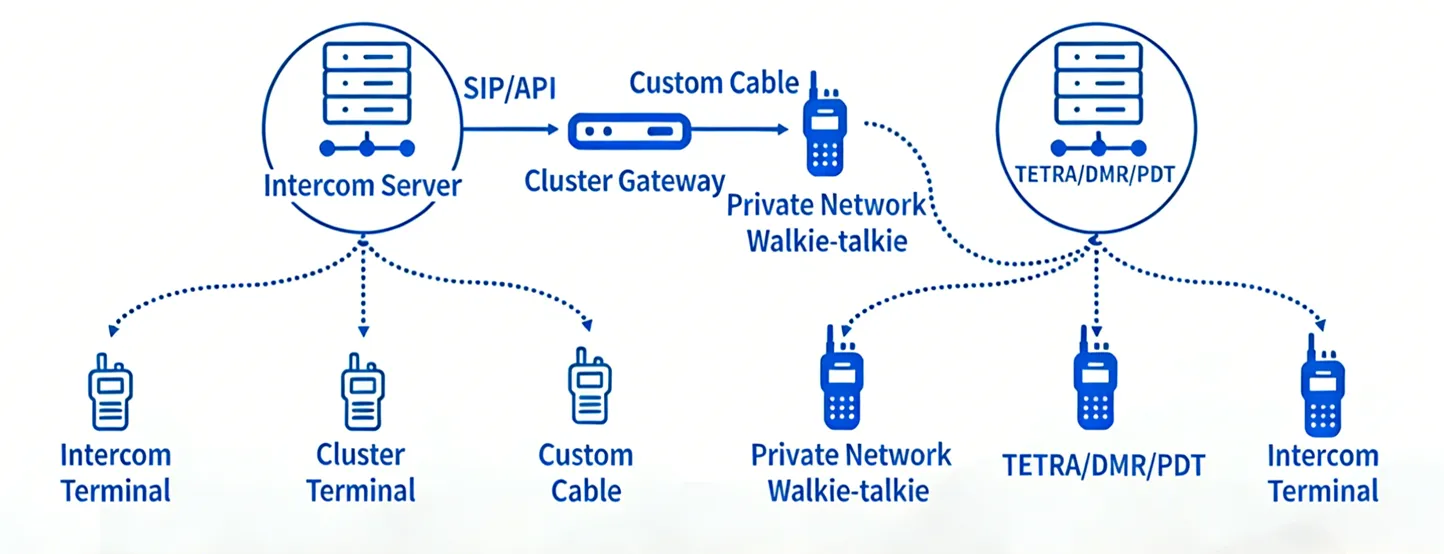
While public and private network PTT each excel in their respective domains, modern integration projects increasingly demand seamless communication between these systems. Becke Telcom’s ROIP (Radio over IP) gateway addresses this need by enabling interoperability between public network PTT platforms and private digital trunking systems.
How the ROIP Gateway Works
Becke Telcom’s ROIP gateway acts as a bridge between heterogeneous communication systems, translating protocols and converting signals to ensure smooth data flow. Key integration capabilities include:
-
SIP Protocol Support: Seamlessly connects with SIP-based public network PTT platforms, enabling call control functions such as talk rights acquisition and release.
-
Multi-Standard Compatibility: Works with major private network standards (PDT, DMR, TETRA, NXDN), supporting integration with devices from leading manufacturers like KENWOOD.
-
Robust Physical Interfaces: Features a 9-core aviation connector and versatile interface definitions, facilitating direct connection with walkie-talkies, vehicle-mounted radios, and dispatch consoles.
-
Transparent Signal Conversion: Converts analog radio signals (RF) to IP packets for transmission over private networks, and vice versa, ensuring low-latency communication between systems.
Benefits of Integration
Integrating public and private network PTT via Becke Telcom’s ROIP gateway delivers numerous advantages:
-
Unified Communication: Enables teams using different systems to communicate seamlessly, eliminating “communication silos” in mixed environments.
-
Flexible Deployment: Combines the coverage of public networks with the security of private networks, allowing organizations to optimize communication based on specific use cases.
-
Investment Protection: Preserves existing investments in both public and private network infrastructure, avoiding the need for costly system replacements.
-
Enhanced Operational Efficiency: Centralizes dispatch and management, enabling administrators to monitor and control all communication channels from a single interface.
Real-World Application Scenario
Consider a large logistics company operating across multiple regions:
-
Warehouse staff use private network PTT (DMR standard) for on-site coordination, leveraging secure, interference-free communication.
-
Delivery drivers use public network PTT (PoC) for real-time updates on routes and deliveries, utilizing positioning and video capabilities.
-
Becke Telcom’s ROIP gateway integrates these systems, allowing warehouse dispatchers to communicate directly with drivers and vice versa. During emergencies, drivers can seamlessly switch to the private network for secure, reliable communication if cellular coverage is lost.
Choosing the Right PTT Solution
Selecting between public and private network PTT (or integrating both) depends on several key factors:
-
Communication Requirements: Assess whether your organization needs multimedia capabilities (public network) or prioritizes security and reliability (private network).
-
Operational Environment: Evaluate cellular coverage in your operational area—private network PTT is essential for remote or signal-poor locations.
-
Budget Constraints: Balance upfront infrastructure costs (private network) against ongoing data expenses (public network).
-
Security Needs: Determine if your communication involves sensitive information that requires the isolation of a private network.
For many organizations, integration via Becke Telcom’s ROIP gateway offers the best of both worlds, combining flexibility, security, and reliability to meet diverse communication needs.
Conclusion
Public network PTT (PoC) and private network PTT are complementary technologies, each designed to address specific communication challenges. Public network PTT excels in flexibility and multimedia capabilities, while private network PTT delivers uncompromised security and reliability for critical operations. As communication needs evolve, the ability to integrate these systems has become a strategic imperative for organizations seeking to optimize their communication infrastructure.
Becke Telcom’s ROIP gateway serves as a critical enabler of this integration, providing a robust, flexible solution to connect public and private network PTT systems. By leveraging this technology, organizations can break down communication barriers, enhance operational efficiency, and ensure reliable connectivity across all scenarios.
Whether deploying a standalone system or integrating multiple platforms, understanding the unique strengths of public and private network PTT is key to building a communication solution that aligns with your organization’s goals. With the right technology and integration strategy, PTT communication can become a powerful asset for collaboration, safety, and productivity.

 English
 Deutsch
 한국어
한국어 Русский
 Français
 日本語
日本語 لالعربية
 हिन्दी
 Español
 Português
 繁体中文
繁体中文 简体中文
简体中文