The Becke IP Phone, as a modern SIP-compatible VoIP (Voice over Internet Protocol) communication device, is engineered to deliver superior voice clarity, reliability, and user-friendly functionality—particularly in business and professional environments. Its design integrates advanced hardware and software features that collectively enhance communication quality. Below is a detailed exploration of the key features that contribute to this enhanced performance:
1. HD Voice (Wideband Audio) Support
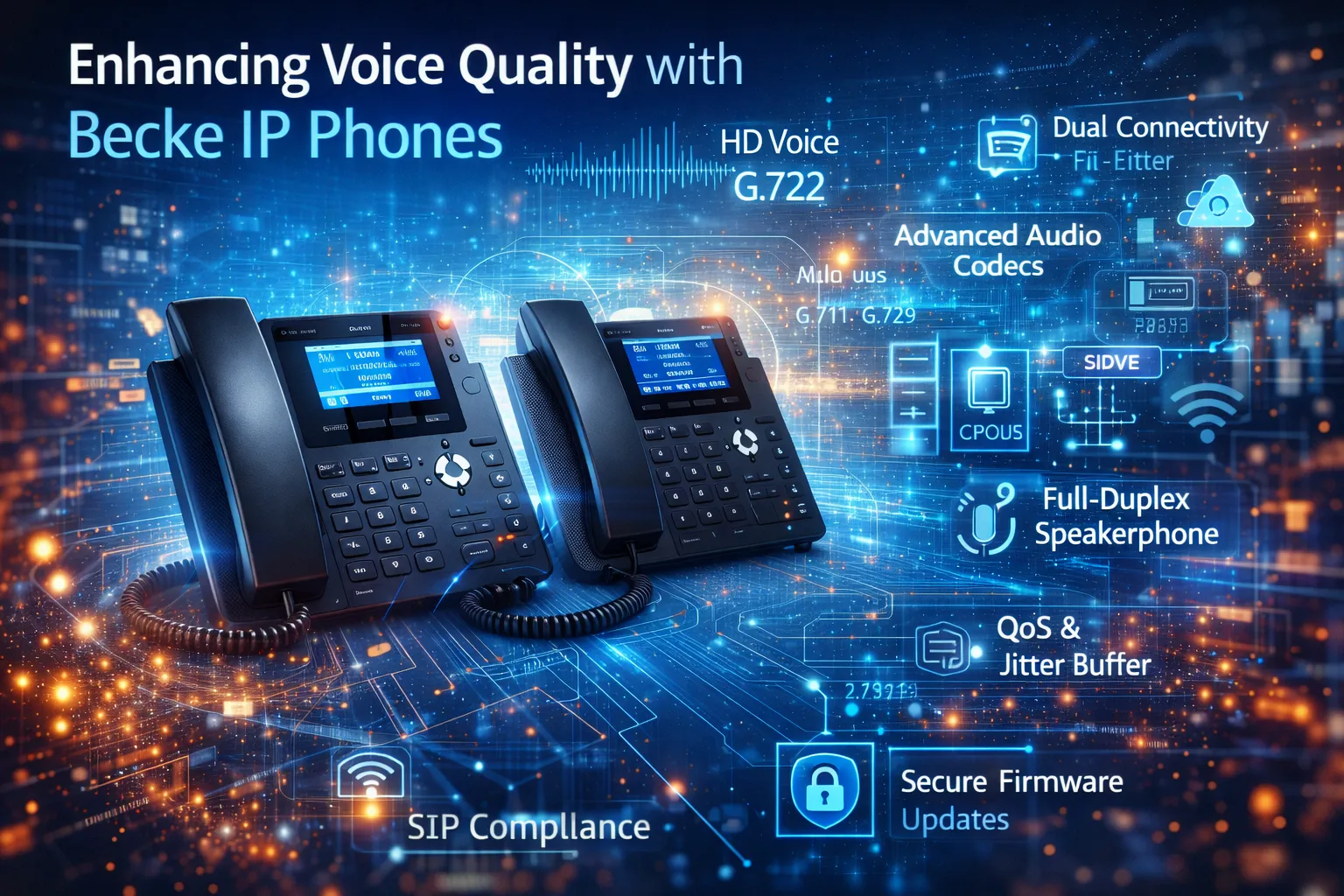
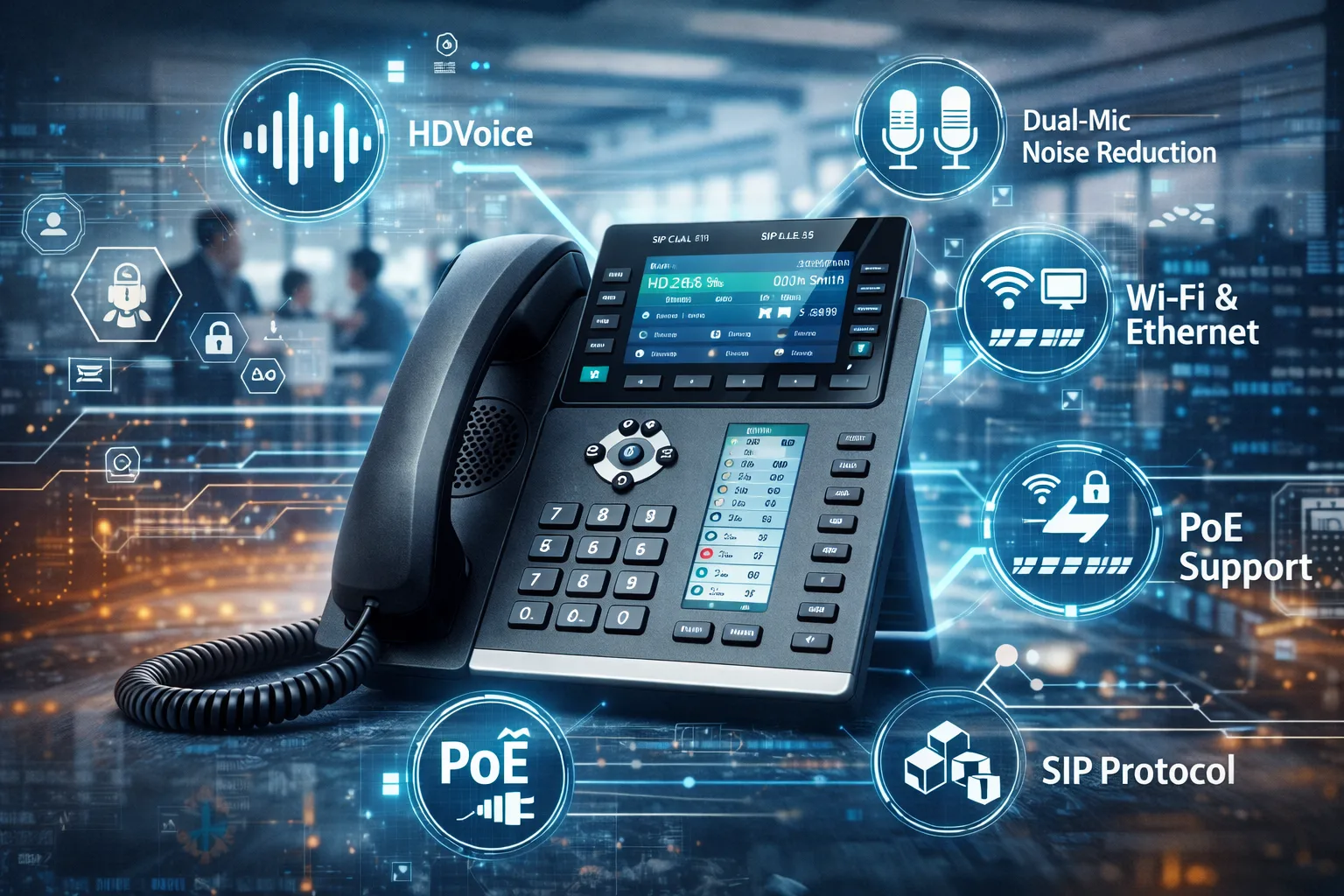
One of the most significant contributors to communication quality is Becke’s support for High-Definition (HD) Voice, often implemented through wideband audio codecs such as G.722. Unlike traditional narrowband telephony (which typically covers 300–3400 Hz), HD Voice extends the frequency range to 50–7000 Hz or higher. This broader spectrum captures more nuances of human speech—such as consonants like “s,” “f,” and “th”—resulting in clearer, more natural-sounding conversations that reduce listener fatigue and improve comprehension, especially during long calls.
2. Advanced Audio Codecs
Becke IP Phones support a suite of industry-standard audio codecs beyond G.722, including G.711 (for uncompressed, toll-quality audio), G.729 (for bandwidth-efficient compression), and Opus (adaptive, low-latency codec ideal for variable network conditions). The ability to negotiate the best codec based on network availability ensures consistent voice quality even under fluctuating bandwidth scenarios.
3. Full-Duplex Speakerphone with Echo Cancellation
Integrated full-duplex speakerphones allow both parties to speak and be heard simultaneously without cutting off audio—a critical feature for hands-free conferencing. Becke phones employ sophisticated acoustic echo cancellation (AEC) and noise suppression algorithms that eliminate feedback loops and background noise (e.g., office chatter, keyboard typing), ensuring only the speaker’s voice is transmitted clearly.
4. Dual-Mic Noise Reduction
Many Becke models feature dual microphones: one captures the user’s voice while the other samples ambient noise. Through real-time signal processing, the system subtracts background interference, significantly improving voice pickup accuracy—especially useful in open-office environments or remote work settings.
5. Robust Network Adaptability (QoS & Jitter Buffer)
Voice quality over IP networks depends heavily on stable data transmission. Becke IP Phones support Quality of Service (QoS) tagging (e.g., IEEE 802.1p/Q and DiffServ), which prioritizes voice packets over less time-sensitive data (like email or file downloads). Additionally, adaptive jitter buffers temporarily store incoming packets to smooth out timing variations caused by network congestion, preventing choppy or broken audio.
6. Dual-Mode Connectivity (Wi-Fi + Ethernet)
Certain Becke models offer dual-mode operation—supporting both wired Ethernet and Wi-Fi (802.11 a/b/g/n/ac). This flexibility ensures reliable connectivity whether the user is at a desk or moving around the office. Wi-Fi models often include roaming support and fast handoff between access points, minimizing call drops during mobility.
7. SIP Protocol Compliance & Interoperability
As a standards-compliant SIP (Session Initiation Protocol) phone, Becke devices seamlessly integrate with major VoIP platforms (e.g., Asterisk, FreePBX, 3CX, Cisco CallManager, Microsoft Teams via gateways). This interoperability ensures consistent feature availability—such as call transfer, hold, conferencing—and avoids proprietary lock-in, enhancing overall communication reliability.
8. Ergonomic Design & User Experience
Physical design also impacts communication quality indirectly. Becke phones often feature backlit displays, intuitive button layouts, and comfortable handsets with optimized earpiece acoustics. A well-designed user interface reduces dialing errors and simplifies access to features like mute, volume control, and directory lookup—keeping users focused on conversation rather than device operation.
9. Firmware Updates & Security
Regular firmware updates not only patch security vulnerabilities but also improve audio processing algorithms and protocol compatibility. Secure boot, TLS/SRTP encryption for signaling and media, and VLAN support protect against eavesdropping and ensure voice data integrity—critical for maintaining trust and professionalism in business communications.
10. Power over Ethernet (PoE) Support
Many Becke IP Phones support PoE (IEEE 802.3af/at), eliminating the need for separate power adapters. This simplifies installation, reduces cable clutter, and ensures uninterrupted operation during power outages when connected to a UPS-backed network switch—enhancing system reliability.
Conclusion
In summary, the Becke IP Phone enhances communication quality through a holistic combination of high-fidelity audio technology, intelligent noise management, network resilience, open standards compliance, and thoughtful ergonomic design. These features collectively minimize distortion, latency, and dropouts while maximizing clarity, convenience, and security—making Becke IP Phones a dependable choice for organizations seeking professional-grade voice communication over IP networks. Whether deployed in small offices, call centers, or enterprise environments, Becke’s focus on audio excellence and user-centric engineering ensures that every conversation remains clear, reliable, and productive.

 English
 Deutsch
 한국어
한국어 Русский
 Français
 日本語
日本語 لالعربية
 हिन्दी
 Español
 Português
 繁体中文
繁体中文 简体中文
简体中文