Leading industrial special communication provider with rich global cases. Our explosion-proof & SIP dispatch systems power projects—your reliable partner with proven success.
Leading industrial special communication provider with rich global cases. Our explosion-proof & SIP dispatch systems power projects—your reliable partner with proven success.
What Is an Explosion-Proof Telephone? A Complete Guide for Hazardous Industrial Sites
Learn what an explosion-proof telephone is, how analog and SIP models differ, how to read explosion-protection ratings, and how these phones connect to IP PBX, dispatch, PA, recording, and alarm systems in petrochemical, oil and gas, mining, energy, and other hazardous industrial sites.
Becke Telcom
Telephone equipment used in petrochemical plants, oil and gas facilities, tank farms, mines, pump stations, compressor rooms, and underground industrial spaces has to deal with conditions that are very different from those found in an office. Flammable gases or vapors may be present, while high noise, moisture, dust, oil, corrosion, and wide temperature changes can all affect the equipment at the same time.
For this reason, choosing a telephone for a hazardous industrial site is not simply a matter of checking whether it can make a call. The installation area, explosion-protection requirements, available cabling, environmental conditions, and the communication system behind the telephone all have to be considered.
An explosion-proof telephone is a fixed industrial communication terminal designed for use in such environments. Depending on the site, it may use a traditional analog telephone line or connect directly to an IP network through SIP. From there, the telephone can become part of a larger system that includes an IP PBX, dispatch console, public address system, voice recording, video surveillance, or alarm platform.
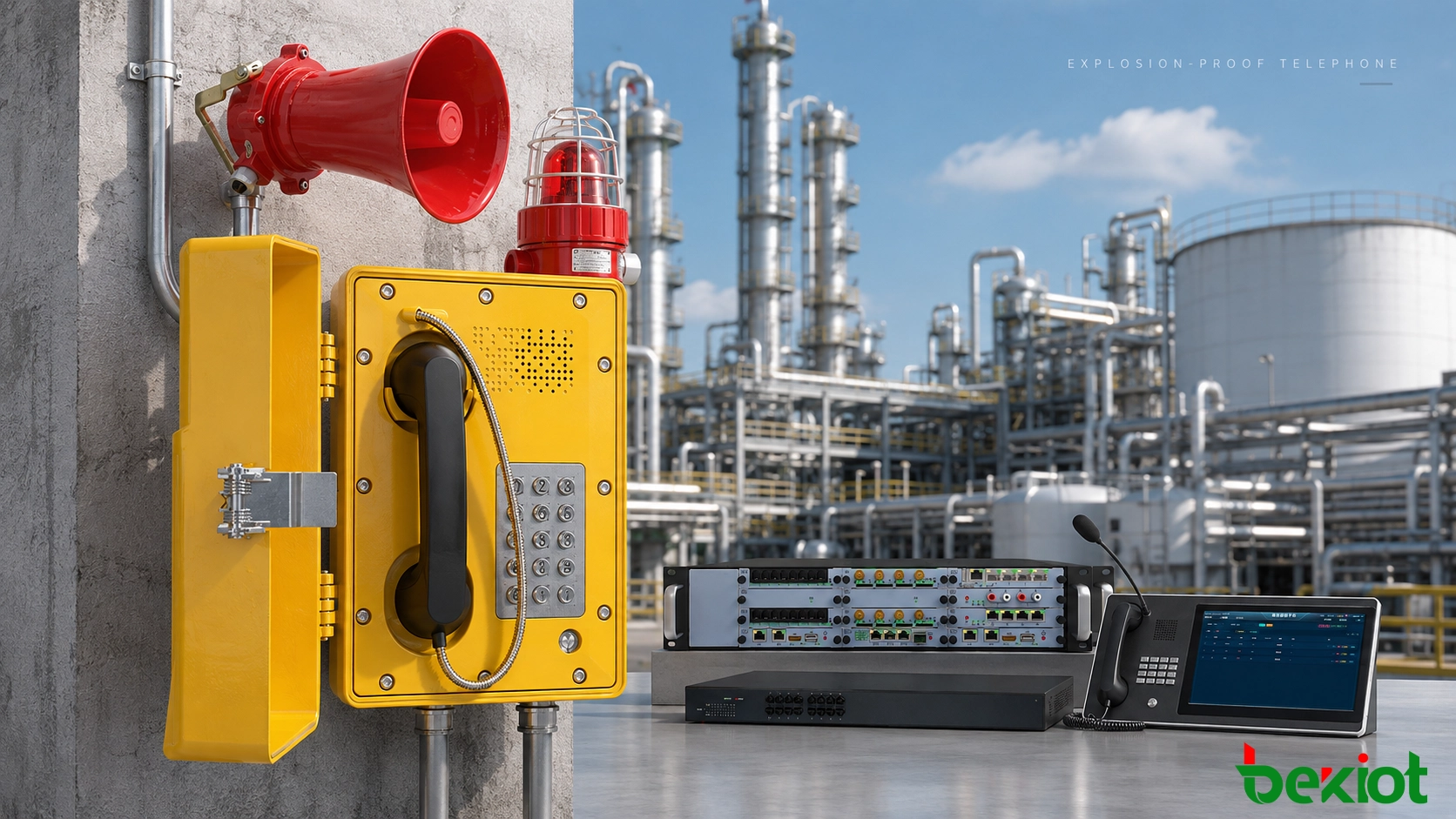
Explosion-proof telephones are commonly installed at fixed communication points in process areas, pump stations, loading zones, and other industrial locations.
What Is an Explosion-Proof Telephone?
At its core, an explosion-proof telephone still performs the normal functions of a telephone: making calls, receiving calls, dialing extensions, and providing two-way voice communication. The difference lies in how the equipment is built and where it is intended to operate.
For equipment installed in a hazardous area, the enclosure, electrical design, cable entry, sealing, connection method, materials, and surface temperature all matter. An explosion-proof telephone therefore cannot be treated as a standard telephone placed inside a heavy metal enclosure.
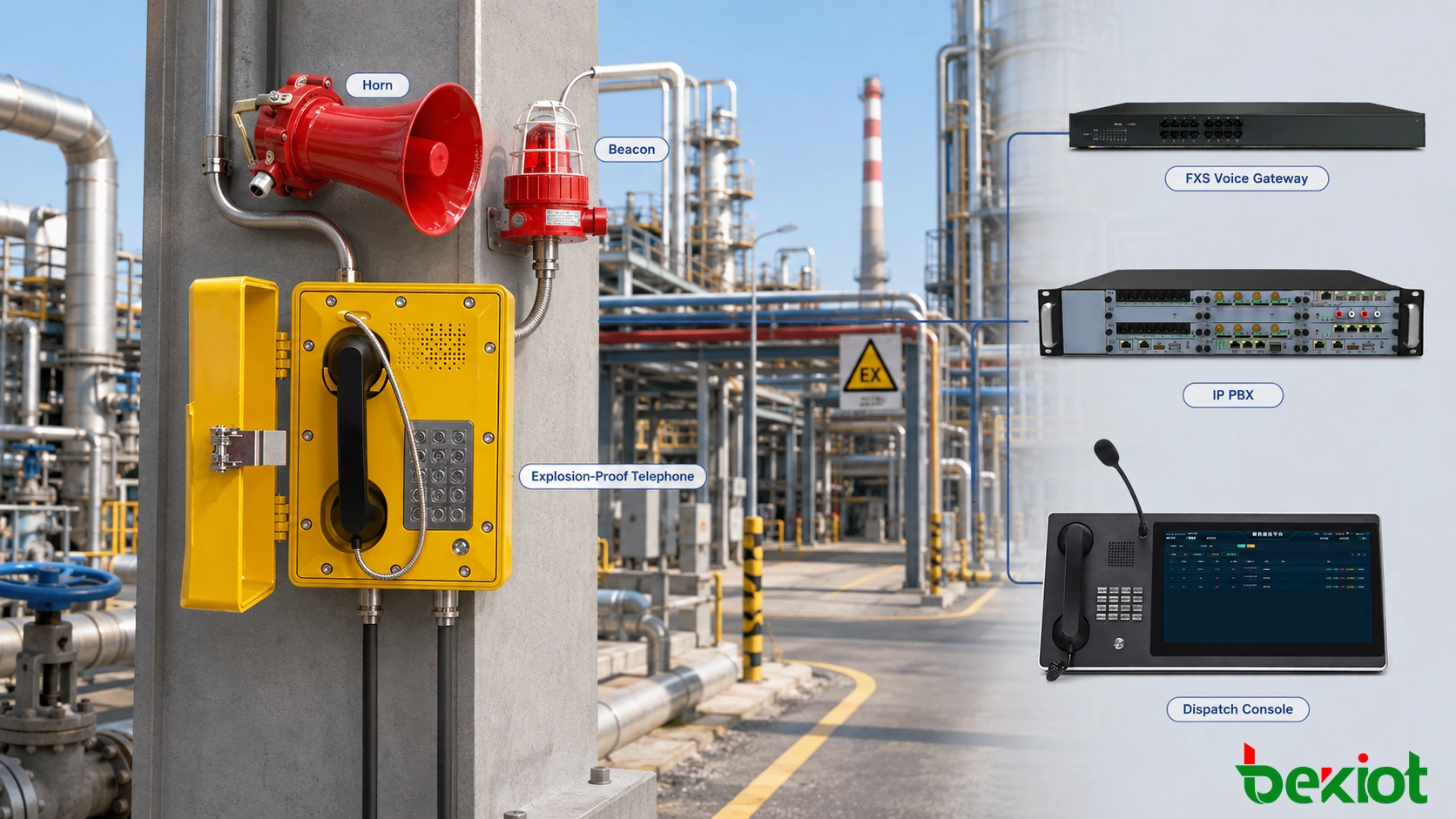
Typical units include a telephone body, handset, microphone, keypad or dedicated call button, and a communication interface. Depending on the model, additional connections may be available for an external loudspeaker, audible and visual alarm device, or other control interfaces.
It is also important to distinguish an explosion-proof telephone from a weatherproof industrial telephone. A wet, dusty, or corrosive outdoor location does not automatically make it a hazardous area. Where an explosive atmosphere is present, the telephone has to be selected according to the actual area classification and site requirements.
Why Ordinary Telephones Are Unsuitable for Hazardous Industrial Areas
Office telephones and most commercial communication terminals are designed for relatively clean and controlled environments. Installing the same equipment beside a process unit, loading station, gas facility, or other hazardous location introduces several problems.
Electrical components can become an ignition concern
A telephone contains switches, connectors, circuits, and a power supply. In a hazardous area, possible sparks, arcs, abnormal temperatures, and electrical faults have to be considered as part of the equipment selection.
This is why the actual hazardous-area classification and the characteristics of the explosive atmosphere are more important than simply choosing a rugged-looking telephone.
Industrial environments are hard on communication equipment
Outdoor process areas and underground facilities can expose telephones to rain, dust, oil, corrosive substances, vibration, accidental impact, and large temperature changes. Enclosure materials, cable glands, seals, mounting hardware, and wiring methods all affect how the unit performs over time.
High noise changes how a telephone needs to work
A ringing telephone may be easy to hear in an office but almost impossible to notice beside compressors, pumps, crushers, or heavy machinery.
In these locations, the telephone may be used together with an explosion-proof horn, external loudspeaker, beacon, or audible and visual alarm. The telephone provides the communication path, while the external devices make sure the call or alarm can actually be noticed by personnel in the area.
Analog or SIP Explosion-Proof Telephone: Which One Fits the Site?
Both analog and SIP explosion-proof telephones are used in industrial projects. The better choice usually depends on the infrastructure that is already available rather than on the telephone itself.
Analog explosion-proof telephones
Analog models use conventional telephone pairs and are normally connected to a PBX, analog extension port, or FXS voice gateway.
This arrangement is still common in older chemical plants, refineries, mines, and utility facilities because telephone copper cables may already run to hundreds of field locations. If those cables are still in good condition, replacing them only to introduce an IP telephone system can add unnecessary construction work.
Where the central system has already moved to SIP, an FXS gateway can keep the field telephone in service while converting the call into the IP network.
SIP explosion-proof telephones
A SIP explosion-proof telephone connects to an industrial Ethernet network and registers to an IP PBX, SIP server, or dispatch platform. This is often the cleaner approach for a new plant or for a site where industrial Ethernet is already available near the field devices.
The IP architecture also makes it easier to use common numbering across different areas and to connect the telephone system with recording, dispatch, public address, and other SIP-based equipment.
Item
Analog Explosion-Proof Telephone
SIP Explosion-Proof Telephone
Transmission
Telephone copper pair
Industrial Ethernet / IP network
System connection
PBX, FXS port, or voice gateway
IP PBX, SIP server, or dispatch platform
Brownfield projects
Can reuse existing telephone wiring
Requires suitable IP network access
Multi-site networking
Usually requires gateways or PBX interconnection
Can use the existing IP network
System integration
Handled through gateways or the PBX
Can connect directly through SIP
For an existing plant, keeping a working analog field network is often the more practical decision. For a new installation, SIP can simplify system expansion and integration, provided that the network and power design have been planned for industrial use.
How to Read Explosion-Proof Telephone Specifications
Explosion-proof telephone data sheets often list explosion-protection markings, gas groups, temperature classes, IP ratings, and operating temperature on the same page. These values describe different aspects of the equipment, so they should not be treated as interchangeable specifications.
Start with the installation area
A control room, an outdoor utility area, and a process unit inside the same refinery can require very different communication equipment. The installation point and hazardous-area classification should therefore be identified before a telephone model is selected.
Gas groups such as IIB and IIC
Markings such as IIB and IIC are commonly seen on explosion-protected industrial equipment. Their relevance depends on the explosive atmosphere at the actual site. The correct selection should follow the project design documents, local requirements, and the certified scope of the equipment.
T6 is not the same as operating temperature
Temperature classes such as T1, T4, and T6 relate to the maximum surface temperature permitted for the equipment under specified conditions. A value such as -40°C to +60°C, on the other hand, normally refers to the ambient operating temperature range of the product.
The two specifications describe different things and should not be confused during equipment selection.
IP66 does not mean explosion-proof
IP66 describes protection against dust and water ingress. It is not an explosion-protection rating.
A telephone may have an IP66 or even higher enclosure rating and still not be suitable for a hazardous area. Explosion protection and environmental ingress protection must be checked separately.
Connecting Explosion-Proof Telephones to IP PBX and Dispatch Systems
A few field telephones can operate as a simple voice network, but larger industrial sites normally need more than point-to-point calling. Number management, control-room dispatch, recording, paging, and interconnection with existing communication systems soon become part of the design.
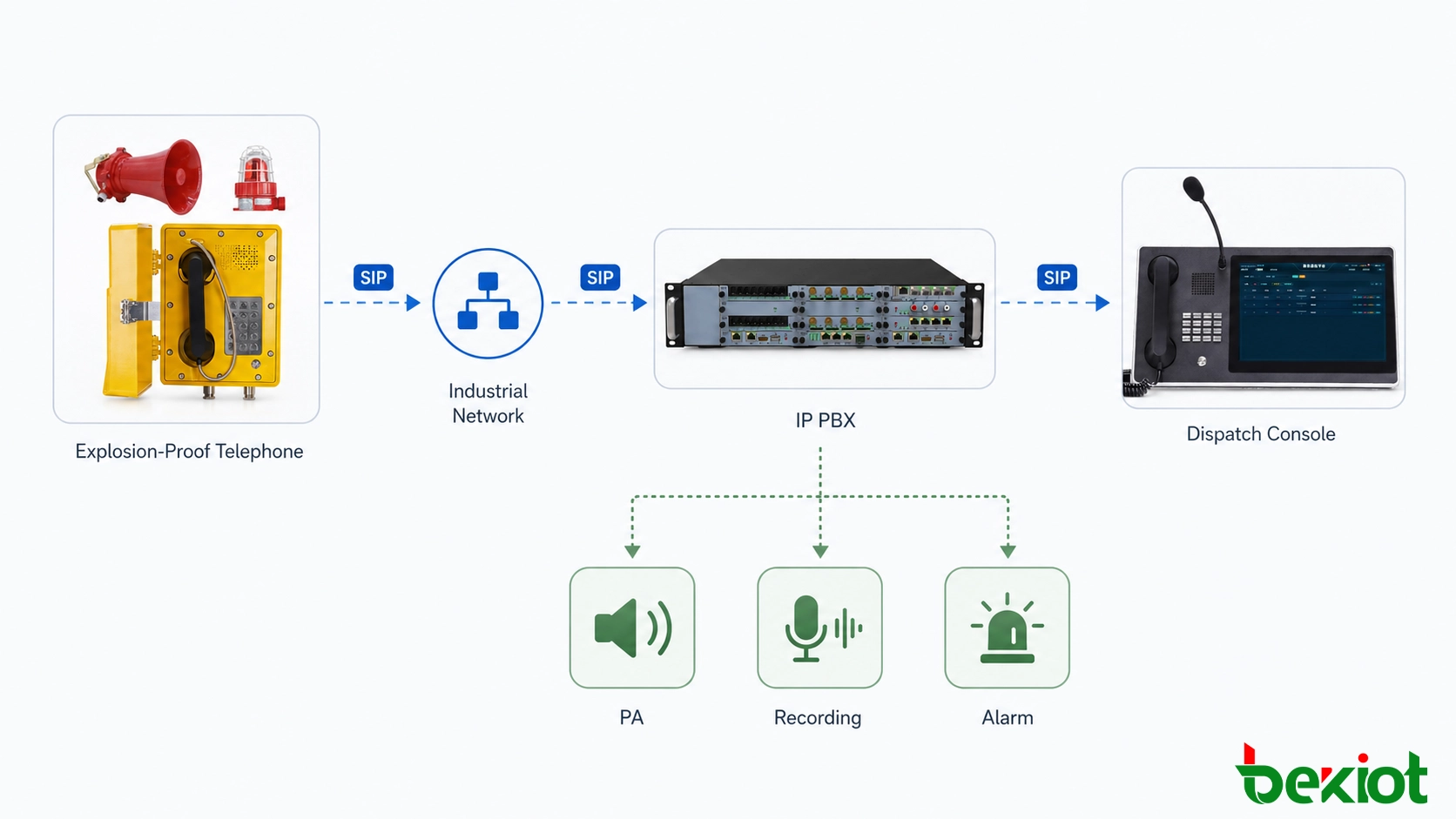
A SIP explosion-proof telephone can connect through the industrial network to an IP PBX, dispatch console, recording system, and PA platform.
Direct SIP connection
A SIP explosion-proof telephone can register through an industrial switch to an IP PBX, SIP server, or dispatch platform. The central system then handles extension numbers and call routing, while dispatch, recording, or PA applications can be connected as required.
A typical path is:
SIP Explosion-Proof Telephone → Industrial Ethernet Switch → IP PBX / SIP Server → Dispatch Console / Recording / PA System
This arrangement is useful when several process areas, buildings, or remote facilities have to use one numbering and communication platform.
Connecting existing analog telephones through an FXS gateway
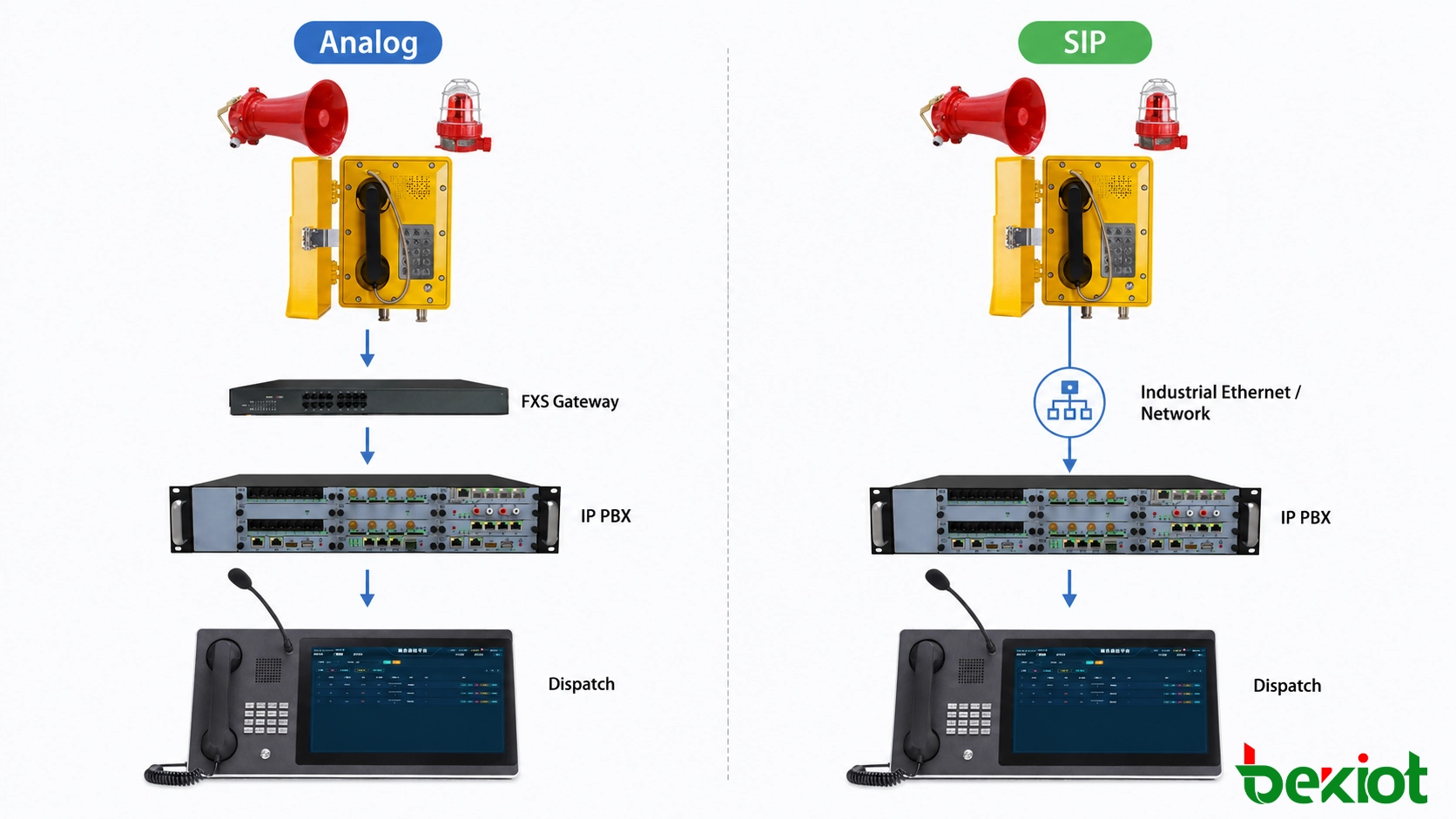
In a brownfield plant, existing field copper pairs can often remain in service. An FXS voice gateway installed in the telecom room converts the analog extensions into SIP channels for the newer IP system.
The communication path becomes:
Analog Explosion-Proof Telephone → Existing Copper Pair → FXS Voice Gateway → IP PBX / Dispatch Platform
This is a common way to modernize the central communication platform without opening cable routes throughout an operating plant.
Keeping the existing PBX during a phased upgrade
A large facility may also keep its existing telephone exchange and interconnect it with the new system. Depending on the available interfaces, this can be done through SIP Trunk, FXO, E1, or another supported connection.
Many upgrade projects are carried out this way: the new dispatch or IP platform is connected first, while field extensions are replaced gradually as equipment reaches the end of its service life.
Analog field telephones can enter the SIP network through an FXS gateway, while SIP models connect directly to the industrial IP network.
Once the telephone is part of a dispatch system, it can do more than make ordinary calls. Depending on the platform, field calls can be routed to dispatch positions, recorded, included in group calling, or linked with paging and emergency notification functions.
For example, an operator in a process area may call the control room to report a leak. The dispatcher confirms the location, contacts the relevant team, and then uses the PA system to issue instructions to the affected zone. At particularly noisy points, horns or audible and visual alarms can provide an additional local warning.
Integration with CCTV, access control, fire alarm systems, or other platforms needs more detailed testing. Basic SIP interoperability does not automatically guarantee functions such as alarm pop-ups, GPIO control, camera linkage, or priority call handling.
Selection, Installation, and Commissioning Checks
A product data sheet is only one part of the selection process. Before ordering the telephone, it is useful to put the site information on one page and work from that.
Site Condition
What to Confirm
Installation area
Ordinary industrial area or hazardous area
Hazard
Gas, vapor, dust, and applicable classification
Explosion protection
Protection method, gas group, temperature class
Environment
Temperature, rain, dust, corrosion, vibration
Existing cabling
Telephone pair or industrial Ethernet
Communication interface
Analog, SIP, or another required interface
Noise level
Need for horn or external loudspeaker
Alarm requirement
Audible/visual alarm or external control
Central system
IP PBX, dispatch, PA, and recording platform
For a new plant, the telephone network is better planned together with the industrial LAN, PA system, dispatch platform, and backup power. Numbering, VLANs, switch locations, server capacity, and UPS coverage can then be decided before field installation begins.
For an existing plant, start by checking the cables that are already in place. A usable copper telephone network can often remain in service behind FXS gateways, which reduces field work and allows the upgrade to be carried out area by area.
Commissioning should go beyond a successful call
A telephone that can dial an extension in a quiet workshop has not necessarily passed a field test. Audio level, microphone pickup, background noise, echo, incoming-call indication, and usability should be checked at the actual installation point.
For SIP telephones, commissioning should also cover IP addressing, VLAN configuration, SIP registration, packet loss, network delay, and power supply. If the system is used for emergency communication, power loss and system restart tests are worth carrying out as well.
Where several systems are integrated, test the complete workflow instead of testing each device separately:
Field Call → Dispatch Answer → Location Confirmation → Team Notification → Zone Announcement → Recording and Event Check
This type of test is much more likely to expose a numbering error, missing permission, routing problem, or incomplete interface than a simple test call.
Conclusion
In a small installation, an explosion-proof telephone may only provide a reliable fixed link between the field and the control room. In a refinery, mine, power facility, or large industrial plant, the more difficult part often comes later: connecting those field telephones with PA, recording, radio, dispatch consoles, and an existing PBX without rebuilding the entire communication network.
Becke Telecom provides explosion-proof telephones, weatherproof industrial telephones, voice gateways, and related industrial communication equipment for both new installations and system upgrades. Existing analog field wiring can be retained where appropriate, while sites with industrial Ethernet can deploy SIP telephones directly. The final architecture should follow the available cabling, central communication platform, and the functions required at the site.
FQA
What documents should be checked when purchasing an explosion-proof telephone?
Besides the model number and technical data sheet, check the relevant explosion-protection certificate, product marking, approved application range, ambient temperature rating, and installation documentation. For projects with formal engineering or acceptance requirements, the certificate and product marking should match the conditions stated in the design documents.
Why are cable entry and wiring details important?
A surprising number of field communication problems come from cable glands, terminals, loose connections, or poor sealing rather than from the telephone electronics.
With explosion-protected equipment, cable entry is also part of the installation method. Cable glands, sealing components, and wiring should follow the product requirements. Modifying cable holes or removing sealing parts can affect both environmental protection and the intended explosion-protection arrangement.
Does an explosion-proof telephone system need UPS backup?
If the telephone is used for operations or emergency reporting, backup power should cover the whole communication path rather than only the field unit.
A powered SIP telephone is still unusable if the industrial switch, IP PBX, gateway, or dispatch server has lost power. UPS planning therefore needs to include the critical network and central communication equipment as well.
What should be considered for long-distance telephone connections?
For analog telephones, long cable runs can introduce line resistance, attenuation, and connector problems. The capability of the PBX or FXS gateway port also needs to be considered.
For SIP telephones, the concern shifts to Ethernet distance, switch placement, fiber links, network latency, and remote power. A long pipe rack or large industrial site should not be wired in the same way as a normal office floor.
What should be checked first if the telephone audio is too low?
Do not assume the telephone itself is faulty. Start with the actual noise level at the installation point, handset and microphone condition, line quality, and audio settings.
For an analog system, cable loss and joints are worth checking. On SIP systems, codec configuration, packet loss, jitter, and audio gain may also affect the result. If the telephone is working correctly but the location is simply too noisy, an external horn or additional audible/visual indication may be the better solution.
Do explosion-proof telephones require regular maintenance?
Yes. Equipment that remains outdoors or in a process area should be inspected periodically for enclosure damage, handset cable condition, keypad operation, mounting hardware, cable entry, and communication quality.
Where horns, beacons, or other external devices are connected, include them in the same inspection. Emergency communication points should also be tested periodically for dialing, answering, two-way audio, incoming-call indication, and system registration.
Becke Telcom specializes in industrial explosion-proof comms for rail, tunnel, oil & gas, and marine sectors, offering PAGA, SOS, and IP telephones with integrated PA, intercom, and calling.
If you have any suggestions or questions for us, please feel free to contact us!
We use cookie to improve your online experience. By continuing to browse this website, you agree to our use of cookie.
Cookies
Please read our Terms and Conditions and this Policy before accessing or using our Services. If you cannot agree with this Policy or the Terms and Conditions, please do not access or use our Services. If you are located in a jurisdiction outside the European Economic Area, by using our Services, you accept the Terms and Conditions and accept our privacy practices described in this Policy. We may modify this Policy at any time, without prior notice, and changes may apply to any Personal Information we already hold about you, as well as any new Personal Information collected after the Policy is modified. If we make changes, we will notify you by revising the date at the top of this Policy. We will provide you with advanced notice if we make any material changes to how we collect, use or disclose your Personal Information that impact your rights under this Policy. If you are located in a jurisdiction other than the European Economic Area, the United Kingdom or Switzerland (collectively “European Countries”), your continued access or use of our Services after receiving the notice of changes, constitutes your acknowledgement that you accept the updated Policy. In addition, we may provide you with real time disclosures or additional information about the Personal Information handling practices of specific parts of our Services. Such notices may supplement this Policy or provide you with additional choices about how we process your Personal Information.
Cookies
Cookies are small text files stored on your device when you access most Websites on the internet or open certain emails. Among other things, Cookies allow a Website to recognize your device and remember if you've been to the Website before. Examples of information collected by Cookies include your browser type and the address of the Website from which you arrived at our Website as well as IP address and clickstream behavior (that is the pages you view and the links you click).We use the term cookie to refer to Cookies and technologies that perform a similar function to Cookies (e.g., tags, pixels, web beacons, etc.). Cookies can be read by the originating Website on each subsequent visit and by any other Website that recognizes the cookie. The Website uses Cookies in order to make the Website easier to use, to support a better user experience, including the provision of information and functionality to you, as well as to provide us with information about how the Website is used so that we can make sure it is as up to date, relevant, and error free as we can. Cookies on the Website We use Cookies to personalize your experience when you visit the Site, uniquely identify your computer for security purposes, and enable us and our third-party service providers to serve ads on our behalf across the internet.
We classify Cookies in the following categories: ● Strictly Necessary Cookies ● Performance Cookies ● Functional Cookies ● Targeting Cookies
Cookie List A cookie is a small piece of data (text file) that a website – when visited by a user – asks your browser to store on your device in order to remember information about you, such as your language preference or login information. Those cookies are set by us and called first-party cookies. We also use third-party cookies – which are cookies from a domain different than the domain of the website you are visiting – for our advertising and marketing efforts. More specifically, we use cookies and other tracking technologies for the following purposes:
Strictly Necessary Cookies These cookies are necessary for the website to function and cannot be switched off in our systems. They are usually only set in response to actions made by you which amount to a request for services, such as setting your privacy preferences, logging in or filling in forms. You can set your browser to block or alert you about these cookies, but some parts of the site will not then work. These cookies do not store any personally identifiable information.
Functional Cookies These cookies enable the website to provide enhanced functionality and personalisation. They may be set by us or by third party providers whose services we have added to our pages. If you do not allow these cookies then some or all of these services may not function properly.
Performance Cookies These cookies allow us to count visits and traffic sources so we can measure and improve the performance of our site. They help us to know which pages are the most and least popular and see how visitors move around the site. All information these cookies collect is aggregated and therefore anonymous. If you do not allow these cookies we will not know when you have visited our site, and will not be able to monitor its performance.
Targeting Cookies These cookies may be set through our site by our advertising partners. They may be used by those companies to build a profile of your interests and show you relevant adverts on other sites. They do not store directly personal information, but are based on uniquely identifying your browser and internet device. If you do not allow these cookies, you will experience less targeted advertising.
How To Turn Off Cookies You can choose to restrict or block Cookies through your browser settings at any time. Please note that certain Cookies may be set as soon as you visit the Website, but you can remove them using your browser settings. However, please be aware that restricting or blocking Cookies set on the Website may impact the functionality or performance of the Website or prevent you from using certain services provided through the Website. It will also affect our ability to update the Website to cater for user preferences and improve performance. Cookies within Mobile Applications
We only use Strictly Necessary Cookies on our mobile applications. These Cookies are critical to the functionality of our applications, so if you block or delete these Cookies you may not be able to use the application. These Cookies are not shared with any other application on your mobile device. We never use the Cookies from the mobile application to store personal information about you.
If you have questions or concerns regarding any information in this Privacy Policy, please contact us by email at . You can also contact us via our customer service at our Site.

 English
 Deutsch
 한국어
한국어 Русский
 Français
 日本語
日本語 لالعربية
 हिन्दी
 Español
 Português
 繁体中文
繁体中文 简体中文
简体中文