Leading industrial special communication provider with rich global cases. Our explosion-proof & SIP dispatch systems power projects—your reliable partner with proven success.
Leading industrial special communication provider with rich global cases. Our explosion-proof & SIP dispatch systems power projects—your reliable partner with proven success.
Typical Applications of Explosion-Proof Telephones in Steel and Metallurgical Plants
Explore explosion-proof telephone applications in steel and metallurgical plants, including coking, blast furnace, gas systems, SIP, IP PBX and dispatch integration.
Becke Telcom
Integrated steel plants cover large production areas, extending from coking, ironmaking and steelmaking to gas recovery, pulverized coal injection, utility systems and plant-wide pipeline networks. Communication conditions vary considerably from one area to another. Some locations are continuously exposed to high temperatures, dust and heavy industrial noise, while others involve combustible media such as coke oven gas, blast furnace gas, converter gas and natural gas.
For this reason, telephone selection in a steel plant cannot be based only on whether the device can make and receive calls. The installation location, hazardous-area classification, communication cabling and the departments that must be contacted during an abnormal event all affect the choice of terminal and the overall communication architecture.
Explosion-proof telephones are mainly installed at fixed communication points located within classified hazardous areas. In ordinary production areas, industrial telephones, IP phones or other communication terminals can be selected according to the environmental conditions. There is no need to use explosion-proof equipment throughout the entire steel plant.
Coking Plants and Coke Oven Gas Treatment Areas
Coking is one of the most typical applications for explosion-proof communication equipment in a steel complex. Coke production, gas purification and gas transportation involve coke oven gas and associated chemical-processing media. These areas contain dense piping, valves and process equipment, while many operating positions require continuous inspection.
Depending on the hazardous-area classification, explosion-proof telephones can be installed near coke oven operating positions, gas purification units, gas valve groups, pump stations, blower equipment and other locations where operators regularly perform inspections or process operations.
The primary purpose of these telephones is to maintain a dependable communication link between field personnel and the coking control room. For example, if an operator discovers abnormal gas pressure, unusual equipment noise or a valve position that does not match the required process condition, the operator can contact the control room directly from the nearest fixed telephone instead of returning to a duty room to find another communication device.
When the telephones are integrated with a centralized dispatch system, each terminal can also be identified by its physical location, such as “Coke Oven Area 03” or “Gas Purification Area 02.” When a call reaches the dispatch console, the operator can immediately identify the source area, reducing the time spent confirming the caller’s location.
Blast Furnace and Converter Gas Systems
Blast furnace areas contain large process equipment, elevated platforms, extensive piping and widely distributed auxiliary facilities. The blast furnace gas system also includes numerous valves, dust-removal units and gas transmission pipelines. Fixed telephone points are therefore commonly required around equipment operating areas, inspection routes and key gas-system locations.
Industrial noise is another important consideration in these areas. When blowers, dust collectors, conveying machinery and other large process equipment are operating continuously, the ringing sound of a standard telephone can easily be masked by background noise.
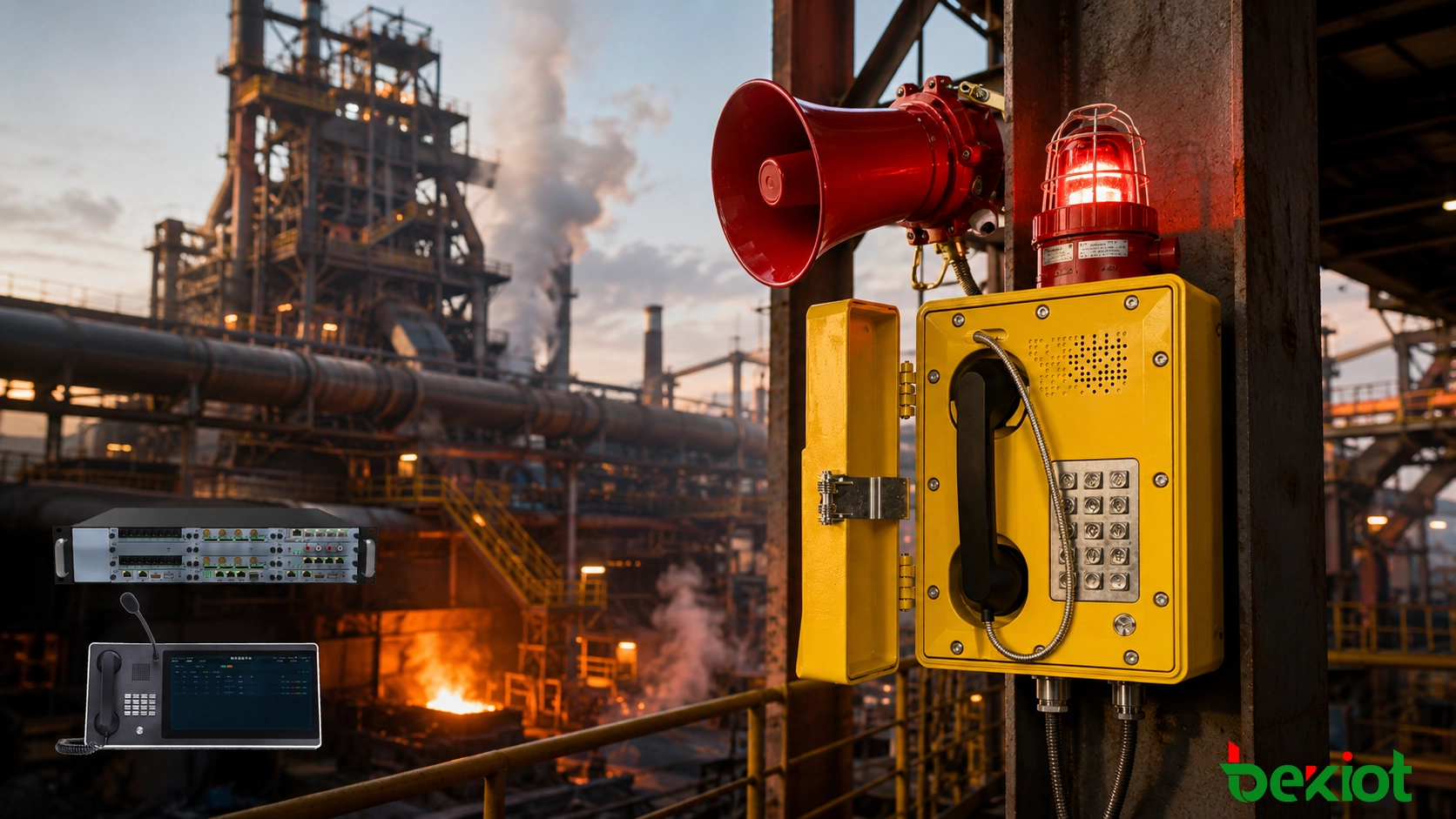
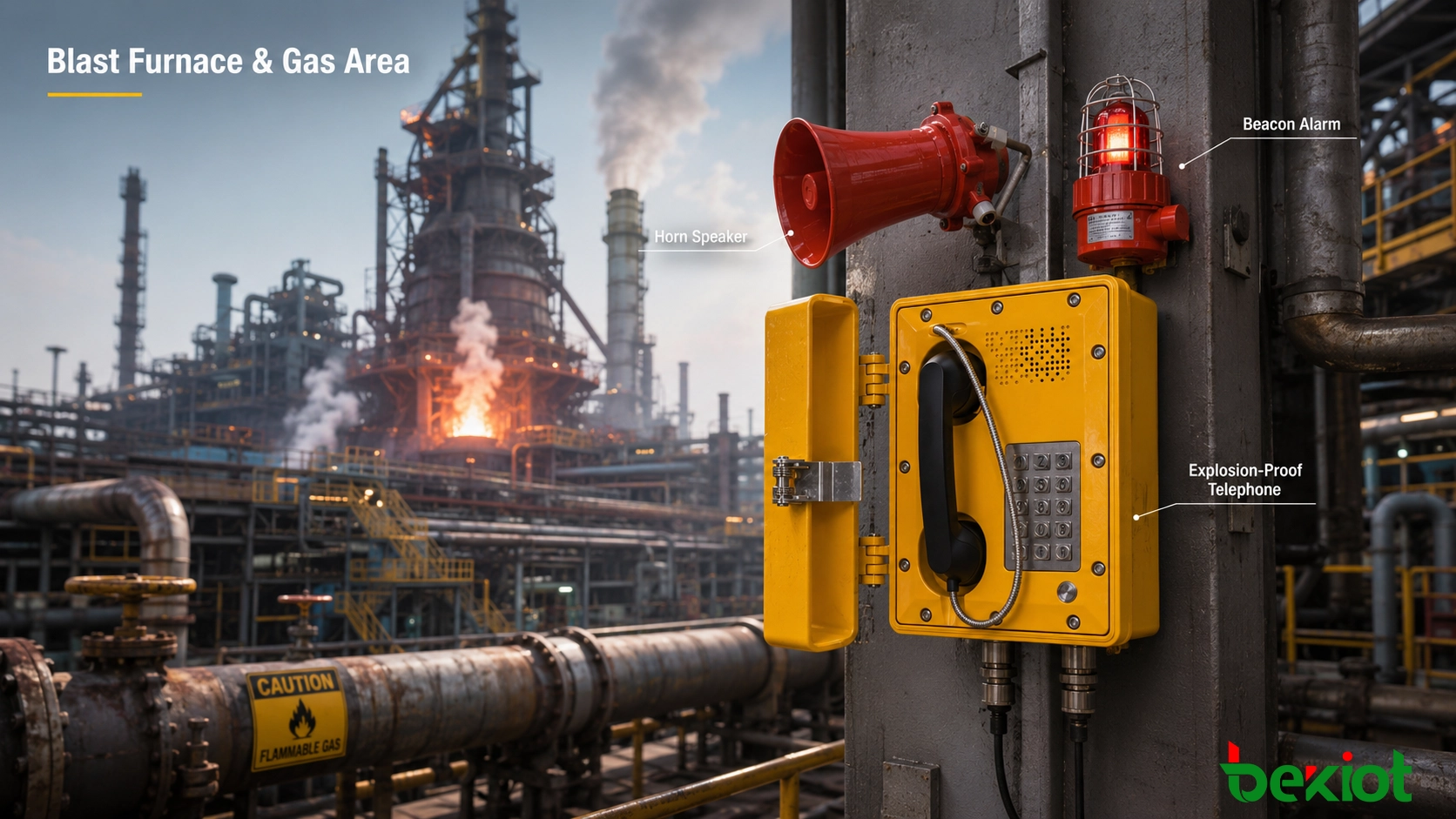
For these locations, explosion-proof telephones can be combined with explosion-proof horn speakers or audible and visual alarm devices where required. When the control room calls the field telephone, personnel can be alerted not only by the telephone ringer but also by a louder acoustic signal or flashing beacon.
Explosion-proof telephones, horn speakers and visual alarm devices can be deployed in blast furnace and gas-system areas according to hazardous-area classification, ambient noise and communication distance.
The use of external horn speakers or visual alarms should be determined by actual site noise levels, installation distance and operating procedures rather than applied uniformly to every telephone point.
In converter steelmaking areas, communication requirements are more concentrated around converter gas recovery, dust-removal facilities and related utility systems. Field terminals may connect to the steelmaking control room or be integrated into the plant-wide production dispatch system, allowing steelmaking, utility, safety and maintenance teams to communicate through a defined communication structure.
Pulverized Coal Preparation and PCI Areas
Pulverized coal preparation and pulverized coal injection systems require a different equipment-selection approach from conventional combustible-gas environments.
Coal crushing, grinding, storage and conveying can generate combustible dust. Before selecting a communication terminal, the project designer must first determine the hazardous material and area classification at the installation point and then verify whether the explosion-protection certification of the telephone is suitable for that specific environment.
Typical fixed communication locations include areas near coal mills, pulverized coal silos, conveying systems, PCI operating points and routine inspection positions.
One common misunderstanding should be avoided: a product described as an “explosion-proof telephone” is not automatically suitable for every explosive atmosphere. Gas and dust environments may require different protection concepts, equipment markings and certification scopes. Project procurement should therefore be based on the actual certificates and technical documentation rather than the product name alone.
In addition to explosion protection, pulverized coal areas may also require consideration of dust accumulation, enclosure sealing, routine cleaning and the long-term reliability of cable entries and electrical connections.
Gas Holders, Booster Stations and Utility Facilities
Large steel plants normally operate dedicated utility systems for the recovery, storage, mixing, pressurization and distribution of blast furnace gas, coke oven gas, converter gas, natural gas and other process utilities.
Gas holders, gas booster stations, mixing stations, pressure-regulating facilities and pipeline valve groups are often located some distance from the main production control rooms. At the same time, equipment switching, valve operations and routine inspections require frequent communication with the energy or utility dispatch center.
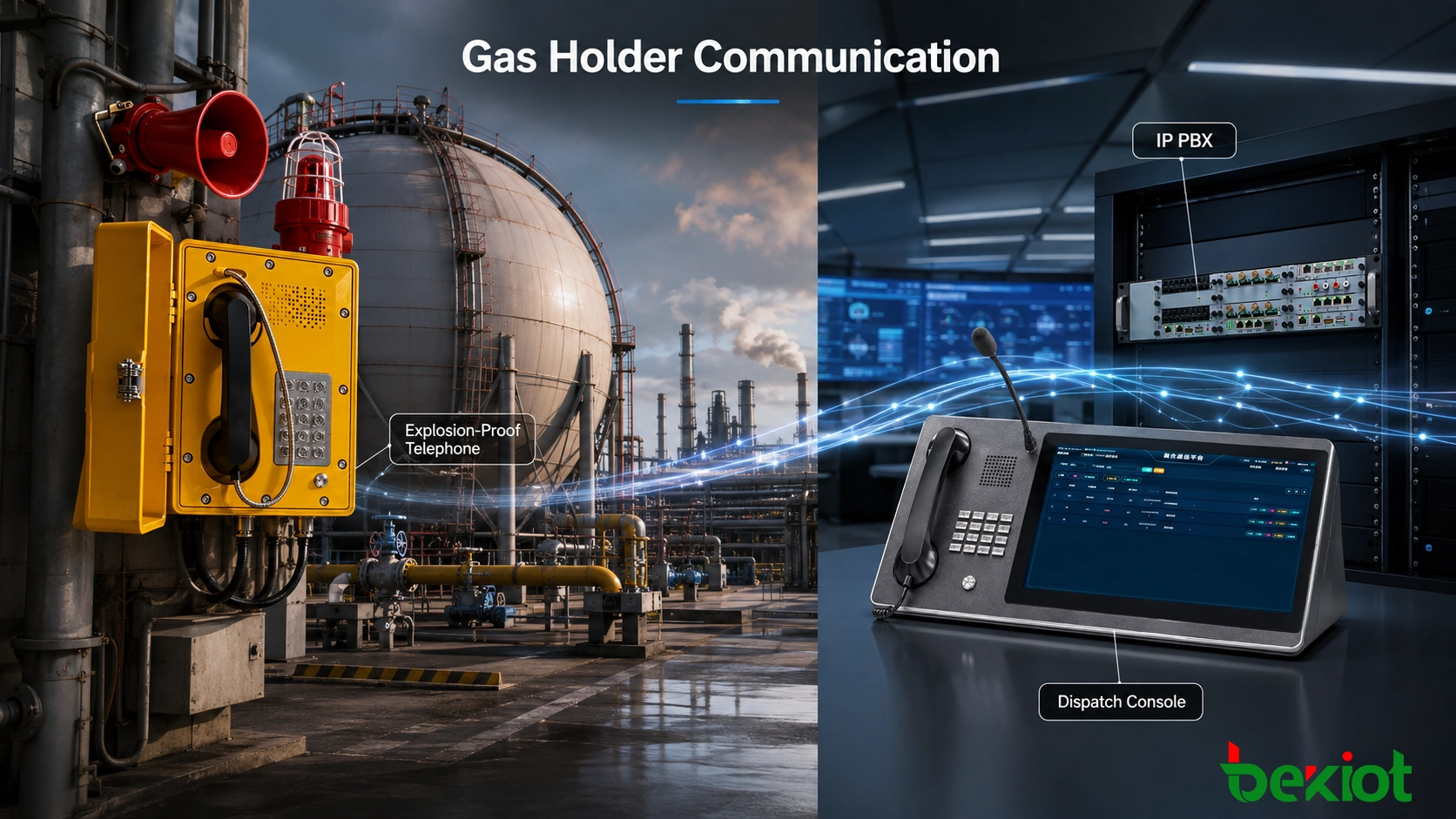
Explosion-proof telephones installed at appropriate classified locations allow field personnel to communicate directly with the utility control center, production dispatch room, safety personnel or maintenance teams.
Gas holders, booster stations and remote valve stations can use fixed explosion-proof telephones to maintain communication with utility and production dispatch personnel.
For example, during a gas-pipeline switching operation, field operators and utility dispatch personnel may need to confirm valve positions, equipment operating conditions and the sequence of each operating step. A fixed telephone provides a clearly defined communication point that does not change as personnel move around the site.
Similar requirements may also be found along plant gas pipe racks, remote valve rooms, pumping stations and utility pipelines. In a large integrated steel complex, reliable fixed communication at these remote points can be more important to production operations than ordinary office telephones.
How Explosion-Proof Telephones Connect to a Steel Plant Dispatch System
New steel plants and brownfield modernization projects often have very different communication infrastructures. There is therefore no single connection method that applies to every explosion-proof telephone installation. The system architecture should be selected according to whether the site uses an IP network, existing analog telephone cabling or a combination of both.
Connecting SIP Explosion-Proof Telephones to the IP Network
If an industrial Ethernet network is already available, SIP explosion-proof telephones can connect directly to industrial network switches and register with an IP PBX or SIP-based dispatch platform.
A typical communication path is:
Explosion-Proof Telephone → Industrial Ethernet Switch → Plant IP Network → IP PBX / SIP Server → Dispatch Console
This architecture makes it easier to assign unified extension numbers to telephones across coking, ironmaking, steelmaking and utility areas. The dispatch platform can also organize terminals by plant area, workshop or process section.
Functions such as call override, forced release, call recording, group calling and broadcast integration depend on the capabilities of the selected dispatch platform and terminals. SIP support alone does not guarantee that every advanced dispatch function will be available.
Retaining Existing Analog Explosion-Proof Telephones
Many steel plants that have been operating for years already have extensive analog telephone cabling. If the existing field wiring and terminals remain in good condition, a modernization project does not necessarily require complete replacement of the installed infrastructure.
A common migration architecture is:
Analog Explosion-Proof Telephone → Existing Telephone Cable → FXS Voice Gateway → IP Network → IP PBX / Dispatch Platform
The existing two-wire field telephone can remain in service, while an FXS voice gateway in the equipment room converts the analog interface to SIP. This allows the core switching and dispatch platform to be upgraded first, with field terminals replaced gradually according to equipment condition, site requirements and project budget.
Integrating Telephone, Public Address and Radio Communication
Communication systems in large steel plants normally include more than fixed telephones. Industrial public address systems, handheld radios, trunked radio systems, audible and visual alarm devices and independent workshop communication systems may all operate within the same facility.
If these systems remain completely separate, dispatch operators may need to switch repeatedly between telephone consoles, radio equipment and public address systems during an abnormal event.
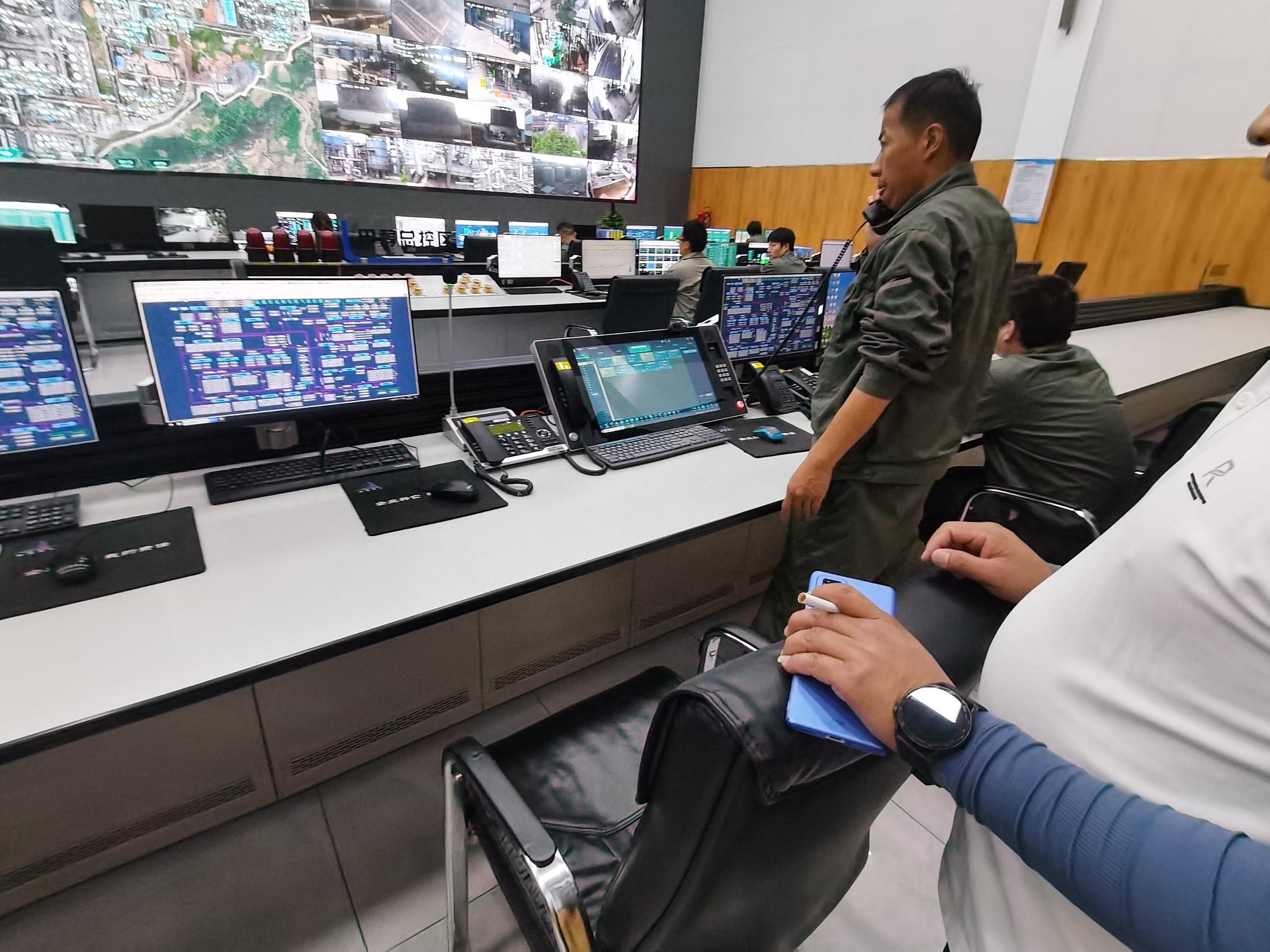
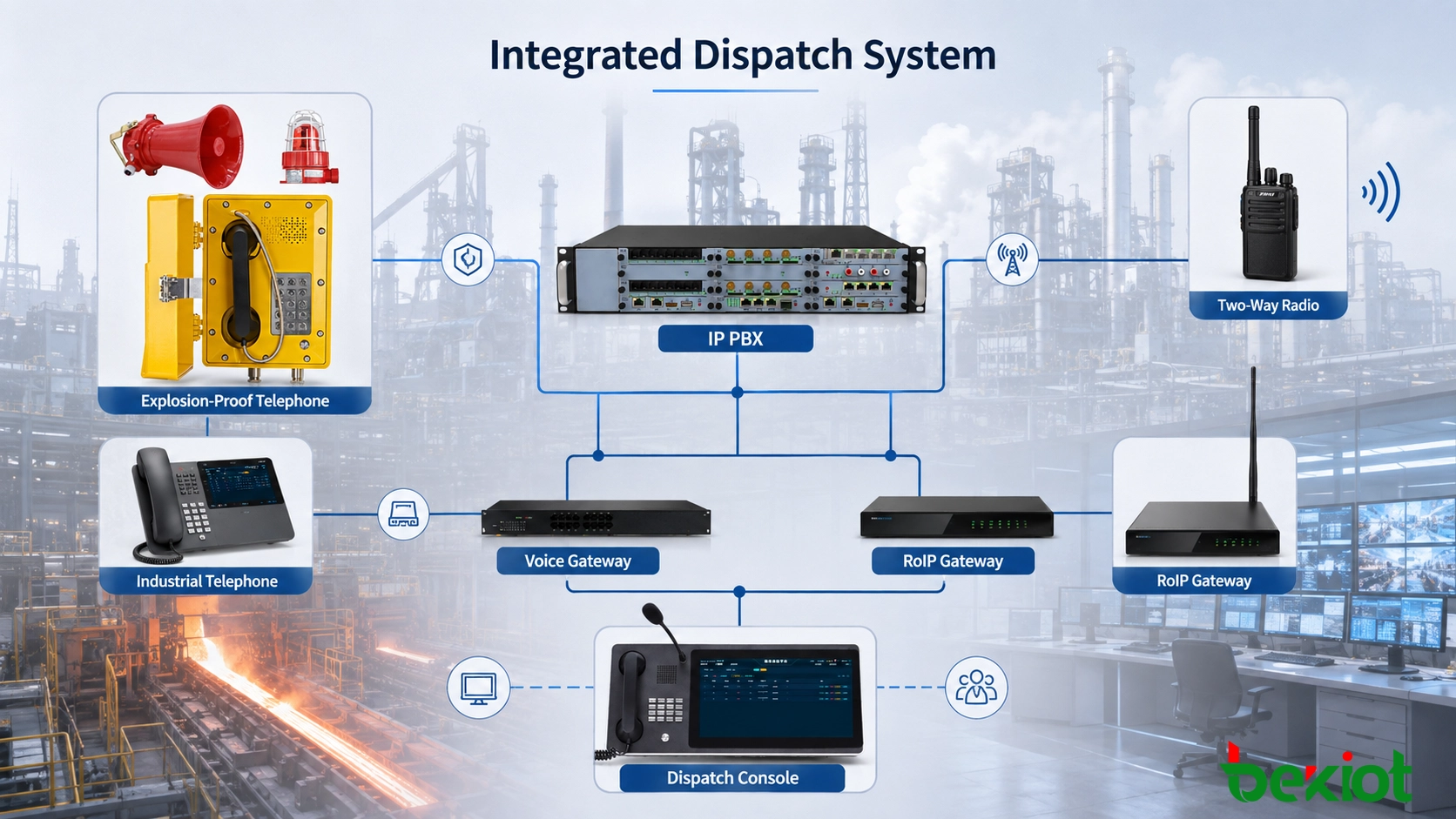
Where suitable interfaces are available, explosion-proof telephones, standard industrial telephones, SIP public address systems and radio communication resources can be integrated into a unified dispatch platform so that different communication methods support the same production and emergency-response workflow.
Explosion-proof telephones, IP PBX, public address and radio communication resources can be integrated with a centralized production dispatch platform according to the available system interfaces.
For example, after personnel in a coking area report a gas-related abnormal condition through an explosion-proof telephone, the dispatcher can immediately contact safety and maintenance personnel. If a wider notification is required, the dispatcher can then use the public address or radio system to notify the relevant operating areas.
The objective of this architecture is not simply to place every communication system on a single screen. Its real value is to reduce separation between communication channels so that field calls, personnel notification and subsequent dispatch operations can follow the actual incident-response process.
What Should Be Confirmed When Selecting Explosion-Proof Telephones for Steel Plants?
When selecting telephones for a metallurgical project, information such as “installed in the coking plant” or “used near the blast furnace” is not sufficient. Even within the same production section, hazardous-area classification and environmental conditions can differ significantly from one installation point to another.
Before confirming the equipment, the following information should be checked:
Installation location: Identify the specific workshop, platform, station building or equipment area.
Hazardous-area classification: Confirm the classification applicable to the exact telephone installation point.
Hazardous material: Determine whether the environment involves combustible gas, vapor or combustible dust.
Explosion-protection parameters: Verify the protection concept, equipment protection level, gas group, temperature class and certification scope.
Environmental conditions: Consider high and low temperatures, dust, rain, corrosion and vibration.
Ambient noise: Determine whether an external horn speaker, amplified ringing or audible and visual alarm device is required.
Communication interface: Confirm whether the project will use SIP networking or retain existing analog telephone lines.
Backend system: Determine whether the telephones need to connect to an IP PBX, dispatch console, recording system, public address system or radio communication system.
The physical installation position should also be reviewed before construction. If a telephone is too far from the actual operating point or is obstructed by large machinery, piping or structural elements, it may be difficult to reach during an emergency even if all equipment specifications meet the project requirements.
The key to explosion-proof communication in a steel and metallurgical plant is not simply installing more explosion-proof telephones. The objective is to place suitable fixed communication terminals at locations where dependable communication is genuinely required, such as coking, gas recovery, utility and pulverized coal systems, and then connect these terminals reliably to the relevant control rooms and production dispatch system.
For steel plants with existing analog telephone infrastructure, voice gateways can be used to support a phased migration toward IP-based communication. New projects can instead be designed around SIP explosion-proof telephones, IP PBX systems and centralized dispatch platforms from the beginning. The final explosion-protection parameters, communication interfaces and system functions should always be determined according to hazardous-area documentation, project design requirements and the actual site network conditions.
Becke Telecom provides explosion-proof telephones, industrial telephones, voice gateways, IP PBX systems and command-and-dispatch solutions for steel, coking and metallurgical projects. System architectures can be designed according to the requirements of new installations, brownfield communication upgrades and multi-system integration.
Becke Telcom specializes in industrial explosion-proof comms for rail, tunnel, oil & gas, and marine sectors, offering PAGA, SOS, and IP telephones with integrated PA, intercom, and calling.
If you have any suggestions or questions for us, please feel free to contact us!
We use cookie to improve your online experience. By continuing to browse this website, you agree to our use of cookie.
Cookies
Please read our Terms and Conditions and this Policy before accessing or using our Services. If you cannot agree with this Policy or the Terms and Conditions, please do not access or use our Services. If you are located in a jurisdiction outside the European Economic Area, by using our Services, you accept the Terms and Conditions and accept our privacy practices described in this Policy. We may modify this Policy at any time, without prior notice, and changes may apply to any Personal Information we already hold about you, as well as any new Personal Information collected after the Policy is modified. If we make changes, we will notify you by revising the date at the top of this Policy. We will provide you with advanced notice if we make any material changes to how we collect, use or disclose your Personal Information that impact your rights under this Policy. If you are located in a jurisdiction other than the European Economic Area, the United Kingdom or Switzerland (collectively “European Countries”), your continued access or use of our Services after receiving the notice of changes, constitutes your acknowledgement that you accept the updated Policy. In addition, we may provide you with real time disclosures or additional information about the Personal Information handling practices of specific parts of our Services. Such notices may supplement this Policy or provide you with additional choices about how we process your Personal Information.
Cookies
Cookies are small text files stored on your device when you access most Websites on the internet or open certain emails. Among other things, Cookies allow a Website to recognize your device and remember if you've been to the Website before. Examples of information collected by Cookies include your browser type and the address of the Website from which you arrived at our Website as well as IP address and clickstream behavior (that is the pages you view and the links you click).We use the term cookie to refer to Cookies and technologies that perform a similar function to Cookies (e.g., tags, pixels, web beacons, etc.). Cookies can be read by the originating Website on each subsequent visit and by any other Website that recognizes the cookie. The Website uses Cookies in order to make the Website easier to use, to support a better user experience, including the provision of information and functionality to you, as well as to provide us with information about how the Website is used so that we can make sure it is as up to date, relevant, and error free as we can. Cookies on the Website We use Cookies to personalize your experience when you visit the Site, uniquely identify your computer for security purposes, and enable us and our third-party service providers to serve ads on our behalf across the internet.
We classify Cookies in the following categories: ● Strictly Necessary Cookies ● Performance Cookies ● Functional Cookies ● Targeting Cookies
Cookie List A cookie is a small piece of data (text file) that a website – when visited by a user – asks your browser to store on your device in order to remember information about you, such as your language preference or login information. Those cookies are set by us and called first-party cookies. We also use third-party cookies – which are cookies from a domain different than the domain of the website you are visiting – for our advertising and marketing efforts. More specifically, we use cookies and other tracking technologies for the following purposes:
Strictly Necessary Cookies These cookies are necessary for the website to function and cannot be switched off in our systems. They are usually only set in response to actions made by you which amount to a request for services, such as setting your privacy preferences, logging in or filling in forms. You can set your browser to block or alert you about these cookies, but some parts of the site will not then work. These cookies do not store any personally identifiable information.
Functional Cookies These cookies enable the website to provide enhanced functionality and personalisation. They may be set by us or by third party providers whose services we have added to our pages. If you do not allow these cookies then some or all of these services may not function properly.
Performance Cookies These cookies allow us to count visits and traffic sources so we can measure and improve the performance of our site. They help us to know which pages are the most and least popular and see how visitors move around the site. All information these cookies collect is aggregated and therefore anonymous. If you do not allow these cookies we will not know when you have visited our site, and will not be able to monitor its performance.
Targeting Cookies These cookies may be set through our site by our advertising partners. They may be used by those companies to build a profile of your interests and show you relevant adverts on other sites. They do not store directly personal information, but are based on uniquely identifying your browser and internet device. If you do not allow these cookies, you will experience less targeted advertising.
How To Turn Off Cookies You can choose to restrict or block Cookies through your browser settings at any time. Please note that certain Cookies may be set as soon as you visit the Website, but you can remove them using your browser settings. However, please be aware that restricting or blocking Cookies set on the Website may impact the functionality or performance of the Website or prevent you from using certain services provided through the Website. It will also affect our ability to update the Website to cater for user preferences and improve performance. Cookies within Mobile Applications
We only use Strictly Necessary Cookies on our mobile applications. These Cookies are critical to the functionality of our applications, so if you block or delete these Cookies you may not be able to use the application. These Cookies are not shared with any other application on your mobile device. We never use the Cookies from the mobile application to store personal information about you.
If you have questions or concerns regarding any information in this Privacy Policy, please contact us by email at . You can also contact us via our customer service at our Site.

 English
 Deutsch
 한국어
한국어 Русский
 Français
 日本語
日本語 لالعربية
 हिन्दी
 Español
 Português
 繁体中文
繁体中文 简体中文
简体中文