Radio Over Internet Protocol (ROIP) gateway, also known as radio gateway or walkie-talkie gateway, was first developed by several American communication companies to address the pain point of long-distance communication for geographically dispersed two-way radios. By leveraging IP network technology, ROIP gateways break through the transmission distance limitations of traditional walkie-talkies and realize the interconnection of voice data between different regions. As the communication industry evolves, ROIP gateways have gone through technical iterations and are now widely applied in various professional communication scenarios with more powerful and diversified functions. Becke Telcom, a professional provider of audio and video communication solutions, has developed a series of ROIP gateway products adapted to modern communication needs, which perfectly combine traditional radio communication with IP network technology and provide reliable technical support for integrated communication and command scheduling in various industries.
The Evolution and Core Technical Parameters of ROIP Gateways
The early iteration of ROIP gateways was designed with a single core function: solving the cross-regional communication problem of two-way radios. Relying on basic IP communication technology, these gateways transmit voice data of walkie-talkies through the public internet or local area network (LAN), fundamentally solving the problem of limited communication distance of traditional walkie-talkies caused by signal power and antenna sensitivity. At that stage, the technical application of ROIP gateways was relatively simple, and the interconnection mode was mainly focused on the direct transmission of radio voice signals through IP networks, without realizing the deep integration with other communication systems.
With the rapid development of Voice Over Internet Protocol (VOIP) technology, especially the maturity of Session Initiation Protocol (SIP)-based softswitch technology, the technical architecture of ROIP gateways has been comprehensively upgraded. Most modern ROIP gateways are built based on the standard SIP protocol, which is the core technical change of this product category. By connecting with external cables, these gateways can convert the analog or digital voice signals of two-way radios into standard SIP protocol data streams, which not only retains the real-time and stability of traditional radio communication, but also endows two-way radios with richer communication capabilities. This technical upgrade makes ROIP gateways no longer a simple "distance extender" for walkie-talkies, but a key bridge connecting radio communication systems with modern IP-based communication systems.
Becke Telcom’s ROIP gateway products follow the latest industry technical standards, and all core models are built based on the SIP protocol. While realizing the basic voice signal conversion, they also optimize the real-time transmission performance of PTT (Push-to-Talk) signals, ensuring zero-error transmission of control signals during the communication process, which is in line with the high requirements of professional communication scenarios such as command scheduling and emergency response for communication stability.
Key Application Scenarios for ROIP Gateways
ROIP gateways are widely used in professional communication fields due to their unique technical advantages, and their application scenarios are highly targeted, mainly focusing on the integration of radio communication systems with other communication platforms and the cross-regional networking of radio systems. The following two scenarios are the most common and core application directions of ROIP gateways in the current market, and Becke Telcom’s ROIP gateway products have been fully optimized and adapted for these two scenarios.
Integrating Two-Way Radios with Telephony Systems
Two-way radios and telephony systems are two relatively independent communication systems with completely different working principles, signal transmission modes and application scenarios. Traditional two-way radios are mainly used in on-site command and short-distance real-time communication scenarios such as industrial production, emergency rescue and property management, while telephony systems, especially the modern telephony systems based on softswitch technology, are the core of enterprise and institutional integrated communication, undertaking the daily communication and scheduling command tasks of the whole organization.
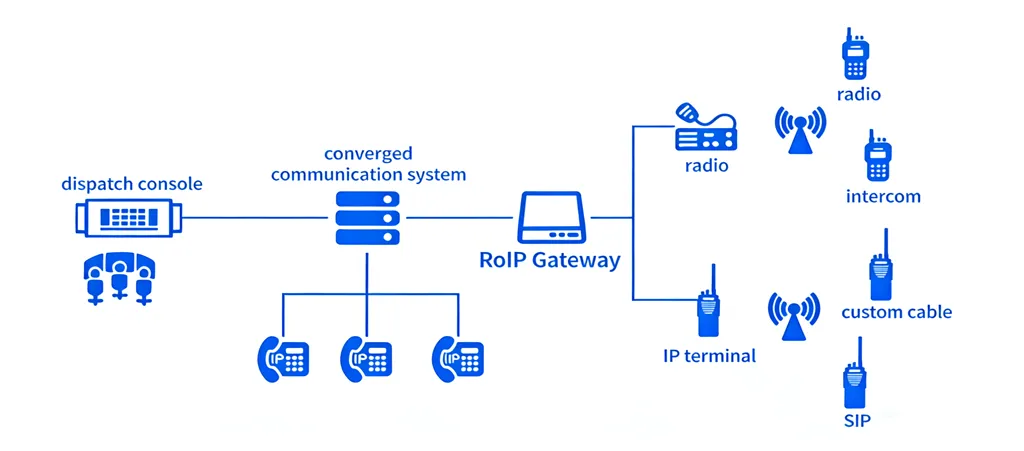
With the continuous improvement of the integrated communication capability of modern enterprises and public institutions, the demand for interconnection and intercommunication between the two independent systems of two-way radios and telephony systems is increasingly strong, especially in professional command and scheduling scenarios such as emergency command, public security dispatch and industrial production scheduling. The telephony system, as the core of the integrated communication platform, needs to realize the unified scheduling and management of all communication terminals including two-way radios, and ROIP gateways have become the indispensable core device to realize this demand.
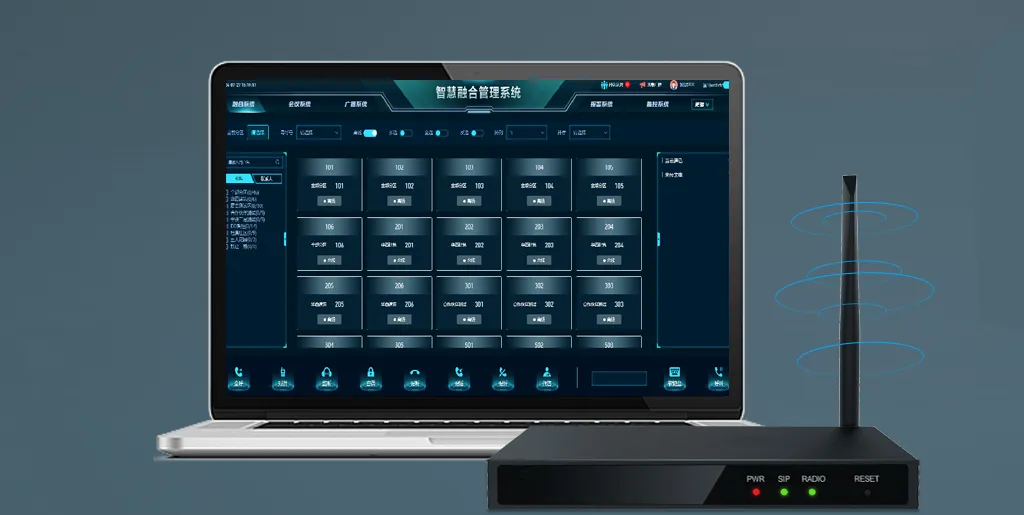
Becke Telcom’s ROIP gateway is compatible with walkie-talkies and vehicle-mounted radios from all major brands on the market, which ensures the stability and anti-interference performance of the physical connection, and is suitable for harsh working environments such as outdoor operation and emergency response. Through customized connecting cables, the gateway can realize rich and flexible control capabilities for radio equipment, including signal acquisition, PTT control and voice feedback. The core function of the gateway is to convert the voice signals of two-way radios into standard SIP protocol data, which can be seamlessly accessed to various softswitch platforms and integrated communication platforms based on the SIP protocol. For users, only simple parameter configuration and physical connection are needed to realize the interconnection between two-way radios and telephony systems, realizing the unified scheduling of radio terminals by the telephony scheduling system and greatly improving the efficiency of command and communication.
Remote Network Deployment for Two-Way Radio Systems
Remote networking of two-way radios is the original and classic application scenario of ROIP gateways, and it is still one of the most widely used scenarios at present. Traditional two-way radio systems are limited by signal coverage, and it is difficult to realize the interconnection of radio channels between different regions, which brings great obstacles to the cross-regional command and communication of enterprises and institutions with multiple branches, as well as public security, fire protection and other departments that need cross-regional collaboration. ROIP gateways solve this problem by leveraging the wide coverage of IP networks, realizing the interconnection of radio channels in different regions through the internet or private IP networks.
With the upgrade of SIP protocol technology, the remote networking mode of modern ROIP gateways has become more simple and efficient. Different from the early single-point interconnection mode, the new generation of ROIP gateways integrate more complete SIP protocol functions, support multi-point networking and multi-channel interconnection, and the networking structure is more flexible and scalable.
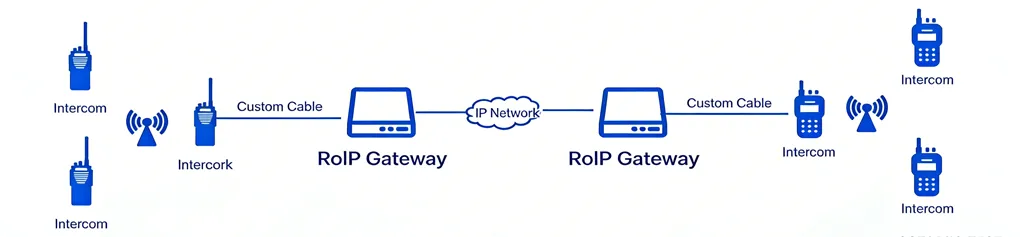
Becke Telcom’s ROIP gateway has a powerful remote networking capability, which can realize the interconnection of multiple gateways across different regions, and support the docking of two-way radios with different frequency bands and multiple standards at the same time, breaking the compatibility limitation between different radio systems. In addition to the basic radio interconnection function, the gateway also supports more flexible application modes such as registering to IP telephone systems and professional monitoring platforms. This multi-functional expansion makes the gateway not only a device for radio remote communication, but also an important part of the integrated communication system, which can realize the data interaction and information sharing between radio communication systems and other professional platforms. This technical advantage makes Becke Telcom’s ROIP gateway products perfectly meet the cross-regional networking needs of various industries, and realize the long-distance real-time communication of two-way radios in special scenarios such as emergency command, military applications, cross-regional enterprise production scheduling and large-scale event security, providing a reliable communication guarantee for the smooth development of various professional work.
The Technological Development Trend of ROIP Gateways
From the initial single-function distance extension device to the modern integrated communication bridge, ROIP gateways have been moving towards the development direction of integration and multi-functionality, driven by the continuous progress of communication technology and the increasing demand of the market for integrated communication. At present, the global ROIP gateway industry is in a critical period of technical upgrading, and the support for professional cluster communication protocols has become an important development trend of high-end ROIP gateway products.
In the international market, many well-known ROIP gateway brands have realized the support for Mission Critical Push-to-Talk (MCPTT) protocol standards. MCPTT protocol is a professional cluster communication protocol specially designed for emergency communication and mission-critical communication scenarios, which has the characteristics of high real-time, high reliability and strong anti-interference. The integration of MCPTT protocol makes ROIP gateways more suitable for the high requirements of emergency response, public security and military fields for communication systems, and has formed a wide application consensus in the international emergency communication field.
In the domestic market, the development of professional broadband cluster communication technologies such as B-TrunC, MCPTT and SIP broadband intercom is at a technical watershed. With the continuous promotion of the digital transformation of the domestic communication industry and the increasing demand for professional cluster communication, the integration of these broadband cluster communication protocols with ROIP gateways has become the key direction of the technical development of domestic ROIP gateway products. Becke Telcom has been keeping close attention to the development of domestic broadband cluster communication technology, and has completed the application adaptation of ROIP gateways to broadband cluster communication scenarios through in-depth technical research and development. In the follow-up, Becke Telcom will launch a series of technical solutions for integrating ROIP gateways with B-TrunC, MCPTT and SIP broadband intercom protocols, further enriching the product functions and expanding the application scenarios, and providing more advanced technical support for the domestic professional communication industry.
Primary Application Fields of Modern ROIP Gateways
Combined with the current technical development level and market application demand, the modern ROIP gateway is mainly applied in two core fields, which are also the two most popular application methods of ROIP gateways in the market at present, and Becke Telcom’s ROIP gateway products have achieved large-scale application in these two fields.
The first core application field is the integrated communication and command scheduling field. In this field, ROIP gateways play the role of a "communication bridge", breaking through the technical barriers between traditional two-way radio communication systems and modern SIP-based integrated communication and scheduling systems, realizing the unified scheduling and management of radio terminals by the central scheduling system. This application is widely used in professional scheduling scenarios such as emergency command, public security fire protection, industrial production and transportation scheduling, effectively improving the integration level and command efficiency of the communication system.
The second core application field is the cross-regional networking communication of two-way radio systems. Relying on the IP network coverage advantage, ROIP gateways realize the interconnection of radio channels in different regions, expand the communication distance and coverage of traditional two-way radios, and solve the problem of cross-regional communication of radio systems. This application is suitable for large enterprises with multiple cross-regional branches, transportation and logistics industries with long-distance operation needs, and public service departments such as border defense and highway management that need cross-regional collaboration, and has become an indispensable technical device for the cross-regional communication of radio systems in these industries.
In the era of integrated communication, the demand for interconnection and intercommunication between different communication systems is becoming more and more urgent, and ROIP gateways, as the core device connecting traditional radio communication and modern IP network communication, will play a more important role in the professional communication field. Becke Telcom will continue to focus on the technical development trend of the ROIP gateway industry, carry out in-depth research and development according to the market demand, and launch more high-performance, multi-functional and highly adaptable ROIP gateway products and solutions, so as to provide more professional and reliable audio and video communication technical support for the development of various industries.

 English
 Deutsch
 한국어
한국어 Русский
 Français
 日本語
日本語 لالعربية
 हिन्दी
 Español
 Português
 繁体中文
繁体中文 简体中文
简体中文