As a core pillar of global smart city development, smart community construction has gained massive traction in recent years, with a core goal of upgrading residents’ daily living experience and boosting the overall governance efficiency of urban intelligent ecosystems. Driven by the demand for refined management, digital public services, and intelligent security, governments and industry practitioners are accelerating the launch of smart community projects in major cities across the board. Yet the smart community sector remains in its early developmental stage, lacking unified industrial standards and standardized implementation guidelines. Most projects deploy a mix of products from different brands and disparate technical frameworks, creating severe bottlenecks for system integration, cross-device collaboration, and centralized management. These systemic fragmentation issues not only raise project deployment difficulty and upfront costs but also hinder the rollout of truly intelligent application scenarios within smart communities, especially the coordinated operation of monitoring, communication, alarm and broadcast modules.
The foundation of high-performance smart community construction lies in achieving full networking of on-site terminal devices and building a unified centralized management system. Only by breaking down data silos and device interoperability barriers can the ecosystem unlock advanced intelligent functions including real-time monitoring, automatic alarm linkage, cross-system scheduling, and data-driven decision-making. As a professional provider of video networking and intelligent communication solutions, Becke Telcom has launched a targeted smart community video networking system, a self-developed core platform tailored for community scenario demands. This system is compatible with mainstream hardware including AVIoT video networking gateways, and integrates a dedicated ROIP gateway to replace traditional trunking gateways and trunking intercom gateways, fulfilling cluster interconnection needs. It realizes unified management of community-wide video surveillance resources, and integrates monitoring, two-way intercom, one-key network alarm, routine broadcast, emergency broadcast, visual call and unified communication functions, enabling seamless docking with smart community platforms and effectively resolving the complex challenges of video access, networking, centralized management and multi-service collaboration in smart community projects.

Core Pain Points in Current Smart Community Management & Service Operations
The rapid expansion of smart community projects has exposed a slew of industry pain points surrounding device interconnection, business coordination and daily management, which directly restrict project quality and long-term operational efficiency. The most prominent issue is the absence of unified access standards: community security and management systems are typically equipped with cameras, network video recorders (NVRs), sensing terminals, and communication devices from various manufacturers. These devices rely on proprietary protocols, custom SDKs, and unique transmission standards, making unified access and centralized monitoring extremely challenging. Many smart community platforms struggle to pull real-time surveillance footage or synchronize device status data, resulting in isolated operation of individual subsystems and a failure to form a cohesive, full-coverage management network.
Beyond protocol fragmentation, the lack of integrated business functions further limits the practical value of smart community systems. Traditional community management tools split monitoring, intercom, alarm, broadcast and communication modules into separate systems, with no effective linkage mechanism. Property managers cannot conduct real-time intercom calls while viewing surveillance footage, residents have no convenient one-key alarm channel for emergencies, and emergency broadcasts cannot be triggered synchronously with alarm signals. This disjointed operation leads to low response efficiency for security breaches, fire hazards, resident help requests and other unexpected incidents, failing to meet the high-efficiency management needs of modern smart communities.
Project implementers and software platform providers also bear heavy workloads related to device docking and system debugging. The vast majority of technical resources are tied up in resolving underlying connectivity issues, leaving minimal bandwidth for teams to focus on core smart community business development and scenario innovation. Collectively, these pain points slow down smart community project implementation, escalate post-launch operation and maintenance costs, and prevent the full realization of the intelligent and convenient management value that smart community construction aims to deliver.
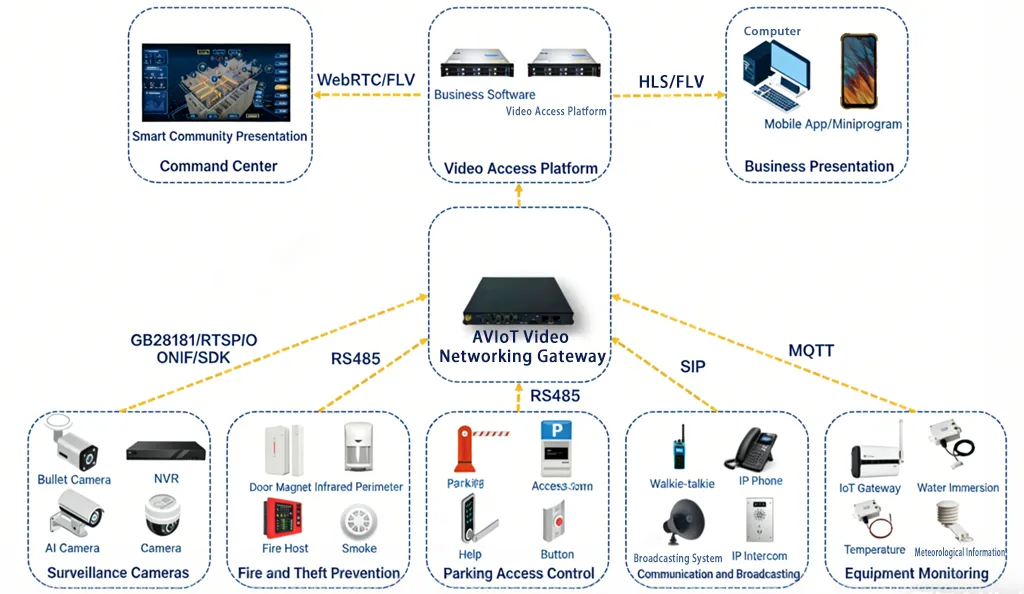
Becke Telcom Smart Community Video Networking System: Core Architecture & Functional Advantages
Becke Telcom’s smart community video networking system adopts a layered, highly scalable architecture, engineered to tackle industrial fragmentation and integration hurdles with a focus on unified device access, integrated business operations and cross-module intelligent linkage. As the self-developed core of the whole solution, this system serves as the central control hub for smart community management, compatible with AVIoT video networking gateways for device access and equipped with ROIP gateway for communication convergence, forming a closed-loop operational system covering front-end device access, central platform control and upper-layer business application. The system focuses on seven core functions to realize all-round smart management of communities: real-time video monitoring, two-way intercom shouting, one-key network alarm, routine public broadcast, emergency priority broadcast, visual call and unified communication scheduling.
2.1 Centralized Video Monitoring: Full-Coverage Real-Time Perception
The video monitoring module is the basic core of Becke Telcom’s smart community system, supporting unified access and centralized management of all surveillance devices in the community, including bullet cameras, AI cameras, standard surveillance cameras and NVRs. The system breaks down brand and technical barriers, docking with AVIoT video networking gateways to adapt to mainstream protocols such as GB28181, RTSP, ONVIF, realizing seamless access of heterogeneous surveillance equipment. It achieves 24/7 real-time monitoring, playback and status query of community public areas, building entrances, parking lots and other key zones, providing clear and stable visual data for daily property management and emergency disposal, and laying a solid foundation for subsequent linkage of intercom, alarm and broadcast functions.
2.2 Integrated Communication Module: Intercom, Visual Call & ROIP Gateway Convergence
For community communication demands, Becke Telcom’s system builds a full-scenario communication module centered on the ROIP gateway, replacing traditional trunking gateways and trunking intercom gateways to realize efficient convergence of voice and visual communication. The module supports clear two-way intercom shouting between property management centers and residential units, parking lots, public facilities; realizes high-definition visual calls between residents and property, visitors and access control, breaking the limitation of pure voice communication; and interconnects with IP phones, walkie-talkies and other communication devices via ROIP gateway to form a unified communication network. Managers can conduct real-time communication while viewing monitoring screens, greatly improving the efficiency of daily management and emergency response.
2.3 Alarm & Broadcast Linkage: One-Key Alarm & Emergency Broadcast
To ensure community security and rapid emergency disposal, the system is equipped with a dedicated one-key network alarm function, which is set up in residential homes, public areas, parking lots and other key positions. Residents or on-site managers can trigger the alarm with one click in case of emergencies, and the system will immediately push the alarm information and corresponding surveillance video to the property dispatching center synchronously. Meanwhile, the system integrates routine broadcast and emergency broadcast functions: routine broadcast is used for community notices, property reminders and other daily services; emergency broadcast has priority triggering authority, which can be automatically activated synchronously with the alarm signal to issue risk prompts, evacuation guidance and other key information in real time, realizing the closed-loop linkage of “alarm + monitoring + broadcast” to maximize the safety of residents’ lives and property.
Full-Scenario Device Access & Cross-Module Intelligent Collaboration
Becke Telcom’s smart community video networking system features extensive device adaptability, covering all core hardware modules involved in smart community construction and achieving full coverage of security protection, facility management, environmental monitoring and communication dispatching. The system supports stable access to a full range of front-end devices, including surveillance cameras, NVRs, door contact sensors, infrared perimeter detectors, parking barriers, fire protection hosts, smoke detectors, access control systems, temperature sensors, water immersion monitoring equipment and meteorological information collection terminals, realizing unified access and management of all community hardware.
More importantly, the system delivers in-depth cross-module intelligent collaboration, integrating video monitoring, intercom shouting, one-key alarm, routine broadcast, emergency broadcast, visual call and unified communication into a single central platform. Unlike traditional fragmented systems, all functional modules of Becke Telcom’s system operate in a coordinated manner: when a one-key alarm is triggered, the system automatically switches to the corresponding monitoring screen, starts the emergency broadcast, and pushes the call channel to the dispatching center; during daily patrols, managers can initiate intercom or visual calls directly through the monitoring interface, and issue routine broadcast notices with one click. This integrated operation model completely eliminates the barriers between single functions, fully meeting the application requirements of intelligent networking, integrated perception and efficient linkage in smart communities.
Practical Value & Deployment Advantages of Becke Telcom’s System
The application of Becke Telcom’s smart community video networking system delivers tangible value to project construction and long-term operation, effectively resolving industry pain points and accelerating the rapid implementation of smart community projects. Its most core advantage is the **integration of all core management functions**, replacing multiple separate systems with one central platform, which simplifies system deployment and daily operation processes. The system’s high compatibility eliminates the need for customized docking for each individual device and protocol, drastically reducing debugging and deployment workloads, shortening project cycles and lowering the technical threshold and construction costs for system integrators and developers.
For property management teams and smart community software platform providers, the system frees up operational and technical resources from tedious multi-system switching and underlying debugging tasks. Property staff can complete monitoring, intercom, alarm handling, broadcast release and other work through a unified interface, greatly improving daily management efficiency; platform developers can focus on business optimization and user experience upgrading, accelerating the iteration of smart community applications and promoting personalized and refined community services.
In terms of operational stability and scalability, the system adopts a modular design, supporting flexible expansion of device access and functional modules as community construction needs evolve. Its reliable protocol adaptation and data transmission capabilities ensure 24/7 uninterrupted operation of monitoring, communication, alarm and broadcast systems, reducing post-launch operation and maintenance pressure. Additionally, the system’s user-friendly operation interface and multi-terminal adaptation features (supporting PCs, mobile phones and management terminals) cater to the diverse management needs of dispatching centers, property teams and residents, boosting the overall operational efficiency of smart communities and enhancing residents’ sense of security, convenience and satisfaction.
Conclusion
Smart community construction is an inevitable trend of urban digital transformation, and building an integrated, efficient and unified management system is the key to driving high-quality development of the industry. Becke Telcom’s self-developed smart community video networking system, with centralized monitoring, integrated communication, one-key alarm and dual-mode broadcast as core functions, and equipped with ROIP gateway for communication convergence, targets the core industry pain points of fragmented devices, disjointed functions and difficult integration in current smart community projects. It realizes unified device management, cross-module intelligent linkage and full-scenario efficient operation, providing a reliable, efficient and scalable technical path for standardized smart community construction.
As smart city construction continues to deepen, the demand for intelligent and integrated community management will rise further. Becke Telcom will continue to optimize its self-developed smart community video networking system, focus on upgrading core functions such as monitoring, intercom, alarm and broadcast, continuously enhance system stability and adaptability, and support the efficient implementation of more smart community projects. By empowering the digital upgrade of community governance, the system contributes to building safer, more convenient and highly intelligent urban living environments.

 English
 Deutsch
 한국어
한국어 Русский
 Français
 日本語
日本語 لالعربية
 हिन्दी
 Español
 Português
 繁体中文
繁体中文 简体中文
简体中文