In modern industrial, public safety and enterprise environments, seamless communication is the lifeblood of operational efficiency, emergency response and cross-system collaboration. As organizations migrate from legacy circuit-switched frameworks to IP-based softswitch architectures, the need for robust, scalable interoperability between disparate networks has never been more critical. Becke Telcom, a leading provider of unified communications and command dispatch solutions, has engineered a modular, future-proof ecosystem centered on three core components: unified communications servers, ROIP gateways, and purpose-built terminals. At the heart of this ecosystem lies the ROIP gateway—replacing legacy cluster gateway and cluster intercom gateway solutions—to bridge the gap between SIP-based communication cores and trunked radio networks, ensuring end-to-end connectivity across protocols, devices and locations. This article breaks down the technical architecture, core functions, and real-world value of Becke Telcom’s integrated solution, highlighting how it addresses the unique challenges of cross-protocol communication in modern dispatch systems.
The Fundamental Role of Gateways in Cross-Network Communication
Before diving into Becke Telcom’s specific solution, it is essential to grasp the universal role of gateways in communication systems. At their core, gateways serve as network boundary intermediaries, enabling communication between two or more networks that use distinct protocols, media formats or technical standards. In basic consumer networking, a home router acts as a gateway, translating local area network (LAN) traffic to wide area network (WAN) traffic, allowing devices to access the internet. In enterprise and industrial communication systems, this role becomes exponentially more complex, as organizations must integrate multiple siloed networks—including voice intercom systems, video surveillance, trunked radio networks, and IP-based communication platforms—into a single, cohesive dispatch infrastructure.
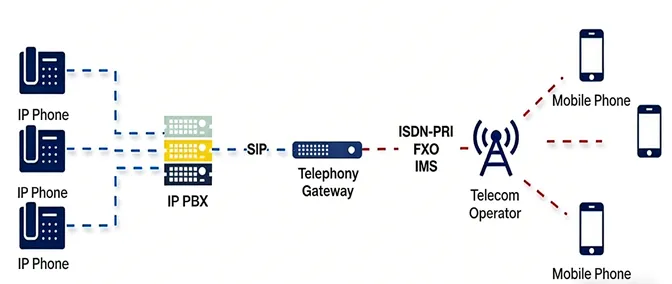
Without gateways, these networks operate in isolation, creating communication bottlenecks, redundant systems and inefficiencies. For example, a public safety agency with a trunked radio network and a SIP-based dispatch system cannot share real-time voice or video data without a gateway to translate between the two protocols. Similarly, industrial facilities with legacy intercom systems and modern IP-based communication tools rely on gateways to unify operations and ensure rapid response to incidents. Becke Telcom’s solution is built on this foundational principle: gateways are not just optional add-ons, but critical enablers of interoperability, designed to simplify system integration, reduce development costs and optimize network performance.
Core Components of Becke Telcom’s Unified Communications & Command Dispatch Systems
Becke Telcom’s unified communications and command dispatch architecture is built on a modular, three-tier framework, with each component playing a distinct, non-redundant role in delivering end-to-end communication capabilities. The framework evolves from the shift from circuit-switched to IP softswitch technology—a transformation that redefined how communication networks process voice, video and data traffic—ensuring scalability, flexibility and compliance with global communication standards.
2.1 Unified Communications Servers: The Central Nervous System
Servers form the central processing and management core of Becke Telcom’s dispatch systems, serving as the “brain” that orchestrates all critical communication functions. Modern deployments are built around Session Initiation Protocol (SIP) servers—the de facto standard for IP-based communication signaling—with Becke Telcom leveraging a modular server architecture tailored to project scale. For small to mid-scale systems, a single physical or virtual server consolidates all core functions, including SIP user management, audio/video switching, call recording, GIS-integrated location tracking and backend system management. For large-scale, high-demand deployments, specialized server modules work in tandem to deliver advanced capabilities:
- Signaling Servers: Manage the setup, teardown and routing of SIP signaling traffic, ensuring reliable connection establishment for voice and video calls across the network.
- Media Servers: Process real-time audio and video traffic, supporting audio mixing, video transcoding and media playback for broadcast and emergency notification use cases.
- Authentication Servers: Enforce network security by validating user and device credentials, restricting access to only authorized terminals and personnel.
- Proxy Servers: Act as intermediaries for SIP traffic, routing requests between internal and external network elements while enhancing security and scalability.
- Recording & Platform Management Servers: Capture and store communication data for compliance and audit purposes, while providing a centralized web interface for network configuration, device management and performance monitoring.
- Map Servers: Integrate Geographic Information System (GIS) functionality, enabling location-based dispatch and real-time tracking of mobile terminals and field assets.
This modular design eliminates the need for standalone deployment of specialized servers in most projects, delivering cost efficiency, simplified implementation and seamless scalability—all without compromising performance or reliability. Functional expansion is achieved through software updates and licensing, rather than costly hardware upgrades, ensuring the system adapts to evolving project requirements.
2.2 ROIP Gateways: The Critical Bridge for Trunked Radio & SIP Interoperability
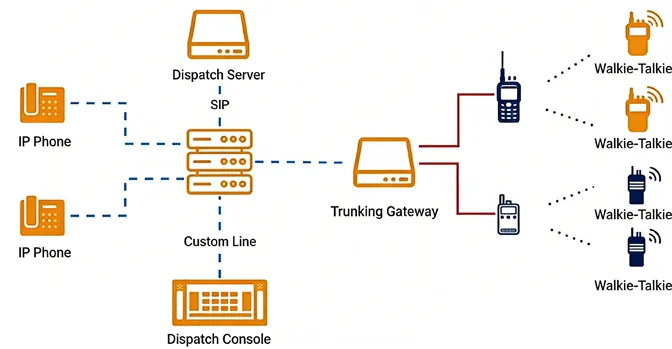
Replacing legacy cluster gateway and cluster intercom gateway solutions, ROIP (Radio over IP) gateways are the cornerstone of Becke Trademark’s interoperability solution, serving as the dedicated bridge between non-SIP networks—specifically trunked radio networks—and the SIP-based communication core. Trunked radio networks, used extensively in public safety, industrial and military applications, rely on proprietary protocols that are incompatible with native SIP. Directly integrating these networks into the core SIP server would bloat the server’s software architecture, increase maintenance complexity and lock users into a closed ecosystem. ROIP gateways solve this challenge by acting as specialized protocol and media translators, handling all necessary conversions to enable seamless communication with the SIP core.
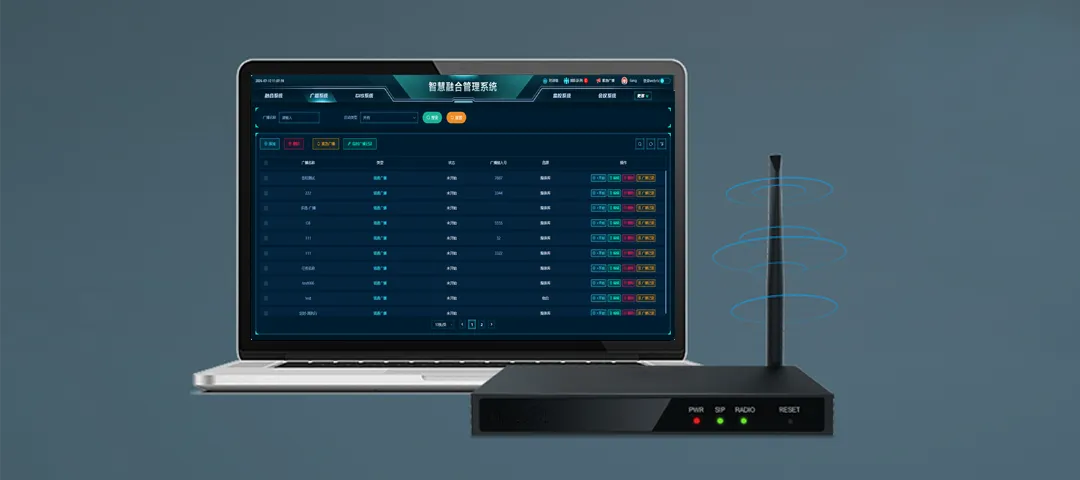 Becke Telcom’s ROIP gateways are engineered to support a wide range of trunked radio systems, including professional trunked radio networks, two-way radios and legacy intercom devices. Their core functions include:
- Protocol Conversion: Translating non-SIP signaling (e.g., trunked radio control signals) to SIP and vice versa, ensuring compatibility between the dispatch core and radio networks.
- Media Conversion: Adjusting audio codecs to ensure seamless voice communication between radio users and SIP terminals, maintaining audio quality across networks.
- Radio Control: Enabling voice detection and remote control of radio devices, allowing dispatch operators to manage radio communications from the SIP-based platform.
- Scalability & Flexibility: Being added on-demand based on the specific radio networks requiring integration, ensuring the system grows with organizational needs without disrupting existing infrastructure.
Beyond basic interoperability, Becke Telcom’s ROIP gateways are designed for reliability and performance, even in harsh industrial and outdoor environments. They support high-volume traffic, low-latency communication and ruggedized hardware options, making them ideal for public safety response, industrial site communication and emergency dispatch scenarios. By offloading protocol and media conversion tasks to dedicated ROIP gateways, the core SIP server operates efficiently, reducing maintenance overhead and simplifying system management.
2.3 Diverse Terminals: Tailored Interfaces for End-User Scenarios
Terminals are the front-end devices that put the power of the unified communications system into the hands of end users, serving as the physical interface between personnel and the SIP/ROIP-based network. Unlike servers and gateways, which form the backend infrastructure, terminals are purpose-built for functionality—not processing—hosting no complex switching or routing logic, instead acting as input/output devices that send and receive traffic to and from the core server. This design makes terminals cost-effective, rugged and easy to deploy, with all network settings and user permissions managed centrally through the server’s management platform.
Becke Telcom offers a comprehensive portfolio of terminals engineered to meet the unique needs of industrial, municipal, enterprise and public safety use cases, ensuring every user and scenario has a purpose-built device:
- IP Phones: Standard desktop terminals for offices, control rooms and industrial facilities, delivering high-quality voice communication and basic dispatch features.
- Smart Terminals: Ruggedized mobile devices (handhelds and tablets) with integrated voice, video and GIS capabilities, designed for field personnel and mobile dispatch teams.
- IP Broadcast Audio Terminals: Waterproof SIP speakers and column speakers for public address and emergency notification in outdoor and industrial environments (e.g., industrial parks, scenic areas and municipal roads).
- Emergency Intercom Terminals: Wall-mounted or standalone devices with one-touch call functionality, used for rapid emergency assistance in public areas, industrial sites and transportation hubs.
- SIP Cameras: IP cameras with integrated SIP communication, enabling two-way audio and video communication alongside video surveillance.
- Dispatch Consoles: Specialized desktop terminals for control room operators, featuring multi-line call management, one-touch dispatch, GIS mapping and real-time terminal status monitoring.
- Portable Video Terminals: Ball cameras and body-worn recorders for mobile video and voice communication during field operations and incident response.
- Video Conference Terminals: Dedicated devices for high-definition video and audio communication in small and large conference rooms, supporting cross-platform collaboration.
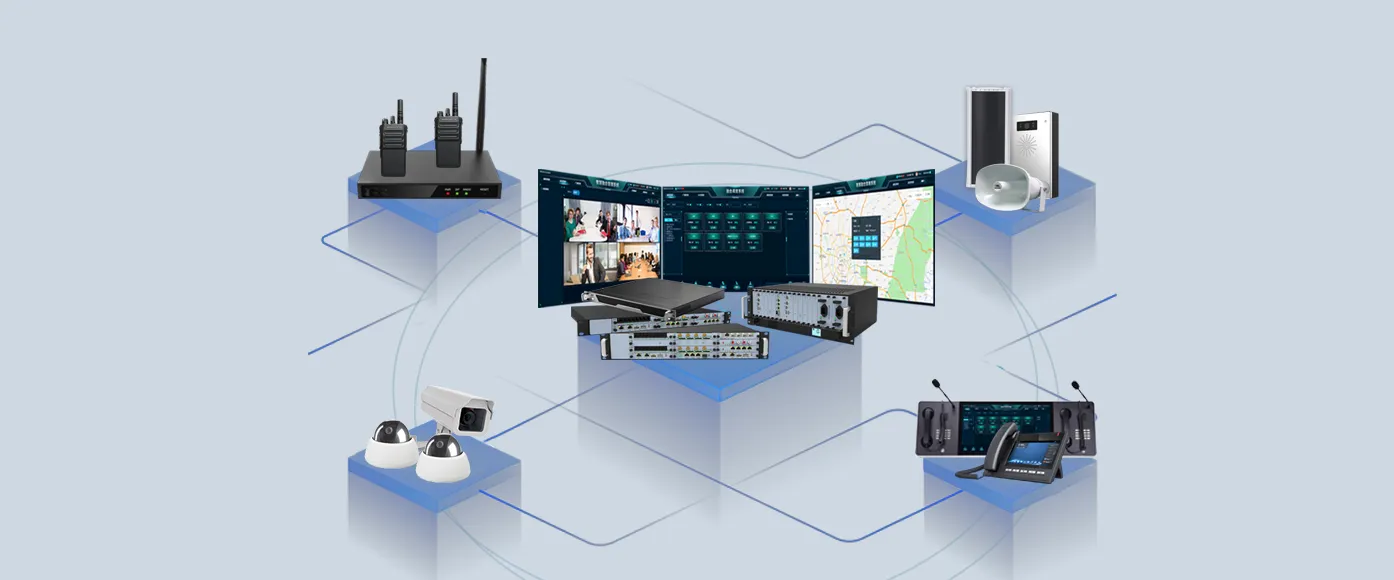
This diverse terminal ecosystem ensures Becke Telcom’s solution is adaptable to any industry, from manufacturing and logistics to public safety and municipal government, aligning with the unique communication needs of every end user.
How Becke Telcom’s Ecosystem Delivers Seamless End-to-End Communications
The true power of Becke Telcom’s unified communications and command dispatch system lies in the seamless synergy between its three core components: servers, ROIP gateways and terminals. This integrated architecture enables end-to-end communication across any protocol, any device and any location, delivering a robust, scalable solution that outperforms traditional circuit-switched systems. The collaboration workflow is straightforward and efficient:
- Server as the Brain: The core SIP server manages all network logic, user authentication, traffic routing and system configuration, serving as the central command hub for the entire ecosystem.
- ROIP Gateway as the Bridge: ROIP gateways translate non-SIP protocols (e.g., trunked radio) to SIP, integrating legacy and specialized systems into the communication core and expanding the network’s reach and interoperability.
- Terminal as the Interface: Terminals put the network’s capabilities into the hands of end users, enabling real-world communication and dispatch, with all user interactions managed through the server’s centralized platform.
This modular architecture supports infinite scalability, allowing organizations to add additional terminals, ROIP gateways or server capacity as needed without disrupting existing infrastructure. It also enables a high degree of customization, with system integrators able to mix and match servers, ROIP gateways and terminals to build solutions tailored to virtually any communication scenario. By adhering to standardized protocols like SIP, Becke Telcom’s solution fosters an open, interoperable ecosystem that enables integration with third-party devices and systems, creating a win-win industry chain that drives innovation and choice for end users.
Key Advantages of Becke Telcom’s Modular, Gateway-Centric Architecture
Becke Telcom’s unified communications and command dispatch solution stands out in the market due to its unique design and technical advantages, all centered on the ROIP gateway and modular server architecture. These key benefits make it the preferred choice for industrial, public safety and enterprise organizations:
4.1 Unmatched Interoperability
The ROIP gateway is the linchpin of this advantage, enabling seamless communication between SIP-based dispatch cores and virtually any trunked radio network. Unlike legacy cluster gateway solutions that limit interoperability to specific radio protocols, Becke Telcom’s ROIP gateways support a wide range of trunked radio standards, ensuring compatibility with legacy systems and modern radio devices. This eliminates communication silos and ensures real-time data sharing across networks, a critical requirement for emergency response and industrial operations.
4.2 Cost Efficiency & Simplified Deployment
The modular server architecture eliminates the need for standalone specialized servers in most projects, reducing hardware costs and implementation complexity. ROIP gateways are added on-demand, ensuring organizations only invest in the components they need, while the consolidated server design streamlines setup and maintenance. Software-based functional expansion further reduces long-term costs, as organizations can add new capabilities through updates rather than costly hardware upgrades.
4.3 Rugged Reliability for Harsh Environments
Becke Telcom’s ROIP gateways and terminals are engineered to withstand the rigors of industrial and outdoor environments, with ruggedized hardware options that resist dust, moisture, extreme temperatures and physical impact. This makes the solution ideal for public safety response, industrial site communication and emergency dispatch scenarios where reliability is non-negotiable.
4.4 Centralized Management & Control
All components of the ecosystem are managed through a single, web-based platform, providing dispatch operators with full visibility into network status, terminal performance and communication traffic. This centralized control simplifies maintenance, reduces operational overhead and ensures rapid response to issues, further enhancing system efficiency.
4.5 Future-Proof Scalability
The modular design ensures the system can adapt to evolving organizational needs, whether expanding to new locations, integrating additional radio networks or adding advanced features like AI-powered analytics. Becke Telcom’s solution is built to grow with businesses, avoiding the need for full system overhauls as requirements change.
Real-World Applications: Industrial, Public Safety & Enterprise Use Cases
Becke Telcom’s unified communications and ROIP gateway solution has been deployed across a wide range of industries, delivering tangible value in real-world scenarios. Below are three key use cases that highlight the solution’s versatility and effectiveness:
5.1 Public Safety & Emergency Response
Public safety agencies rely on seamless communication between trunked radio networks (used by first responders) and SIP-based dispatch systems (used by command centers) to save lives. Becke Telcom’s ROIP gateways enable real-time voice communication between radio users and dispatch operators, with GIS-integrated terminals providing location data for mobile responders. During emergencies, this interoperability ensures rapid coordination, allowing command centers to direct resources efficiently and share critical information across networks. The ruggedized design of ROIP gateways and terminals ensures reliable performance in harsh outdoor environments, from urban disaster zones to rural remote areas.
5.2 Industrial Facility Communication
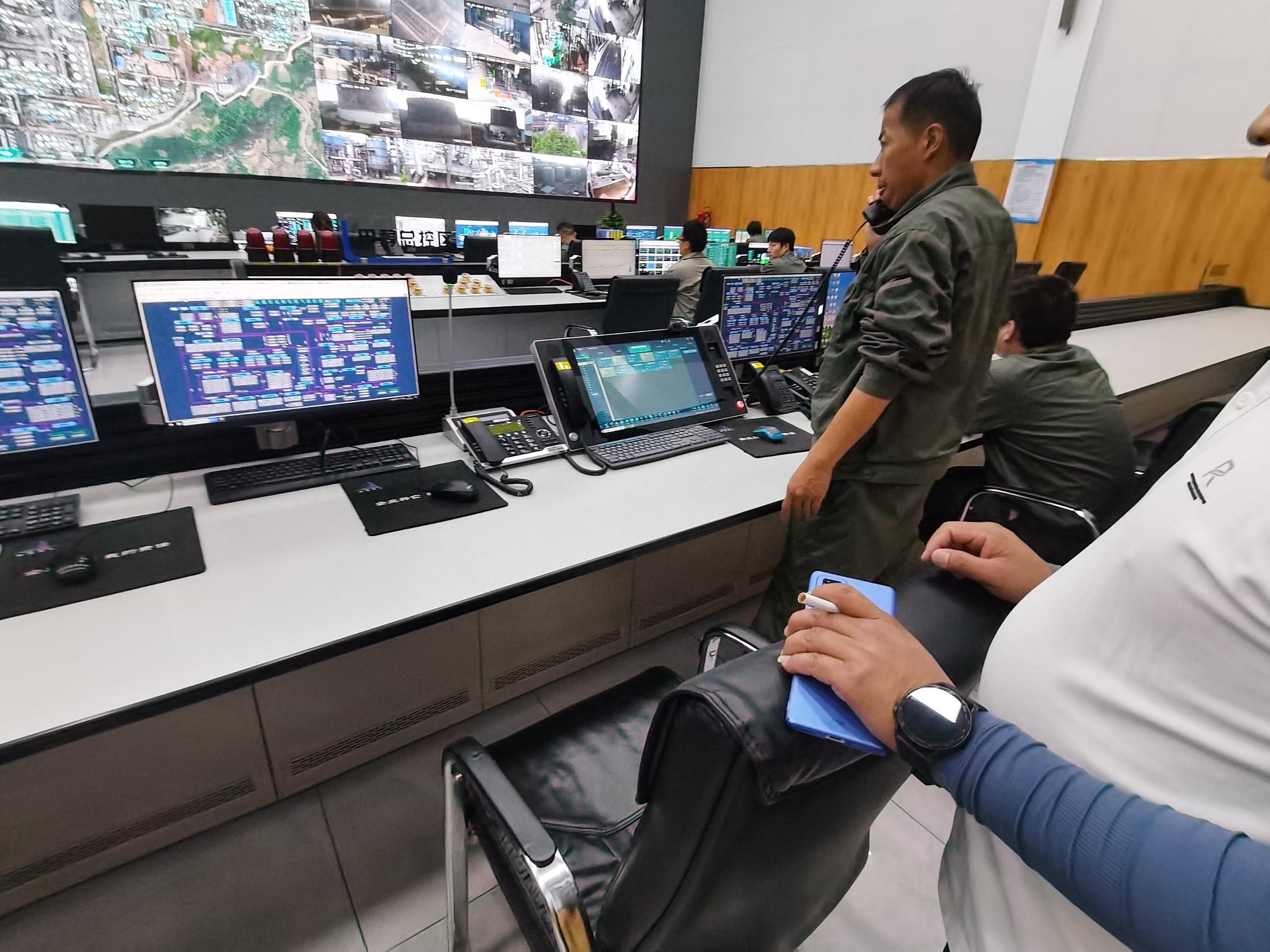
Industrial facilities, such as manufacturing plants, refineries and power stations, operate with multiple siloed networks, including trunked radio for on-site personnel, IP-based intercom systems for control rooms and video surveillance for security. Becke Telcom’s ROIP gateways unify these networks, enabling dispatch operators to communicate with on-site staff via radio, monitor video feeds in real time and manage emergency response—all from a single platform. This reduces communication delays, improves safety and streamlines operations, ensuring rapid response to industrial incidents like equipment malfunctions or safety hazards.
5.3 Enterprise & Municipal Communication
Large enterprises and municipal governments often have complex communication needs, including office intercom systems, public address systems for public spaces and mobile communication for field teams. Becke Telcom’s solution integrates these systems via ROIP gateways and diverse terminals, enabling centralized communication management. For example, a municipal government can use IP broadcast audio terminals to send emergency notifications to public areas, while dispatch consoles manage communication between field staff and control centers. This unification improves operational efficiency and enhances public safety for residents and employees.
Conclusion: Future-Proofing Communications with Becke Telcom’s Solutions
In an era where seamless communication is essential for operational efficiency, safety and collaboration, Becke Telcom’s unified communications and command dispatch architecture—centered on servers, ROIP gateways and purpose-built terminals—delivers a robust, scalable solution that

 English
 Deutsch
 한국어
한국어 Русский
 Français
 日本語
日本語 لالعربية
 हिन्दी
 Español
 Português
 繁体中文
繁体中文 简体中文
简体中文