Video access gateways stand as a pivotal multifunctional video fusion device in the field of intelligent system integration, boasting robust video input and output capabilities that underpin cross-platform video application development. In the construction of smart projects spanning various industries, these gateways serve as a bridge to integrate disparate video monitoring systems, and their media forwarding and API interface capabilities enable seamless combination of cross-platform video resources with diverse business function platforms. What makes them a game-changer for project development is that the complex video processing work is fully handled by the gateways themselves, while developers only need to call simple interfaces to complete integration and development work.
Widely applied in smart water conservancy, smart power, smart emergency response, smart parks and other smart project scenarios, video access gateways are often associated with API development for system integration. However, their functional value far exceeds this single application mode. Beyond API-based development, video access gateways support a wealth of out-of-the-box application scenarios that only require simple network configuration without additional technical development. These scenarios fully leverage the device’s native video processing, protocol conversion and resource forwarding capabilities, providing efficient and convenient video integration solutions for command scheduling, video conferencing, national standard platform interconnection and on-screen display applications. This article delves into the core non-development application scenarios and core capabilities of video access gateways, as well as their practical value in smart project integration.
What is a Video Access Gateway
At its core, a video access gateway is a dedicated video fusion and processing device designed to solve the pain points of heterogeneous video resource interconnection, protocol incompatibility and cross-system integration in intelligent projects. It is equipped with a comprehensive set of video input interfaces that support access to mainstream video monitoring equipment and platforms on the market, including various video surveillance cameras, video recorders and professional video monitoring platforms. On the output side, it features flexible media forwarding and protocol conversion capabilities, which can adapt to the video format and protocol requirements of different business systems.
In traditional smart project development, integrating cross-platform video resources with business systems often involves complex video decoding, transcoding and protocol adaptation work, which requires a lot of technical development and debugging time. The video access gateway redefines this process by taking over all the underlying video processing work. Developers only need to invoke the standard API interfaces provided by the gateway to realize the access and application of video resources in the business platform, greatly simplifying the project development cycle and reducing technical development costs.
In addition to its API development compatibility, the most prominent advantage of the video access gateway is its zero-development configuration capability. For many standard application scenarios in the industry, the device can complete the whole process of video resource access, forwarding and integration only through simple network parameter configuration and system networking, without the need for secondary development by technical personnel. This characteristic makes it suitable for both customized smart project development and rapid deployment of standard video integration requirements, and it has become an indispensable core device in the field of industrial video system integration.
Non-Development Application Scenarios of Video Access Gateway
The zero-development application capabilities of video access gateways are derived from their mature protocol conversion, media forwarding and system docking modules. In actual project applications, these capabilities can be directly activated through configuration, covering core video integration needs such as command scheduling, video conferencing, on-screen display and national standard platform interconnection. The following are the most common and practical non-development application scenarios of the device.
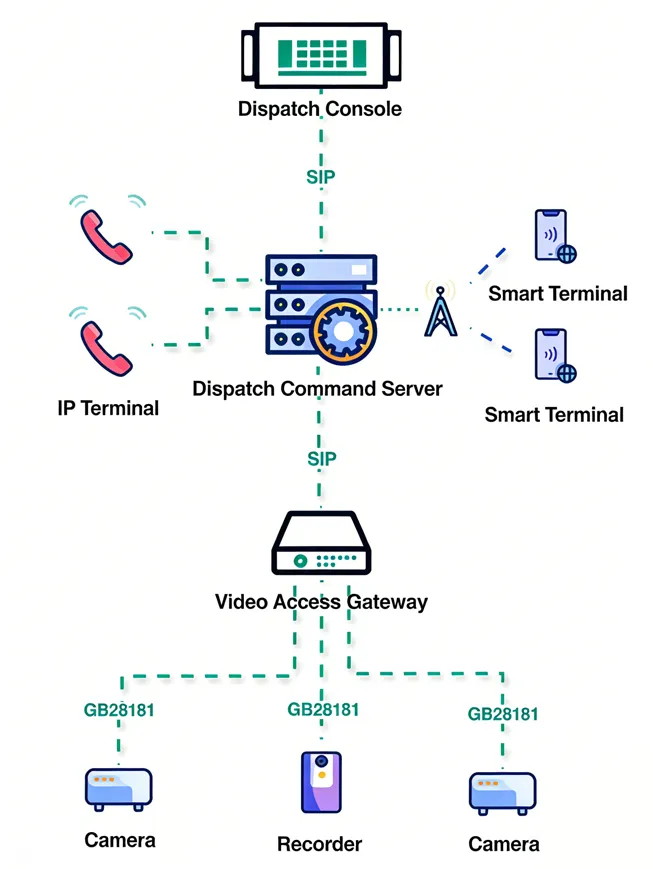
Unified Video Access for Command and Dispatch Systems
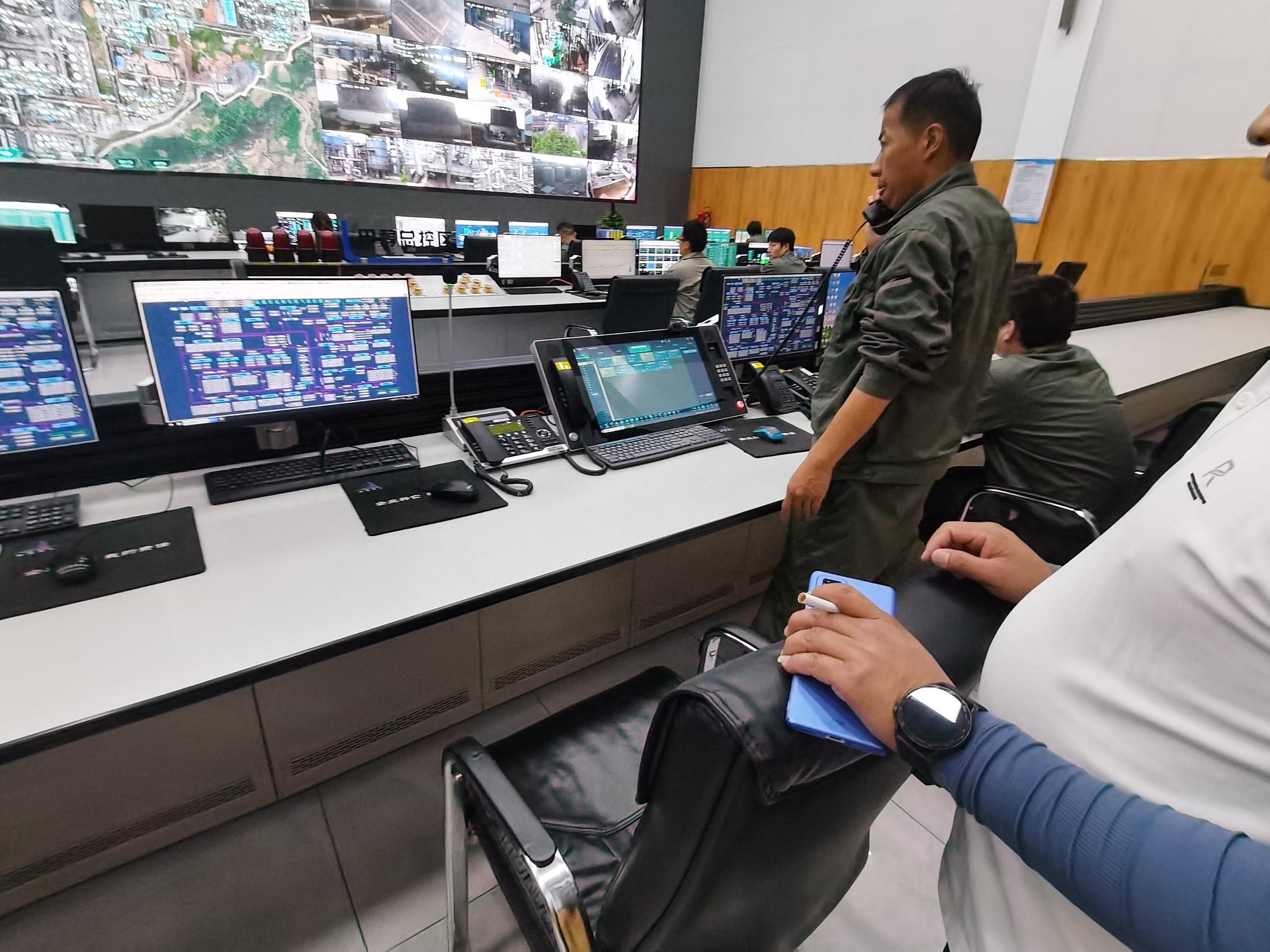
Command scheduling and emergency command systems are the core of smart emergency response, smart power and smart park management, and their normal operation relies on the real-time access and unified scheduling of multi-source video resources. In such project scenarios, it is necessary to integrate video resources from diverse devices such as video surveillance cameras, ball capture cameras and law enforcement recorders into the central command and dispatch system to realize real-time video monitoring and command decision-making. The video access gateway is the optimal device to meet this demand.
The video access gateway can natively dock with various video surveillance cameras, video recorders and monitoring platforms on the market, and realize the unified access of all video resources in the command scheduling scene through its built-in video collection module. After collecting the video stream, the gateway completes real-time transcoding and protocol conversion through its media processing capability, and converts the heterogeneous video stream into the standard SIP protocol that is widely compatible with the command and dispatch system.
The entire application process requires no additional technical development. The technical staff only needs to complete the networking configuration between the video access gateway and the command and dispatch system, including the docking of the scheduling server, IP terminals and intelligent terminals, and the binding of video source devices and the gateway. After the configuration is completed, the command and dispatch system can realize real-time access and control of all connected video resources, which greatly improves the real-time and comprehensiveness of command scheduling and emergency response.
Video Surveillance Integration with Video Conferencing Systems
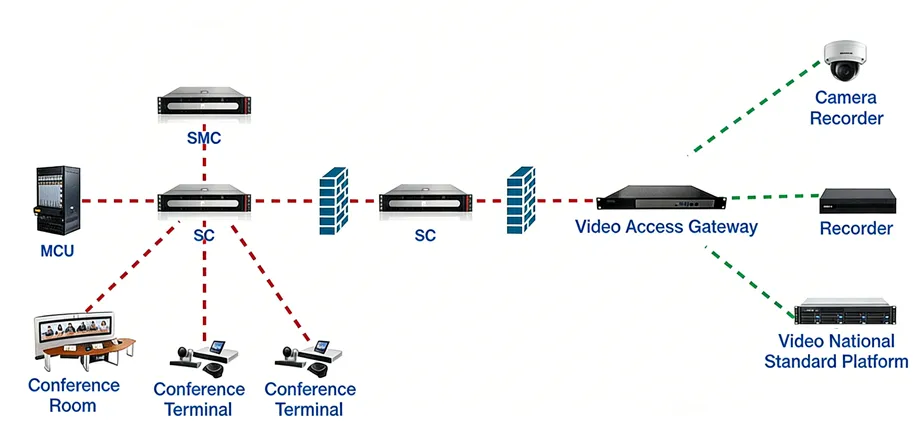
In many enterprise and government project scenarios, there is a strong demand for integrating on-site video surveillance resources into the video conferencing system. For example, in the daily management of smart parks, the management team needs to view the real-time video of key areas such as park entrances and exits, production workshops and storage areas during video conferences; in emergency response work, the emergency command team needs to share on-site surveillance video in the video conference to conduct remote decision-making and deployment. The video access gateway can realize the seamless integration of video surveillance resources and video conferencing systems through its streaming media conversion capability, without the need for secondary development.
In this application scenario, the video access gateway is connected to the front-end video surveillance equipment (cameras), video recorders and national standard video platforms, and the collected video surveillance stream is converted into a streaming media format compatible with the video conferencing system through its internal protocol conversion module. The gateway is then docked with the core equipment of the video conferencing system, including MCU, video conference management and control platforms and conference terminals.
After completing the simple network configuration, the administrator can directly initiate a video conference on the video conference management and control platform, and pull the real-time video stream of any connected video surveillance device into the conference system with one click. All conference terminals can view and share the surveillance video resources in real time, realizing the deep integration of video surveillance and video conferencing business. This function breaks the information island between the video surveillance system and the video conferencing system, and enriches the information acquisition channels of the video conferencing system.
HDMI Output with Decoder Integration for On-Screen Display
In command centers, vehicle-mounted command systems and other professional application scenarios, video resources need to be output to large screens, matrix displays and other display devices through HDMI interfaces to realize the centralized display and real-time monitoring of video images. This on-screen display demand requires the conversion of IP video streams into analog or standard HDMI video signals, and the video access gateway can perfectly meet this demand through its cooperation with video decoders, and the whole process only needs simple network configuration.
The video access gateway supports the access of various standard IP video streams, including RTSP, RTMP and GB28181 protocols. After the IP video stream is collected and processed by the gateway, it can output a standard RTSP video stream to the matched video decoder according to the on-site demand. The video decoder then converts the RTSP stream into an HDMI video signal and outputs it to large screens, matrix displays and other display devices, completing the on-screen display application of video resources such as video surveillance.
This application mode is widely used in the command centers of smart emergency response and smart power projects, as well as the vehicle-mounted command systems of mobile emergency teams. It has the advantages of simple configuration, low delay and stable video output, and can realize the real-time on-screen display of multi-source video resources without any technical development, which greatly improves the visual management level of the command center and mobile command system.
Multi-Capability National Standard Platform Application (GB/T28181)
As a national standard for video surveillance system interconnection in China, GB/T28181 is the unified protocol standard followed by video surveillance systems in various smart projects. The video access gateway can be directly used as a multi-capability national standard video surveillance platform through simple configuration, supporting the interconnection and intercommunication of upper and lower level national standard platforms and the access of non-national standard video resources, and has become an important node for national standard video resource integration in smart projects.
In terms of downward access, the video access gateway fully supports the access of video surveillance devices and platforms that comply with the GB/T28181 national standard, including national standard cameras, national standard video monitoring platforms and video recorders. It can realize the unified collection and management of all downward national standard video resources. In terms of upward docking, the gateway can be used as a lower-level national standard platform to access the upper-level national standard video monitoring platform, and the upper-level platform can view and control all video resources under the gateway in real time, realizing the hierarchical management and interconnection of national standard video resources.
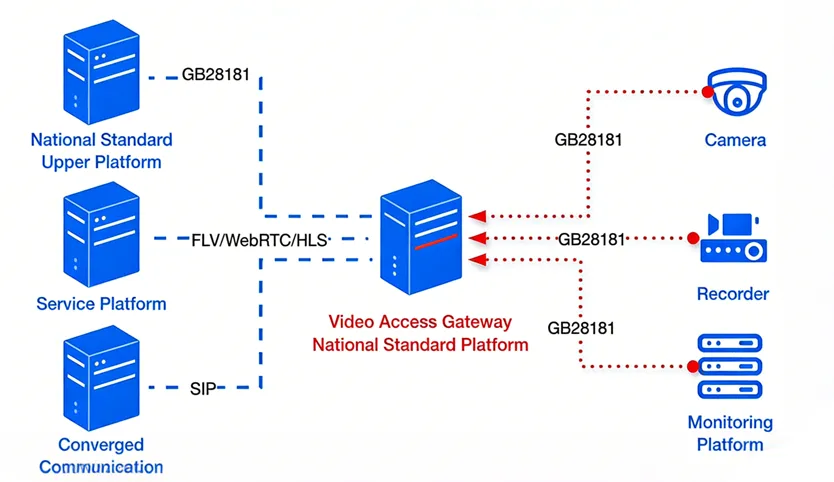
What is more important is that the gateway solves the pain point of non-national standard video resource access to the national standard platform. It supports the access of non-national standard video streams such as RTSP, RTMP and FLV, and transcodes these video streams into the video format complying with the GB/T28181 standard through its built-in transcoding module, and then pushes them to the upper-level national standard platform. This enables the non-national standard video resources in the project to be seamlessly integrated into the national standard video surveillance system without additional development.
In terms of video viewing, the video access gateway supports a variety of mainstream video viewing protocols, including http-flv, websocket-flv, M3U8 and WebRTC, and realizes plug-in-free playback of H.265 video streams, which is compatible with various terminal devices such as computers and mobile phones. The administrator can freely allocate video resources through the gateway’s management interface, realizing the flexible sharing and authority management of video resources. All these functions can be realized only through simple configuration, and the gateway can be used as a professional and multifunctional national standard video monitoring platform.
Core Capabilities Supporting Diverse Application Scenarios
The rich non-development application scenarios of video access gateways are based on their powerful and comprehensive core technical capabilities. These capabilities cover the whole process of video resource collection, processing, forwarding and output, and are the fundamental guarantee for the device to realize zero-development configuration and rapid integration. The core capabilities of the video access gateway mainly include the following aspects:
First, multi-protocol video access capability. The gateway supports almost all mainstream video transmission protocols on the market, including RTSP, RTMP, FLV and GB/T28181, and can natively dock with various video surveillance cameras, video recorders, ball capture cameras and other front-end devices, as well as professional video monitoring platforms, realizing the one-stop access of heterogeneous video resources.
Second, real-time video transcoding and protocol conversion capability. This is the core capability of the gateway. It can transcode and convert the collected heterogeneous video streams into standard protocols and video formats such as SIP, GB/T28181 and RTSP in real time, realizing the protocol compatibility between different video resources and business systems, and laying the foundation for zero-development integration.
Third, high-performance media forwarding capability. The gateway is equipped with a high-performance media processing chip, which can realize the low-delay forwarding of multi-channel video streams at the same time, ensuring the real-time performance of video transmission in command scheduling, video conferencing and other scenarios, and supporting the concurrent access of multiple terminal devices.
Fourth, multi-protocol video output capability. While realizing video processing and conversion, the gateway supports the output of video streams in a variety of protocols, including FLV, HLS, WebRTC and RTSP, which is compatible with different display terminals, business systems and playback platforms, and meets the diverse video application needs in smart projects.
Fifth, simple network configuration and management capability. The gateway is equipped with a humanized visual management interface, and all functional modules and application scenarios can be configured through simple parameter setting and networking docking. Technical personnel without professional development capabilities can also complete the configuration and deployment of the device, which greatly reduces the application threshold of the device.
In addition to the above zero-development core capabilities, the video access gateway also retains a complete API interface system, which can provide flexible secondary development capabilities for customized smart project development. Developers can call the gateway’s API interface to realize the deep integration of video resources and personalized business platforms, realizing the organic combination of standard application and customized development.
Application of Video Access Gateway in Smart Industry Projects
With its comprehensive core capabilities and diverse zero-development application scenarios, the video access gateway has become an indispensable core device in the construction of various smart industry projects, and its application value is fully reflected in smart water conservancy, smart power, smart emergency response, smart parks and other key fields.
In smart water conservancy projects, the gateway can realize the unified access of video resources from water conservancy monitoring points such as reservoirs, rivers and sluices, and integrate the video resources into the water conservancy command and dispatch system and video conferencing system through zero-development configuration, realizing the real-time monitoring and remote command of water conservancy projects. In smart power projects, it can integrate the video resources of substation, power transmission line and power plant monitoring points into the power emergency command system, and realize the on-screen display of video resources in the power command center through cooperation with decoders, providing visual support for power operation and maintenance and emergency disposal.
In smart emergency response projects, the gateway is the core of the emergency command video system. It can realize the unified access of on-site emergency monitoring video resources, and integrate them into the emergency command scheduling system and cross-departmental video conferencing system, realizing the real-time sharing of emergency on-site video and improving the efficiency of emergency command and decision-making. In smart park projects, the gateway can integrate the video resources of park surveillance, access control and workshop monitoring into the park management system, and realize the seamless connection with the park management team’s video conferencing system, providing visual support for the daily management and emergency disposal of the park.
In all these smart project scenarios, the video access gateway can adapt to the actual project needs flexibly. For standard video integration needs, it can realize rapid deployment through zero-development configuration, saving project construction time and cost; for customized development needs, it can provide API interface support to realize the deep integration of video resources and personalized business systems. This flexible application mode makes the video access gateway a universal video fusion solution in the smart industry.
Key Advantages for System Integration
For system integrators and project constructors in the smart industry, the video access gateway brings a number of practical advantages in project development and construction, which greatly improves the efficiency and quality of video system integration in smart projects:
- Simplify project development and reduce technical costs: The gateway takes over all complex video processing work, and the zero-development configuration capability meets most standard video integration needs, avoiding a lot of secondary development work and reducing the technical development cost and project debugging cycle of the project.
- Solve the problem of heterogeneous video resource interconnection: The multi-protocol access and conversion capability of the gateway breaks the protocol barrier between different video devices and systems, realizing the one-stop access and unified management of heterogeneous video resources, and solving the long-standing pain point of video system integration in smart projects.
- Realize rapid deployment and flexible expansion: The simple network configuration capability enables the gateway to be quickly deployed and put into use in the project, and the device supports flexible expansion of video access channels. When the project needs to add video resources, it only needs to complete the device access and simple configuration, without modifying the original system structure.
- Improve the stability and real-time performance of the video system: The high-performance media processing and forwarding capability of the gateway ensures the low-delay and stable transmission of multi-channel video streams, and the plug-in-free playback and multi-terminal compatibility capabilities improve the usability and coverage of video resources.
- Realize the organic combination of standard application and customized development: The gateway not only supports zero-development standard application, but also provides a complete API interface system for customized development, which can adapt to the diverse needs of different smart projects and has strong scalability and plasticity.
Conclusion
As a professional multifunctional video fusion device, the video access gateway is far more than a supporting device for API development in smart project construction. Its rich zero-development application scenarios, based on powerful multi-protocol access, transcoding conversion, media forwarding and national standard platform interconnection capabilities, provide efficient, convenient and low-cost video integration solutions for command scheduling, video conferencing, on-screen display and national standard video system interconnection in various smart projects.
In the era of rapid development of the smart industry, the demand for video resource integration and sharing in smart water conservancy, smart power, smart emergency response, smart parks and other projects is increasing day by day. The video access gateway, with its characteristics of simple configuration, rapid deployment, strong compatibility and flexible expansion, has become the core device of video system integration in smart projects. It not only simplifies the development and construction process of smart projects, but also improves the integration level and application efficiency of video resources, providing strong technical support for the digital and intelligent transformation of various industries.
In the future, with the continuous upgrading of video processing technology and the continuous expansion of smart project application scenarios, the functional capabilities of video access gateways will be further enriched and improved, and their application scope will be more extensive, becoming an indispensable important part of the smart industry ecosystem.

 English
 Deutsch
 한국어
한국어 Русский
 Français
 日本語
日本語 لالعربية
 हिन्दी
 Español
 Português
 繁体中文
繁体中文 简体中文
简体中文