Leading industrial special communication provider with rich global cases. Our explosion-proof & SIP dispatch systems power projects—your reliable partner with proven success.
Leading industrial special communication provider with rich global cases. Our explosion-proof & SIP dispatch systems power projects—your reliable partner with proven success.
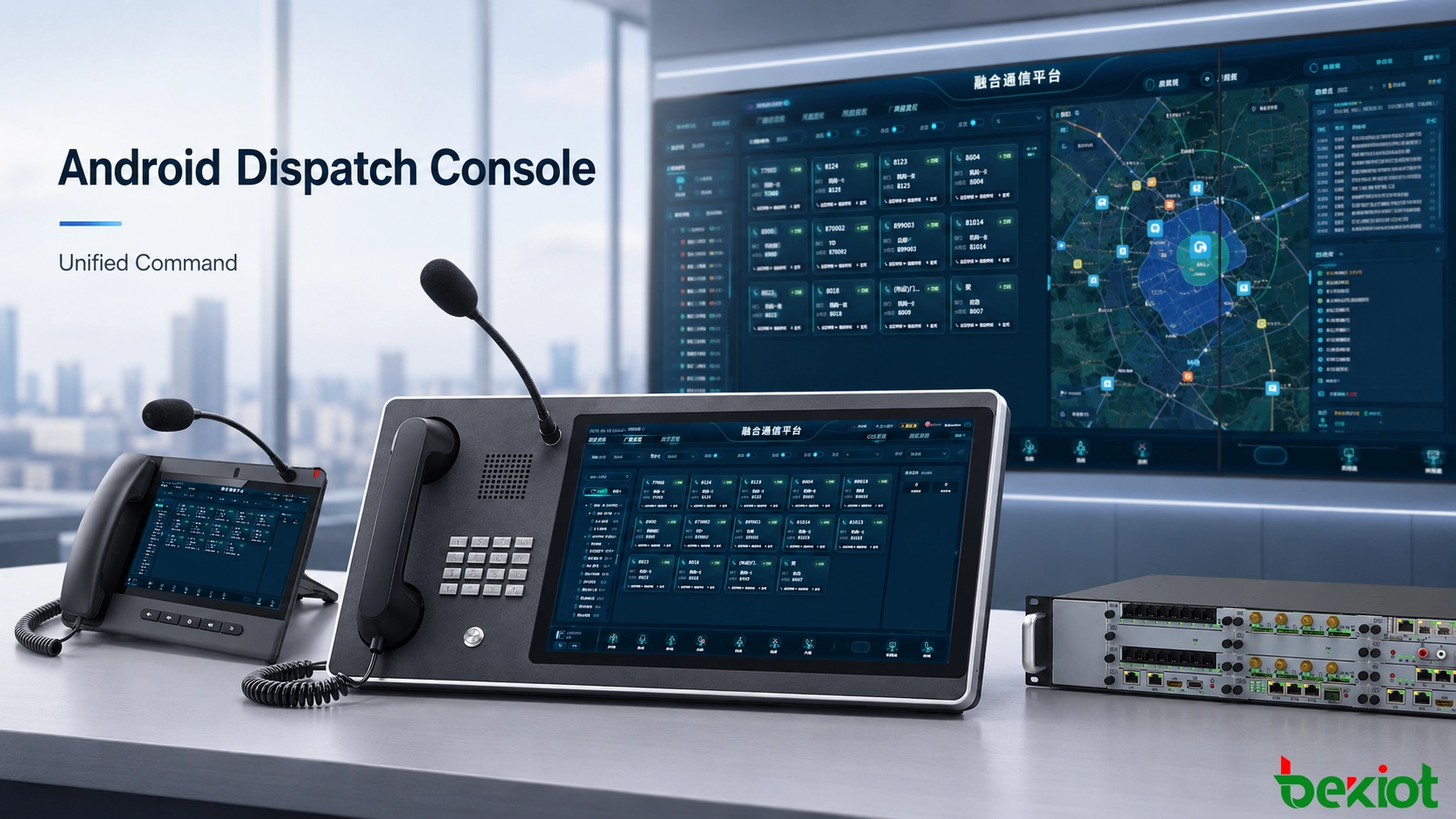
Android Dispatch Console Solution for Unified Command and Communication
Explore how an Android dispatch console unifies voice, video, GIS, PTT, mobile command, real-time data, and cross-network communications for emergency, transport, energy, and industrial operations.
Becke Telcom
Modern command environments increasingly depend on information arriving from different networks, devices, teams, and locations at the same time. Traditional dispatch systems can become difficult to operate when voice, video, radio, telephone, mapping, messaging, and field data remain separated. An Android dispatch console addresses this problem by bringing these resources into a unified operational interface that can be used in a control center, command vehicle, temporary command post, or directly at an incident site.
The objective is not simply to move conventional dispatch functions onto a touchscreen. A well-designed solution extends command capabilities beyond the fixed control room, connects heterogeneous communication networks, improves situational awareness, and gives operators a consistent way to communicate with field personnel while events are developing.
A Unified Command Environment
At the center of the solution is converged communication. Instead of requiring operators to work separately with radio systems, telephones, video platforms, messaging applications, and monitoring resources, the dispatch environment connects them through a common operational layer.
A typical deployment may need to communicate across private trunked networks, public 4G or 5G services, fixed telephone networks such as PSTN, IP telephony, video conferencing systems, and sensor networks. Private radio resources may include 350 MHz systems or digital trunking technologies such as PDT and TETRA, while IP-based systems can use standards such as SIP to exchange signaling and media between different platforms.
This interoperability is important because field teams rarely use only one type of terminal. A control center may need to communicate simultaneously with radio users, smartphone users, fixed telephones, IP phones, vehicle terminals, video devices, or remote command posts.
Breaking Down Communication Silos
The main challenge is not the lack of communication tools but the lack of coordination between them. When each network has its own interface, contact list, operating procedure, and event record, dispatchers spend more time switching between systems and manually transferring information.
A converged platform creates a common control point. Contacts can be organized by department, response group, operational region, vehicle, facility, or temporary incident team. Operators can then select the required resource from one interface instead of remembering which independent system should be used.
One Interface for Multiple Resources
The dispatch console acts as an operational hub rather than a simple calling terminal. From the same interface, an authorized operator may initiate a voice call, create a temporary group, view a camera, locate personnel on a map, distribute a message, start a conference, or review an event.
The benefit is especially clear during emergencies. A dispatcher who receives an incident report can identify the location, check nearby personnel, open relevant video, establish communication with field teams, and distribute instructions without repeatedly moving between unrelated applications.
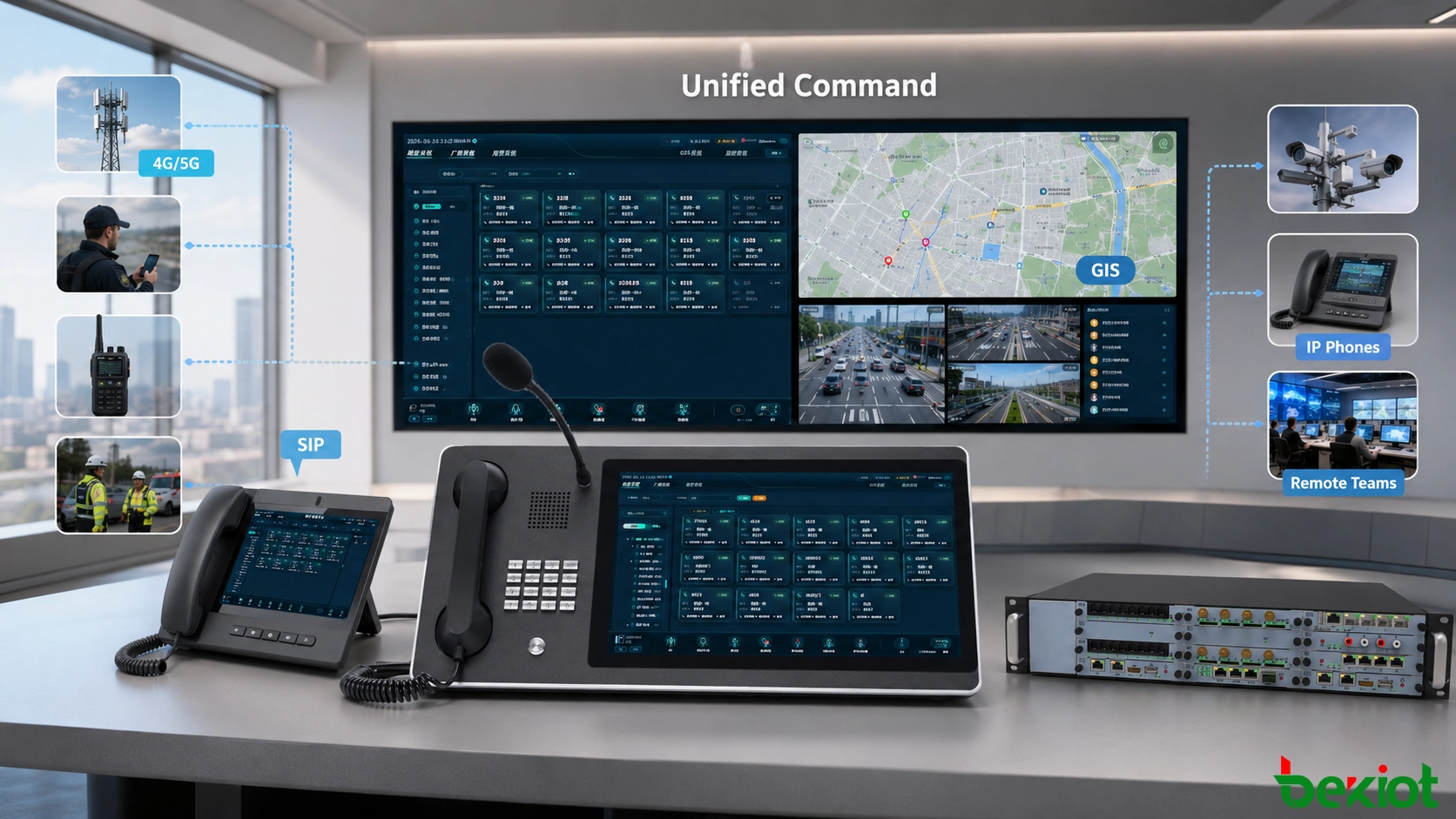
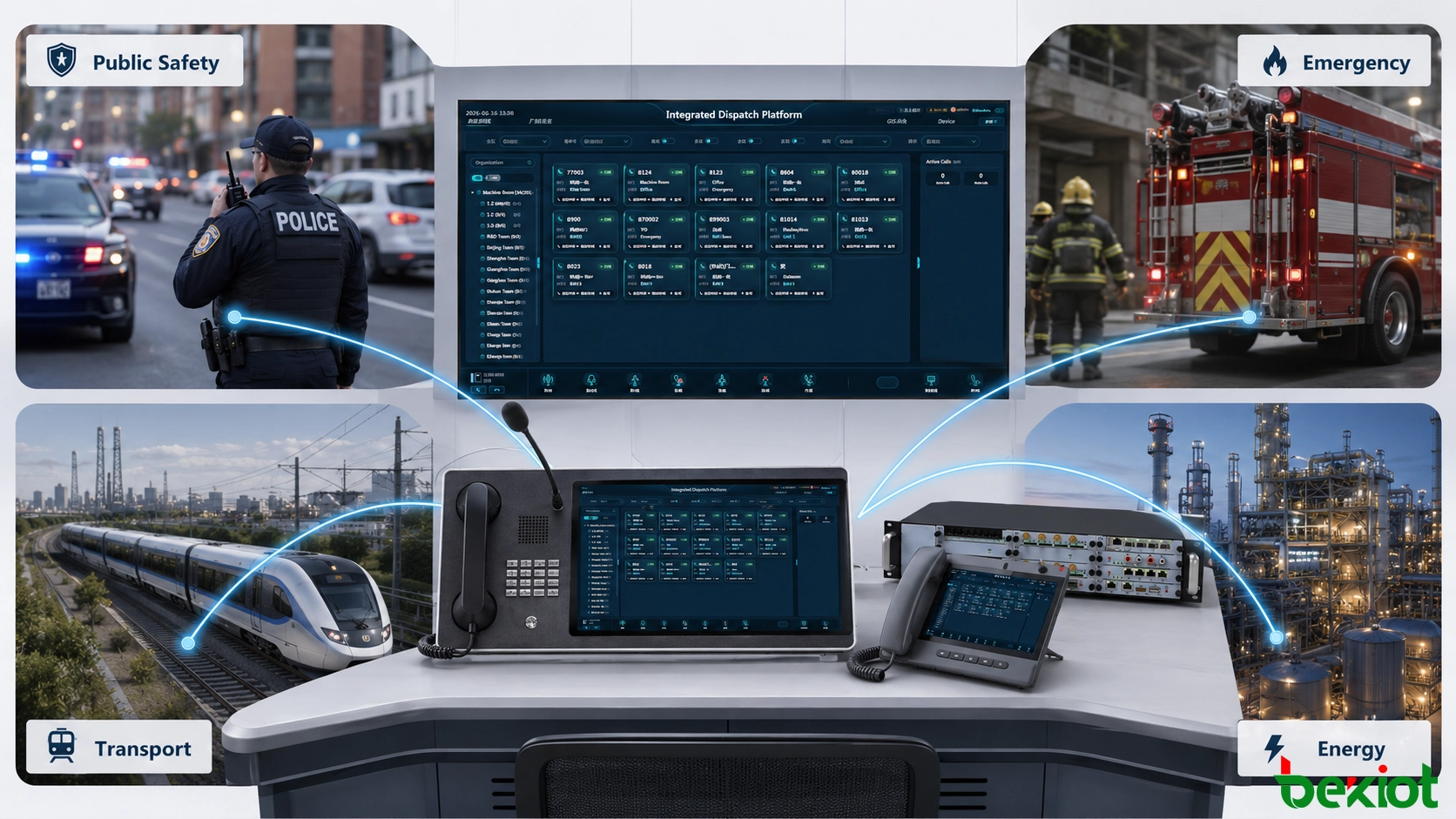
A unified dispatch environment connects different communication networks and field resources through one operational interface.
A conventional dispatch position is normally tied to a fixed control room. That arrangement remains appropriate for permanent operations centers, but many incidents develop outside the control room. Emergency commanders, maintenance supervisors, security managers, transport coordinators, and industrial response teams may need access to dispatch resources while moving between locations.
Android-based devices make it possible to extend selected dispatch functions to smartphones, tablets, vehicle-mounted terminals, and portable command equipment. The command function can therefore move closer to the incident without removing the centralized control center from the workflow.
Mobility is only one advantage. The Android environment also provides a mature touchscreen interaction model. Map zooming, resource selection, contact grouping, video switching, and other actions can be handled through familiar touch operations. This can reduce the number of physical controls required on a portable terminal and make complex information easier to navigate.
The platform is also suitable for application-level customization. Different industries may require different information on the main screen. A public-safety deployment may emphasize location, unit status, incident details, and video. A transportation operator may prioritize routes, vehicles, stations, and operational groups. An energy company may need facilities, maintenance teams, alarms, and remote-site communication.
Compared with a completely proprietary hardware environment, software-based deployment can also make system expansion and version updates more flexible. This does not mean that every commercial tablet is automatically suitable for critical dispatch. Device durability, security, battery life, network access, user permissions, and environmental requirements still need to be evaluated according to the actual project.
Voice, Video, and Data in One Interface
Voice remains the foundation of dispatch communication, but modern operations require much more than basic point-to-point calling. A practical platform should allow the dispatcher to choose the appropriate communication method according to the type and urgency of the event.
Professional Voice Dispatch
Push-to-talk communication can support individual calls, group calls, and temporary groups across compatible terminals. Depending on network integration, users may include handheld radios, smartphones, vehicle radios, or other mobile endpoints.
Telephone resources can also be incorporated through PSTN or IP telephony. This allows the dispatch position to communicate with internal extensions, fixed operational posts, external telephone users, and other telephone networks from the same working environment.
Professional control functions may include call transfer, call pickup, monitoring, priority intervention, forced connection, forced release, conferencing, and group communication. These capabilities become particularly valuable when an urgent instruction must take priority over routine communications.
Video-Assisted Decision Making
Video adds direct visual context to information received by voice. Relevant sources can include CCTV cameras, body-worn cameras, drones, vehicle cameras, portable video terminals, and IP cameras installed around an operational site.
The operator may select a video source to verify an incident, distribute the stream to another user, or send it to a control-room display. During a major event, video conferencing can connect field personnel, control-room operators, technical specialists, and management teams for joint assessment.
Interoperability with standards such as H.323 and SIP can also help connect existing video conferencing resources instead of forcing organizations to replace every installed system.
Multimedia Information Exchange
Some operational information is easier to send as data than through voice. Integrated messaging can support text, photographs, short video clips, documents, coordinates, and other field information.
For example, a technician can send an equipment image together with a location instead of trying to describe the condition entirely over the radio. A command center can distribute a written instruction to multiple users so that important details remain visible after the voice call ends.
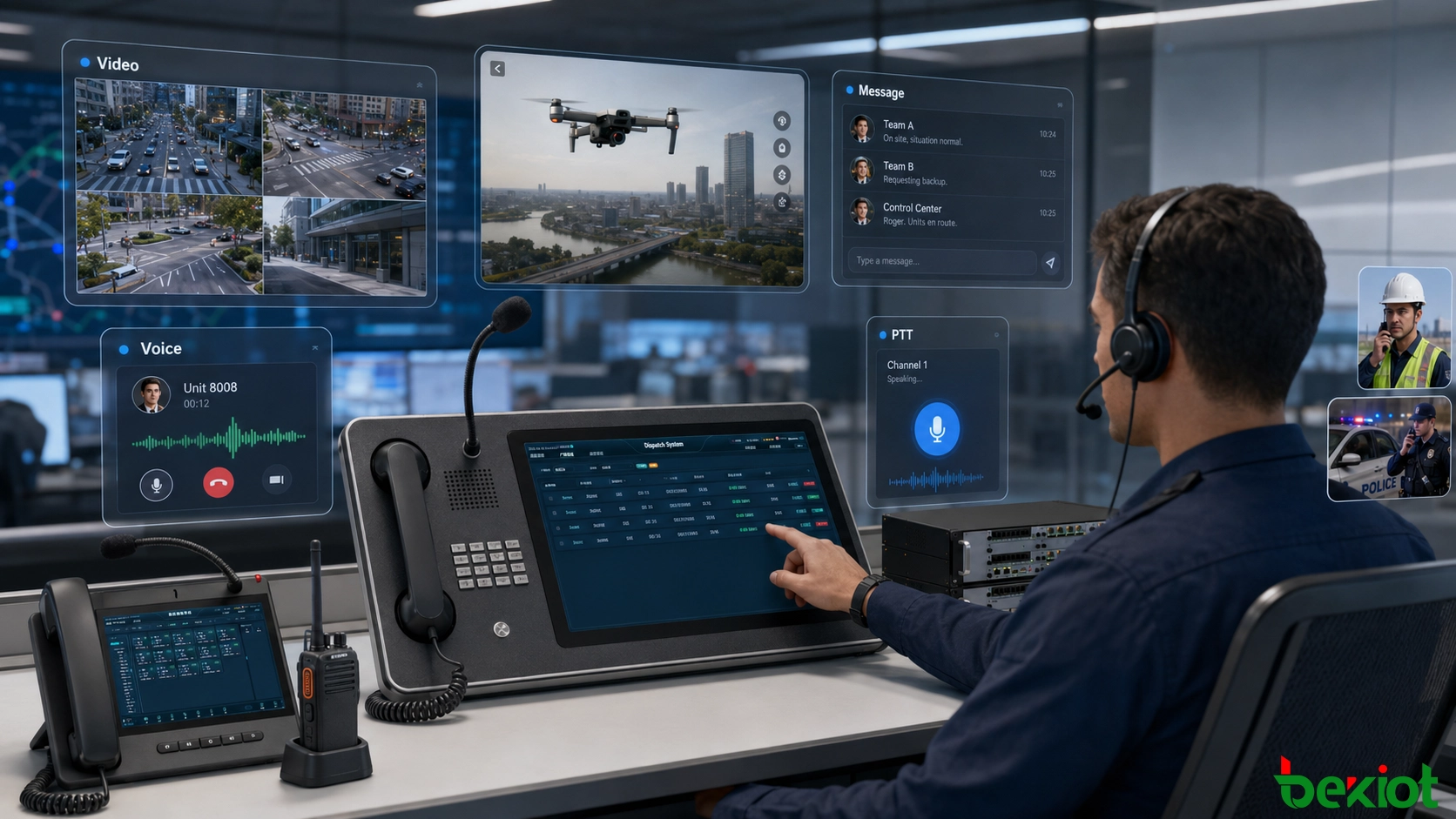
Voice, video, messaging, and field data can be combined according to the communication needs of each operational event.
Situational Awareness Through Maps and Media
Communication becomes more effective when the dispatcher can understand where people, vehicles, facilities, alarms, and incidents are located. GIS integration turns the map from a passive reference into an active dispatch interface.
Personnel, vehicles, communication terminals, cameras, facilities, and events can be represented on an electronic map where location data is available. The operator can then examine resources around an incident rather than searching through a long directory of names or numbers.
Map-based operations can include selecting an individual resource, drawing a selection area around several users, establishing a temporary communication group, starting a call, or opening nearby video resources. This is particularly useful for incidents where the closest available team may not belong to the operator's normal organizational group.
Historical positioning information can provide additional value after an operation. Personnel or vehicle tracks may be stored and replayed to reconstruct movement during an incident, support operational reviews, and help determine whether response procedures should be adjusted.
GIS should not operate as an isolated feature. Its value increases when location information is connected with communication status, terminal availability, incident records, cameras, and field feedback. The map then becomes part of the decision process rather than simply another screen.
Where the Solution Delivers Value
The same technical foundation can be adapted to industries with very different operational requirements. What these environments share is the need to coordinate distributed personnel while information and conditions are changing quickly.
Public Safety Operations
Public-safety teams may need to receive incidents, locate nearby personnel, organize temporary response groups, exchange voice and video, and continuously update the command center. Mobile dispatch enables supervisors away from the main control room to retain access to relevant communication resources.
When an event occurs, personnel near the affected area can be identified through location information, connected through group communication, and supported with video or multimedia information. This creates a flatter response process than manually passing instructions through multiple communication layers.
Fire and Emergency Response
Fire and rescue operations often involve rapidly changing conditions and several types of field equipment. A dispatch environment can bring together mobile personnel, command vehicles, body-worn video, drones, fixed cameras, expert support teams, and voice communication.
Combining aerial and ground-level information can improve understanding of the incident area. The control center can maintain the broader operational picture while commanders closer to the scene use mobile terminals for immediate coordination.
Transport, Energy, and Mining
Transportation organizations can use converged dispatch for daily operations and emergency management across buses, rail networks, airports, stations, depots, and maintenance teams. Voice, video, location, and operational groups can be organized around routes, facilities, or incidents.
Energy and mining environments introduce additional communication challenges because personnel may be distributed across remote facilities, underground areas, production sites, or large industrial zones. These projects may require a combination of wired and wireless communications to connect fixed control rooms with mobile personnel.
The objective is not simply to add another communication network. The system should connect existing voice, video, monitoring, and operational resources so that the control center can coordinate field activities through a consistent workflow.
Mobile and fixed dispatch resources can support public safety, emergency response, transportation, energy, and industrial operations.
Architecture and Deployment Planning
A scalable converged communication platform is commonly organized in layers rather than built as one isolated application. A practical architecture may include a resource layer, protocol access layer, media service layer, dispatch software layer, and business application layer.
The resource layer contains the communication and information sources used by the system, such as radio systems, telephone networks, cameras, mobile terminals, broadcasting equipment, sensors, and other field devices.
The protocol access layer handles connection with heterogeneous networks. SIP can provide a standardized method for connecting many IP communication resources, while gateways and dedicated interfaces may be required for legacy telephone networks, trunked radio systems, or specialized industry equipment.
Media services handle voice, video, conferencing, recording, distribution, and related processing. Above this layer, dispatch software provides user management, call control, group organization, GIS interaction, terminal status, event handling, and operational records.
Android terminals can communicate with these backend services through controlled APIs. This architecture keeps critical communication functions in the central system while allowing mobile applications to access the capabilities authorized for each user.
Deployment planning should also consider resilience. A mobile interface is only useful when the underlying network and communication services remain available. Projects should evaluate network redundancy, private and public wireless coverage, server availability, user authentication, permission management, recording requirements, cybersecurity, and alternative communication paths.
Future systems are also likely to make greater use of AI and IoT information. Speech recognition can assist hands-free operations, video analytics can help identify relevant objects or abnormal activity, and historical operational data can support resource recommendations or situation forecasting.
IoT integration can extend situational awareness beyond communication terminals. Environmental sensors, equipment alarms, access-control events, positioning devices, and even personnel safety sensors can become additional sources of information for the command platform.
These technologies should support rather than replace human decision-making. The dispatcher still needs to understand operational priorities, verify information, and determine which resources should respond. Automation is most useful when it reduces repetitive work and makes important information easier to identify.
Final Notes
An Android dispatch console extends converged communication from the fixed control room into a more flexible command environment. Its main advantage is not the operating system itself, but the ability to combine mobile access with voice dispatch, video, GIS, messaging, cross-network interoperability, and centralized resource management.
For organizations dealing with distributed teams and rapidly changing events, this approach can reduce communication barriers and shorten the path between incident awareness and operational action. The most reliable implementations begin with real communication workflows, integrate existing resources where practical, and then add mobile, video, GIS, AI, and IoT capabilities according to actual operational requirements.
FAQ
Can a mobile dispatch terminal completely replace a fixed control-room console?
Not necessarily. Mobile terminals are valuable for field command and remote access, while fixed consoles are generally better suited to continuous control-room operation, large displays, multiple simultaneous information sources, and permanent operator positions. Many projects use both as complementary interfaces.
Can standard Android tablets be used for critical dispatch work?
The software may run on compatible commercial devices, but critical deployments should evaluate hardware durability, operating temperature, battery capacity, network interfaces, device management, security policies, and environmental protection before selecting terminals.
How should access permissions be controlled?
A dispatch platform should normally use authenticated user accounts and role-based permissions. Different operators may be allowed to view, call, monitor, record, control, or manage different resources according to their responsibilities.
What should be considered when public mobile coverage is unreliable?
The communication design should not depend on a single access network when service continuity is critical. Depending on the application, organizations may combine public mobile networks with private wireless systems, wired infrastructure, radio networks, redundant links, or local communication resources.
Becke Telcom specializes in industrial explosion-proof comms for rail, tunnel, oil & gas, and marine sectors, offering PAGA, SOS, and IP telephones with integrated PA, intercom, and calling.
If you have any suggestions or questions for us, please feel free to contact us!
We use cookie to improve your online experience. By continuing to browse this website, you agree to our use of cookie.
Cookies
Please read our Terms and Conditions and this Policy before accessing or using our Services. If you cannot agree with this Policy or the Terms and Conditions, please do not access or use our Services. If you are located in a jurisdiction outside the European Economic Area, by using our Services, you accept the Terms and Conditions and accept our privacy practices described in this Policy. We may modify this Policy at any time, without prior notice, and changes may apply to any Personal Information we already hold about you, as well as any new Personal Information collected after the Policy is modified. If we make changes, we will notify you by revising the date at the top of this Policy. We will provide you with advanced notice if we make any material changes to how we collect, use or disclose your Personal Information that impact your rights under this Policy. If you are located in a jurisdiction other than the European Economic Area, the United Kingdom or Switzerland (collectively “European Countries”), your continued access or use of our Services after receiving the notice of changes, constitutes your acknowledgement that you accept the updated Policy. In addition, we may provide you with real time disclosures or additional information about the Personal Information handling practices of specific parts of our Services. Such notices may supplement this Policy or provide you with additional choices about how we process your Personal Information.
Cookies
Cookies are small text files stored on your device when you access most Websites on the internet or open certain emails. Among other things, Cookies allow a Website to recognize your device and remember if you've been to the Website before. Examples of information collected by Cookies include your browser type and the address of the Website from which you arrived at our Website as well as IP address and clickstream behavior (that is the pages you view and the links you click).We use the term cookie to refer to Cookies and technologies that perform a similar function to Cookies (e.g., tags, pixels, web beacons, etc.). Cookies can be read by the originating Website on each subsequent visit and by any other Website that recognizes the cookie. The Website uses Cookies in order to make the Website easier to use, to support a better user experience, including the provision of information and functionality to you, as well as to provide us with information about how the Website is used so that we can make sure it is as up to date, relevant, and error free as we can. Cookies on the Website We use Cookies to personalize your experience when you visit the Site, uniquely identify your computer for security purposes, and enable us and our third-party service providers to serve ads on our behalf across the internet.
We classify Cookies in the following categories: ● Strictly Necessary Cookies ● Performance Cookies ● Functional Cookies ● Targeting Cookies
Cookie List A cookie is a small piece of data (text file) that a website – when visited by a user – asks your browser to store on your device in order to remember information about you, such as your language preference or login information. Those cookies are set by us and called first-party cookies. We also use third-party cookies – which are cookies from a domain different than the domain of the website you are visiting – for our advertising and marketing efforts. More specifically, we use cookies and other tracking technologies for the following purposes:
Strictly Necessary Cookies These cookies are necessary for the website to function and cannot be switched off in our systems. They are usually only set in response to actions made by you which amount to a request for services, such as setting your privacy preferences, logging in or filling in forms. You can set your browser to block or alert you about these cookies, but some parts of the site will not then work. These cookies do not store any personally identifiable information.
Functional Cookies These cookies enable the website to provide enhanced functionality and personalisation. They may be set by us or by third party providers whose services we have added to our pages. If you do not allow these cookies then some or all of these services may not function properly.
Performance Cookies These cookies allow us to count visits and traffic sources so we can measure and improve the performance of our site. They help us to know which pages are the most and least popular and see how visitors move around the site. All information these cookies collect is aggregated and therefore anonymous. If you do not allow these cookies we will not know when you have visited our site, and will not be able to monitor its performance.
Targeting Cookies These cookies may be set through our site by our advertising partners. They may be used by those companies to build a profile of your interests and show you relevant adverts on other sites. They do not store directly personal information, but are based on uniquely identifying your browser and internet device. If you do not allow these cookies, you will experience less targeted advertising.
How To Turn Off Cookies You can choose to restrict or block Cookies through your browser settings at any time. Please note that certain Cookies may be set as soon as you visit the Website, but you can remove them using your browser settings. However, please be aware that restricting or blocking Cookies set on the Website may impact the functionality or performance of the Website or prevent you from using certain services provided through the Website. It will also affect our ability to update the Website to cater for user preferences and improve performance. Cookies within Mobile Applications
We only use Strictly Necessary Cookies on our mobile applications. These Cookies are critical to the functionality of our applications, so if you block or delete these Cookies you may not be able to use the application. These Cookies are not shared with any other application on your mobile device. We never use the Cookies from the mobile application to store personal information about you.
If you have questions or concerns regarding any information in this Privacy Policy, please contact us by email at . You can also contact us via our customer service at our Site.

 English
 Deutsch
 한국어
한국어 Русский
 Français
 日本語
日本語 لالعربية
 हिन्दी
 Español
 Português
 繁体中文
繁体中文 简体中文
简体中文