Leading industrial special communication provider with rich global cases. Our explosion-proof & SIP dispatch systems power projects—your reliable partner with proven success.
Leading industrial special communication provider with rich global cases. Our explosion-proof & SIP dispatch systems power projects—your reliable partner with proven success.
Power System Dispatch Console Solution: Architecture, Functions, and Applications
A practical power system dispatch console solution covering control center architecture, communication, real-time monitoring, data analysis, emergency response, recording, and grid operation workflows.
Becke Telcom
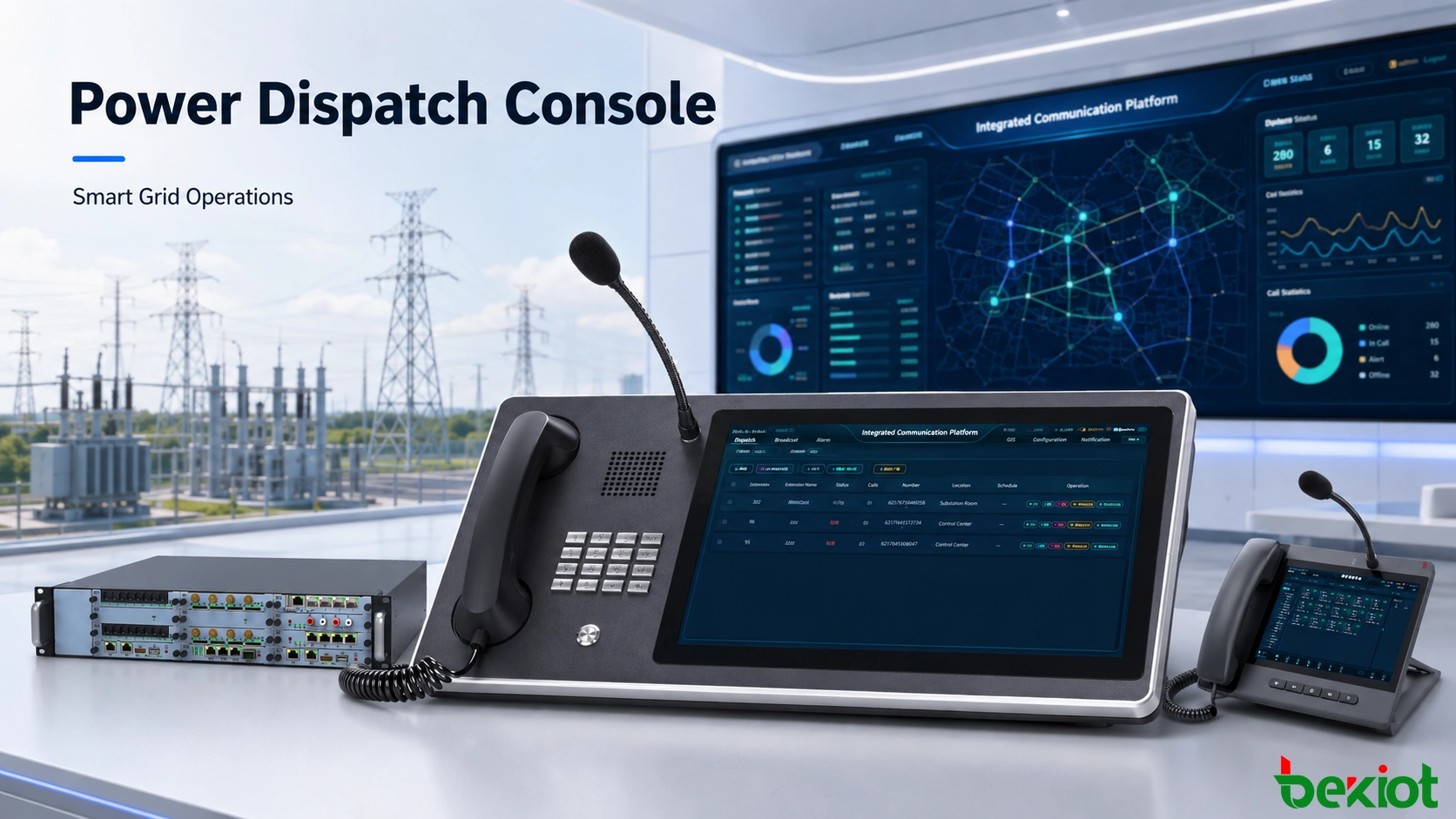
A power system dispatch console serves as the operational communication and coordination point between control centers, substations, field personnel, maintenance teams, and other departments involved in grid operation. Rather than functioning as an ordinary telephone workstation, it brings communication, operational information, monitoring resources, dispatch commands, and event records into a more centralized working environment.
This centralized approach is especially important for modern power networks. Dispatchers may need to monitor grid conditions, communicate with several teams, evaluate an abnormal event, issue instructions, track field progress, and preserve communication records at the same time. A properly designed dispatch solution reduces unnecessary switching between independent systems and helps operators maintain a clearer view of ongoing operations.
How the Solution Is Structured
A typical power dispatch solution can be understood through three closely connected layers: the operator environment, the dispatch software platform, and the communication network. Each layer performs a different role, but the overall effectiveness of the system depends on how well they work together.
Operator and Control Center Equipment
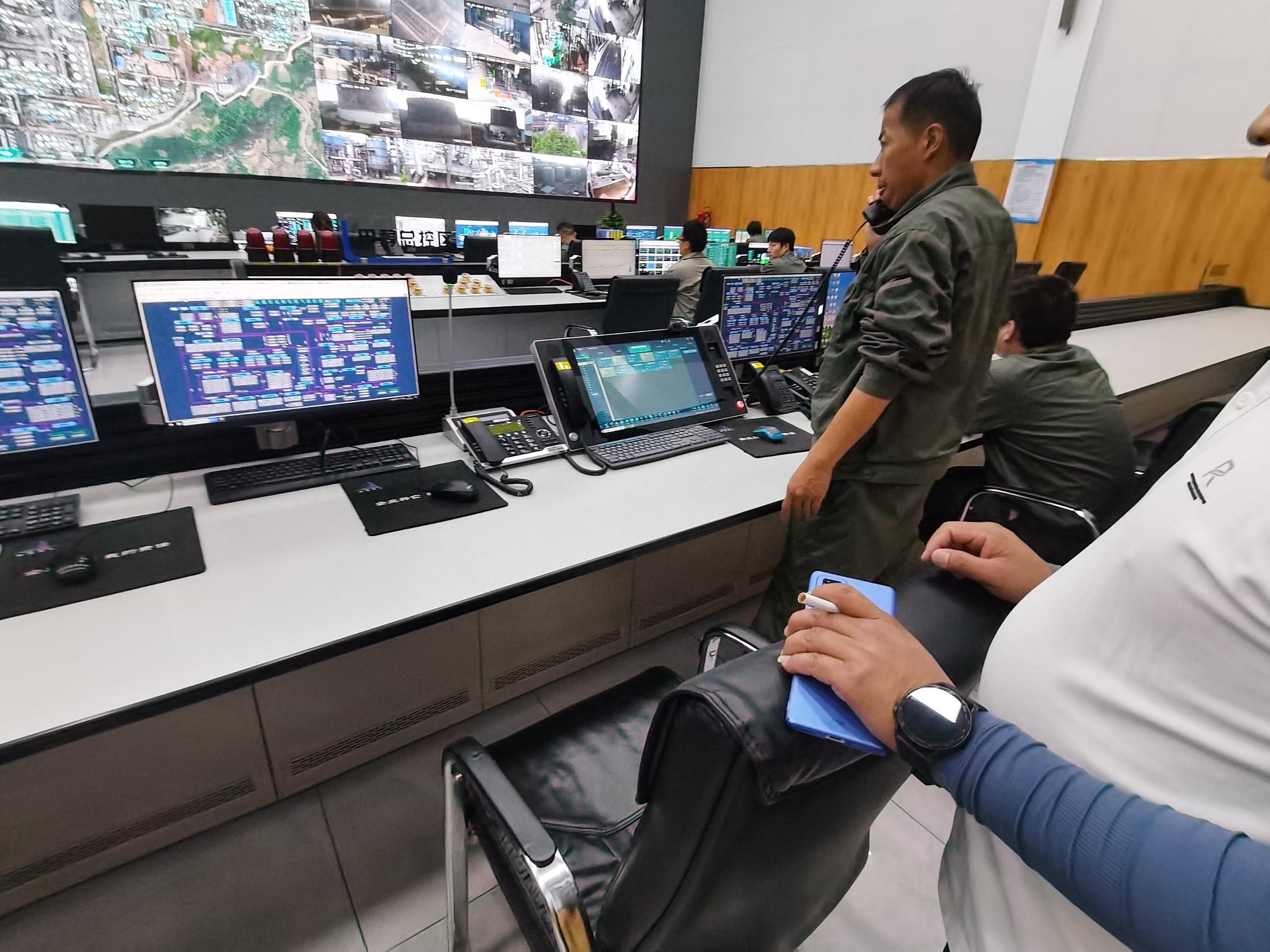
The operator workstation provides dispatchers with the interface used to monitor information and perform communication tasks. Depending on the control center design, operators may work with one or several displays, dedicated communication terminals, control interfaces, keyboards, touch interfaces, monitoring screens, and supporting server resources.
The purpose of these devices is not simply to display more information. Their value lies in presenting operational data in a way that allows dispatchers to identify important changes quickly and communicate without interrupting their workflow.
Communication equipment connects the control center with substations, maintenance personnel, inspection teams, production departments, and remote facilities. Fixed telephones, dispatch terminals, radios, intercom devices, and other communication endpoints may therefore form part of the same operational environment.
Dispatch Software Platform
The software layer provides the communication and management functions used during daily operation and emergency response. Depending on system requirements, it can organize users and communication groups, display terminal status, initiate calls, manage conferences, distribute instructions, maintain operational records, and provide access to relevant location or monitoring information.
A unified interface is particularly useful when a control center manages a large number of users. Instead of remembering individual numbers or switching continuously between independent communication tools, dispatchers can organize contacts according to departments, substations, maintenance groups, duty teams, or geographical areas.
Communication Network
The network provides the connection between the dispatch center and distributed communication endpoints. Wired communication normally provides stable connectivity for fixed control rooms and permanent facilities, while wireless communication can extend access to mobile personnel and locations where fixed connections are impractical.
In power applications, these two approaches are often complementary. Fixed infrastructure can support continuous communication between major operational sites, while wireless access gives inspection and maintenance personnel greater mobility.
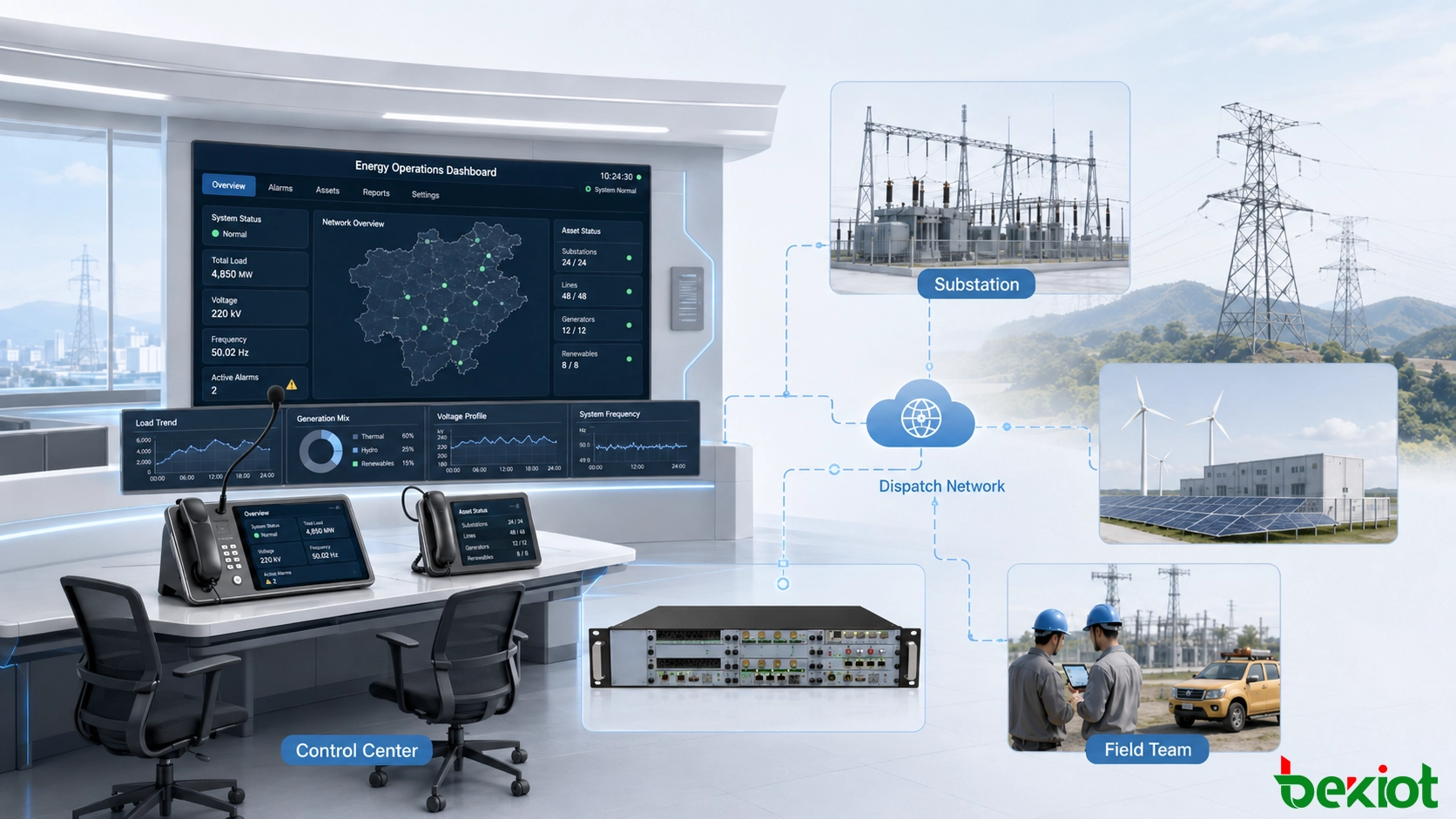
A dispatch solution connects control center operators with field communication, operational information, and distributed power facilities.
Communication remains one of the most important responsibilities of a dispatch console. During normal operation, the system helps operators contact substations, maintenance departments, duty personnel, and other operational units. During abnormal events, the same communication environment becomes part of the incident response process.
Common voice dispatch capabilities can include direct calling, call transfer, call holding, priority intervention, call monitoring, call pickup, group communication, conferencing, and broadcasting. These functions allow an operator to choose the appropriate communication method according to the urgency and number of people involved.
For example, a routine equipment inspection may require only a direct call between the dispatcher and a field technician. A larger incident may require communication with several substations, maintenance teams, and management personnel at the same time. Group calling and conferencing reduce the need to repeat the same instructions through separate calls.
Video communication can provide additional context where visual confirmation is important. If video resources are connected to the dispatch environment, operators can combine voice communication with images from substations, equipment areas, or field personnel. This helps the control center understand conditions that may be difficult to describe through voice alone.
Location-based information can also support dispatch decisions. When terminal or personnel positions are available through GIS, dispatchers can identify resources near an affected facility and communicate with the most appropriate response team. Text instructions and predefined messages provide another communication channel for information that needs to remain visible or be distributed consistently.
From Grid Monitoring to Field Response
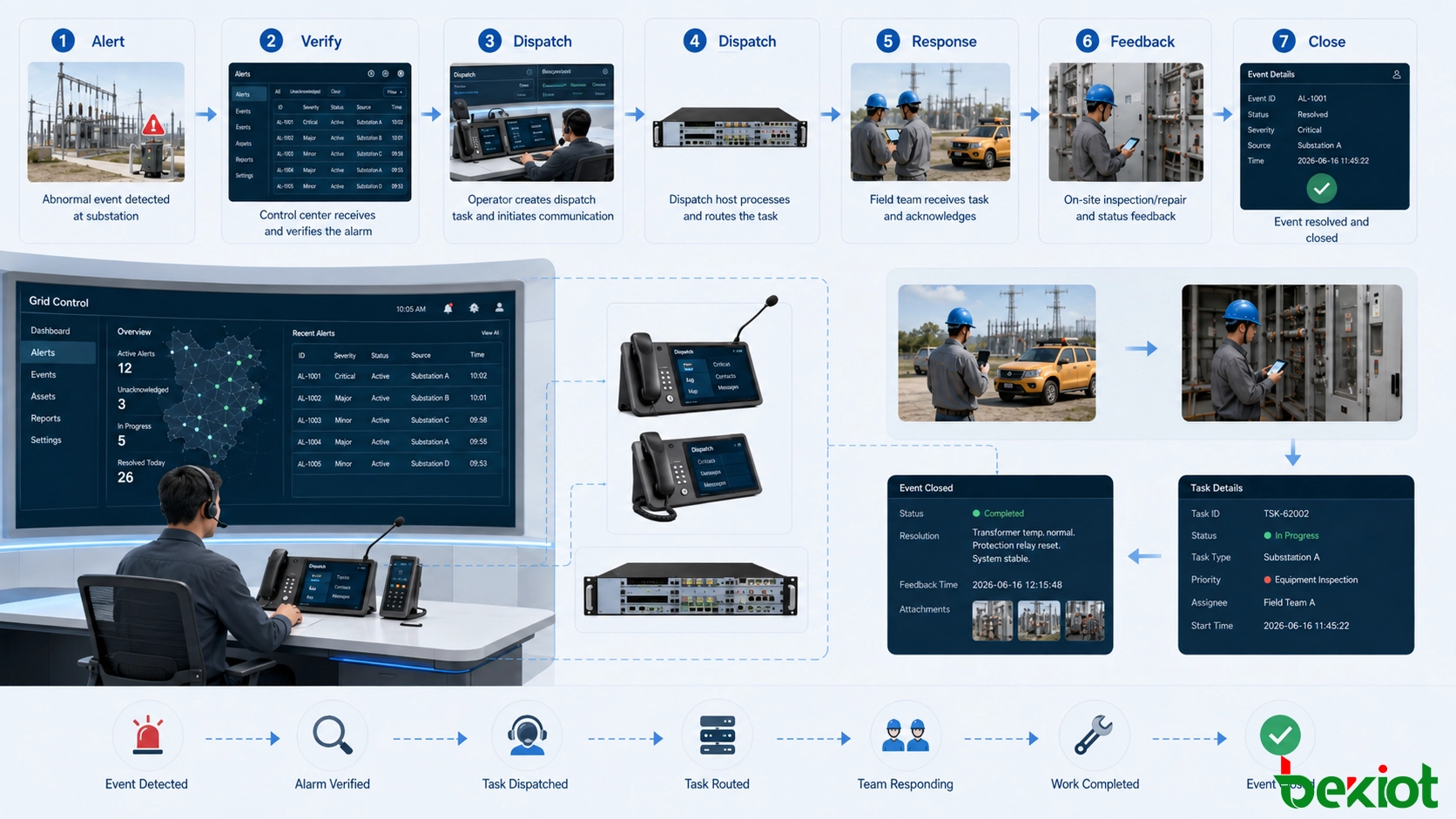
The value of the dispatch console becomes clearer when it is viewed as part of an operational workflow rather than as an isolated communication device. In a power control center, communication normally follows the development of an event.
The process begins with situational awareness. Operational systems, sensors, monitoring equipment, cameras, and field reports provide information about the condition of substations, transmission facilities, power equipment, and other critical assets. Important electrical parameters may include voltage, current, frequency, loading conditions, and equipment operating status.
When an abnormal condition is detected, the dispatcher evaluates its severity and possible impact. The next step is to determine which personnel, departments, or sites need to respond. Communication tools can then be used to issue instructions and coordinate the required resources.
A typical operational sequence can therefore include:
Detect an abnormal operating condition or receive a field report.
Confirm the affected equipment, location, and operational scope.
Analyze available monitoring and operating information.
Identify the appropriate duty, maintenance, or emergency personnel.
Issue communication and operational instructions.
Receive progress updates from the field.
Adjust the response according to changing conditions.
Close the event and preserve the relevant records.
This workflow shows why power dispatch communication cannot rely only on basic point-to-point calling. Operators need to move continuously between information assessment, communication, resource coordination, and progress tracking.
Power dispatch connects event detection, operational assessment, communication, field response, and follow-up into a continuous workflow.
Using Operational Data More Effectively
Modern grid operation produces large amounts of information. The dispatch environment can help turn this information into practical support for operational planning and decision-making.
Useful datasets may come from equipment sensors, historical operating records, weather information, monitoring systems, and broader demand-related data. Before these datasets can support decision-making, inaccurate entries, missing values, and duplicate information may need to be identified and processed.
Once organized, the information can be used for statistical analysis, pattern recognition, operational comparison, and predictive modeling. This changes the role of the dispatch center from simply reacting to events toward identifying conditions that may require attention before they develop into larger problems.
Load Forecasting
Historical power consumption, weather conditions, holidays, seasonal changes, and economic activity can influence electricity demand. Forecasting tools can combine these factors to estimate short- and medium-term load requirements. Dispatchers and system operators can then use the results to support generation planning and operational scheduling.
Equipment Risk Assessment
Historical operating records and condition data can also help identify unusual equipment behavior. Detecting developing problems earlier gives maintenance teams more time to investigate equipment and arrange preventive work instead of responding only after a failure occurs.
Renewable Generation Forecasting
As renewable generation becomes a larger part of the electricity supply, dispatch centers must manage more variable power sources. Forecasting wind, solar, and other renewable generation can help operators prepare for changes in supply and improve the coordination between generation and demand.
Artificial intelligence and machine learning can further assist this process by identifying recurring operational patterns in large datasets. Their role is not to remove the dispatcher from the decision process, but to provide additional information that can support faster and more consistent judgment.
Applications Across Power Operations
The same dispatch architecture can support several different parts of a power organization. The exact configuration depends on network scale, operational responsibilities, geographical coverage, and existing communication infrastructure.
Operational Area
Dispatch Role
Primary Purpose
Grid Control Center
Centralized communication and operational coordination
Maintain system-wide situational awareness and coordinate grid operations
Substations
Direct communication with control center operators
Report operating conditions and receive dispatch instructions
Maintenance Teams
Task assignment and field communication
Coordinate inspection, repair, and equipment restoration
Emergency Response
Group communication and multi-department coordination
Accelerate response to faults and major incidents
Remote Power Sites
Connection of distributed operational locations
Improve communication between central and remote facilities
Renewable Energy Operations
Coordination of distributed and variable generation
Support changing generation conditions and grid balancing
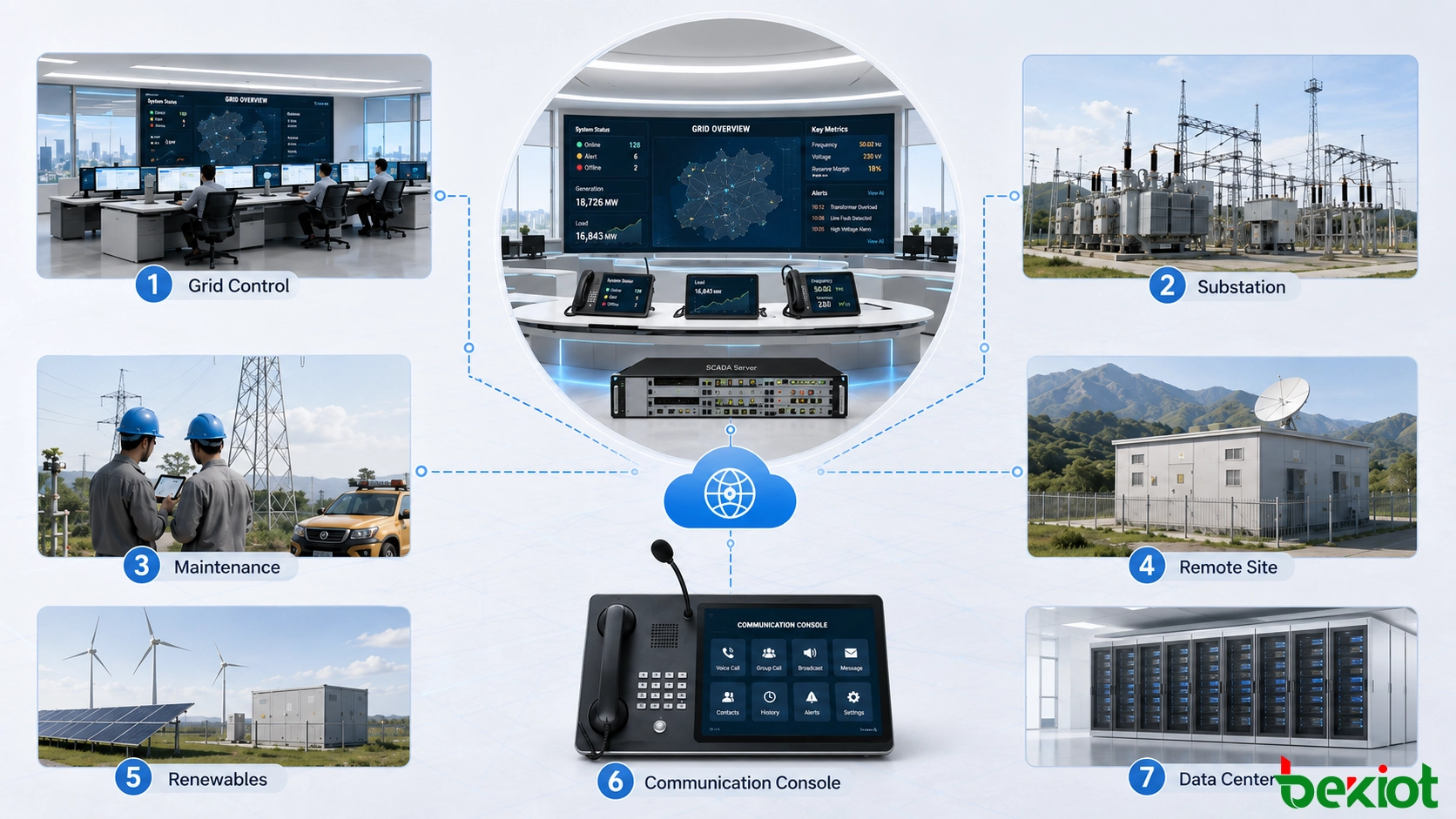
A control center may therefore use the same communication framework during routine scheduling, planned maintenance, equipment faults, grid disturbances, emergency restoration, and coordination with remote sites.
This becomes increasingly important as power networks grow more distributed. Renewable generation sites, remote substations, mobile maintenance teams, and regional control centers may all need to exchange information quickly. A centralized dispatch environment provides a common communication point without requiring every operational unit to work through separate communication processes.
A centralized dispatch environment supports communication between control centers, substations, maintenance teams, and distributed energy facilities.
Planning a Reliable Deployment
A successful power dispatch solution should be planned around operational processes rather than around individual devices. Adding more screens, terminals, or communication channels does not automatically improve dispatch efficiency. The system must make it easier for operators to find the right person, understand the current situation, issue instructions, and follow the progress of an event.
The first design consideration is the communication structure. Organizations should identify control centers, substations, duty rooms, maintenance departments, remote facilities, and mobile teams that need to communicate. These users can then be organized according to operational responsibilities rather than simply by extension number.
Network design is equally important. Fixed sites normally require dependable wired connectivity, while mobile personnel may require wireless access. Where different communication methods are used, the objective should be consistent operational communication rather than a collection of isolated networks.
Another consideration is information presentation. Dispatchers should be able to distinguish normal operating information from alarms and high-priority events. Frequently contacted teams and critical locations should be easier to access than rarely used resources. During an emergency, unnecessary menu navigation can slow communication.
The deployment should also consider growth. Power organizations may add substations, renewable generation facilities, regional offices, monitoring systems, or additional operational teams over time. A scalable system architecture makes it possible to extend communication without redesigning the entire dispatch process.
Earlier industry projections estimated that China's power dispatch control system market could reach approximately RMB 20 billion by 2025, with an annual compound growth rate of around 8%. While this figure represented a market forecast rather than a confirmed current market value, it reflected the wider industry trend toward digitalized and more intelligent grid control environments.
Why Integrated Dispatch Matters
The main purpose of a power dispatch console solution is not simply to place more communication tools in front of an operator. Its value comes from connecting operational information, communication resources, personnel, and response processes within a consistent dispatch environment.
For routine grid operation, this approach improves communication between control centers and field personnel. During equipment faults or emergency events, it provides a clearer path from problem identification to instruction delivery and response tracking. When combined with operational data analysis and forecasting, the dispatch center can also move beyond reactive communication toward more proactive operational management.
As electricity networks become more distributed and data-intensive, dispatch environments are likely to place greater emphasis on intelligent analysis, resource coordination, cross-department collaboration, and centralized information access. The most effective solution will therefore be one that supports the operator's complete workflow while remaining flexible enough to evolve with the power system.
FAQ
Does a dispatch center need both wired and wireless communication?
They serve different operational needs. Wired connections are well suited to permanent control rooms and fixed facilities, while wireless communication gives mobile inspection and maintenance personnel greater flexibility. Using both allows the communication system to cover fixed and mobile operating environments.
Why is workstation design important in a 24-hour control center?
Dispatch personnel may work at the same position for extended periods. Screen placement, working distance, console layout, seating, and access to frequently used controls can therefore affect operator fatigue and the speed of routine operations.
What information is useful during a post-incident review?
Communication recordings, event timelines, dispatch instructions, operating records, location information, and field feedback can help reconstruct how an incident developed and how the response was carried out. This information can support training and future process improvement.
Can this type of dispatch architecture be used outside the power industry?
Yes. The same centralized coordination concept can also support transportation, emergency management, industrial operations, and other environments where operators need to communicate with multiple teams while monitoring changing operational conditions.
Becke Telcom specializes in industrial explosion-proof comms for rail, tunnel, oil & gas, and marine sectors, offering PAGA, SOS, and IP telephones with integrated PA, intercom, and calling.
If you have any suggestions or questions for us, please feel free to contact us!
We use cookie to improve your online experience. By continuing to browse this website, you agree to our use of cookie.
Cookies
Please read our Terms and Conditions and this Policy before accessing or using our Services. If you cannot agree with this Policy or the Terms and Conditions, please do not access or use our Services. If you are located in a jurisdiction outside the European Economic Area, by using our Services, you accept the Terms and Conditions and accept our privacy practices described in this Policy. We may modify this Policy at any time, without prior notice, and changes may apply to any Personal Information we already hold about you, as well as any new Personal Information collected after the Policy is modified. If we make changes, we will notify you by revising the date at the top of this Policy. We will provide you with advanced notice if we make any material changes to how we collect, use or disclose your Personal Information that impact your rights under this Policy. If you are located in a jurisdiction other than the European Economic Area, the United Kingdom or Switzerland (collectively “European Countries”), your continued access or use of our Services after receiving the notice of changes, constitutes your acknowledgement that you accept the updated Policy. In addition, we may provide you with real time disclosures or additional information about the Personal Information handling practices of specific parts of our Services. Such notices may supplement this Policy or provide you with additional choices about how we process your Personal Information.
Cookies
Cookies are small text files stored on your device when you access most Websites on the internet or open certain emails. Among other things, Cookies allow a Website to recognize your device and remember if you've been to the Website before. Examples of information collected by Cookies include your browser type and the address of the Website from which you arrived at our Website as well as IP address and clickstream behavior (that is the pages you view and the links you click).We use the term cookie to refer to Cookies and technologies that perform a similar function to Cookies (e.g., tags, pixels, web beacons, etc.). Cookies can be read by the originating Website on each subsequent visit and by any other Website that recognizes the cookie. The Website uses Cookies in order to make the Website easier to use, to support a better user experience, including the provision of information and functionality to you, as well as to provide us with information about how the Website is used so that we can make sure it is as up to date, relevant, and error free as we can. Cookies on the Website We use Cookies to personalize your experience when you visit the Site, uniquely identify your computer for security purposes, and enable us and our third-party service providers to serve ads on our behalf across the internet.
We classify Cookies in the following categories: ● Strictly Necessary Cookies ● Performance Cookies ● Functional Cookies ● Targeting Cookies
Cookie List A cookie is a small piece of data (text file) that a website – when visited by a user – asks your browser to store on your device in order to remember information about you, such as your language preference or login information. Those cookies are set by us and called first-party cookies. We also use third-party cookies – which are cookies from a domain different than the domain of the website you are visiting – for our advertising and marketing efforts. More specifically, we use cookies and other tracking technologies for the following purposes:
Strictly Necessary Cookies These cookies are necessary for the website to function and cannot be switched off in our systems. They are usually only set in response to actions made by you which amount to a request for services, such as setting your privacy preferences, logging in or filling in forms. You can set your browser to block or alert you about these cookies, but some parts of the site will not then work. These cookies do not store any personally identifiable information.
Functional Cookies These cookies enable the website to provide enhanced functionality and personalisation. They may be set by us or by third party providers whose services we have added to our pages. If you do not allow these cookies then some or all of these services may not function properly.
Performance Cookies These cookies allow us to count visits and traffic sources so we can measure and improve the performance of our site. They help us to know which pages are the most and least popular and see how visitors move around the site. All information these cookies collect is aggregated and therefore anonymous. If you do not allow these cookies we will not know when you have visited our site, and will not be able to monitor its performance.
Targeting Cookies These cookies may be set through our site by our advertising partners. They may be used by those companies to build a profile of your interests and show you relevant adverts on other sites. They do not store directly personal information, but are based on uniquely identifying your browser and internet device. If you do not allow these cookies, you will experience less targeted advertising.
How To Turn Off Cookies You can choose to restrict or block Cookies through your browser settings at any time. Please note that certain Cookies may be set as soon as you visit the Website, but you can remove them using your browser settings. However, please be aware that restricting or blocking Cookies set on the Website may impact the functionality or performance of the Website or prevent you from using certain services provided through the Website. It will also affect our ability to update the Website to cater for user preferences and improve performance. Cookies within Mobile Applications
We only use Strictly Necessary Cookies on our mobile applications. These Cookies are critical to the functionality of our applications, so if you block or delete these Cookies you may not be able to use the application. These Cookies are not shared with any other application on your mobile device. We never use the Cookies from the mobile application to store personal information about you.
If you have questions or concerns regarding any information in this Privacy Policy, please contact us by email at . You can also contact us via our customer service at our Site.

 English
 Deutsch
 한국어
한국어 Русский
 Français
 日本語
日本語 لالعربية
 हिन्दी
 Español
 Português
 繁体中文
繁体中文 简体中文
简体中文