In the modern landscape of enterprise communication and command dispatch, two-way radios remain a critical communication tool for on-site teams across various industries, with their stable wireless transmission and instant intercom capabilities. However, the independent radio communication system often exists in isolation from IP-based communication systems such as softswitch and IPPBX, creating an audio communication barrier that hinders unified scheduling and collaborative work. To solve this problem, Becke Telcom has Becke-BW223 ROIP Gateway , which bridges the gap between traditional radio communication and IP communication based on ROIP technology and SIP protocol, enabling seamless interconnection between radio systems and softswitch, IPPBX, and command dispatch systems, and meeting the diverse audio fusion business needs of enterprises and public institutions.
Core Functions of Becke Telcom’s Becke-BW223 ROIP Gateway
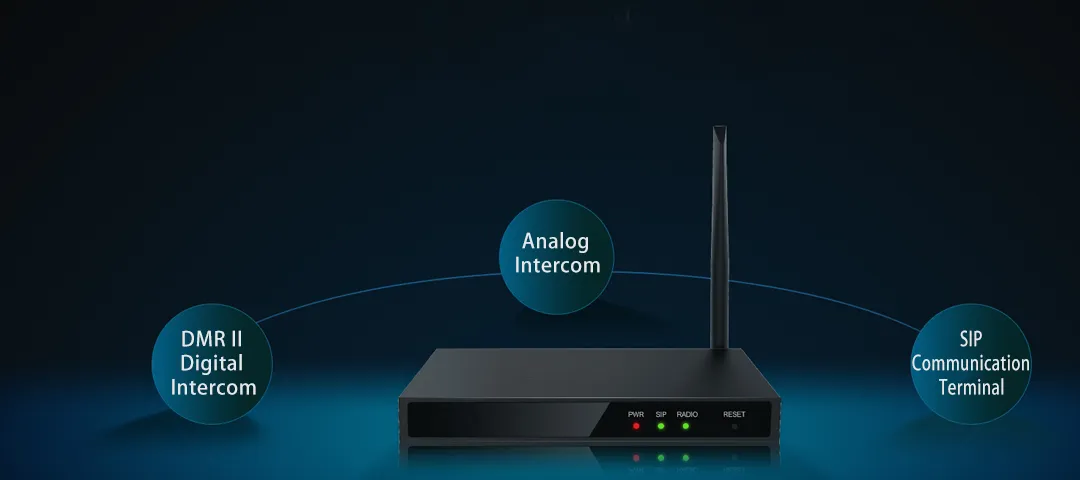
The core value of the Becke-BW223 ROIP Gateway lies in its integrated ROIP and SIP protocol support, which delivers multiple advantages including compact size, excellent voice processing, low latency, and strong compatibility. Its primary function is to serve as a wireless cluster access gateway that can integrate various wireless radio communication systems into emergency command unified communication platforms, enabling interoperability with traditional analog/digital intercom systems. Notably, it also supports standalone operation without relying on a unified communication platform, providing flexible deployment options for different usage scenarios.
The gateway is designed to facilitate three key communication modes to meet diverse business needs:
- Single Call: Supports 1 connection of analog/DMR digital radio and 1 SIP call connection, enabling direct one-to-one communication between radio terminals and SIP devices.
- Group Call: Enables group communication between analog/digital intercom systems and SIP phones, ensuring synchronized information sharing among team members across different communication devices.
- Trans-regional Communication: Leverages multiple DSS keys on SIP phones, which can be configured as speed dial keys for different intercom groups, breaking geographical limitations for cross-region collaboration.
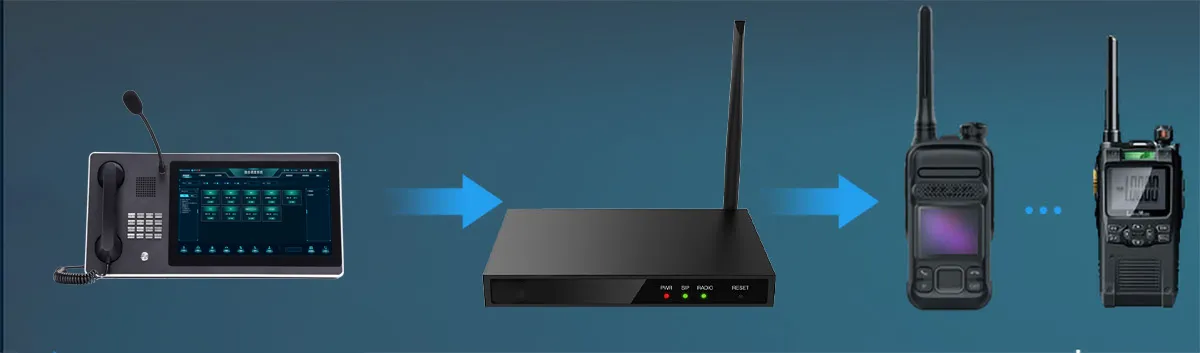
This multi-mode communication capability allows the Becke-BW223 to act as a versatile bridge between radio and IP infrastructures, ensuring seamless two-way audio transmission and breaking information silos between the two systems. Whether for daily internal communication or emergency command dispatch, the gateway guarantees smooth audio flow and enhances overall communication and scheduling efficiency.
Hardware Configurations and Multi-Standard Compatibility
Becke-BW223 features flexible hardware configurations and broad compatibility. The gateway is available in 1-port, 2-port, 3-port, and 4-port models, allowing users to select the appropriate configuration based on the size of their radio teams and actual business needs, achieving cost-effective deployment without excessive investment.
In terms of hardware design, the Becke-BW223 features a compact form factor with dimensions of 430×300×44.5mm, supporting both desktop and wall-mounted installation to save space in different environments. It adopts a DB9 Female interface type, which ensures stable connection with various radio devices. The gateway is equipped with 10/100M RJ45 network interfaces (dual 100M network ports for reliable data transmission) and supports multiple power supply options including AC 220V, DC 12V, and PoE (at)power supply,adapting to different on-site power conditions. Its operating environment specifications are robust: working temperature ranges from 0℃ to 55℃, and working humidity from 0% to 95% (non-condensing), ensuring stable operation in harsh industrial or outdoor settings.
A standout feature of the Becke-BW223 is its comprehensive multi-standard compatibility. It integrates a UHF band (400-470MHz) intercom module, supporting connections to both analog and digital radios. It is compatible with mainstream intercom brands such as Motorola and Hytera, eliminating compatibility issues with existing user equipment. Additionally, it supports standard SIP protocols for seamless connection with various SIP communication devices, covering a wide range of radio types and ensuring smooth integration with users’ existing communication ecosystems without the need for large-scale equipment replacement, thus effectively reducing system transformation costs.
Key Product Specifications and Special Features
Core Technical Specifications
- Protocol Support: Standard SIP protocol for IP communication, ROIP technology for radio-IP conversion.
- Audio Performance: Unbalanced audio input/output with 600 ohms impedance, -26dBm to +12dBm level, and 100Hz to 1500Hz frequency range. Supports multiple voice coding formats including G.711A, G.711μ, G.729, G.723, GSM, iLBC, and Speex. For high-definition voice needs, it also supports G.722 and Opus wideband coding, along with VAD (Voice Activity Detection) technology to optimize audio quality.
- DTMF Support: RFC-2833 and InBand standards, ensuring reliable transmission of dual-tone multi-frequency signals for control functions.
- Programming and Management: Supports HTTP and serial port programming, with a web-based management interface for intuitive configuration and monitoring.
Special Functional Advantages
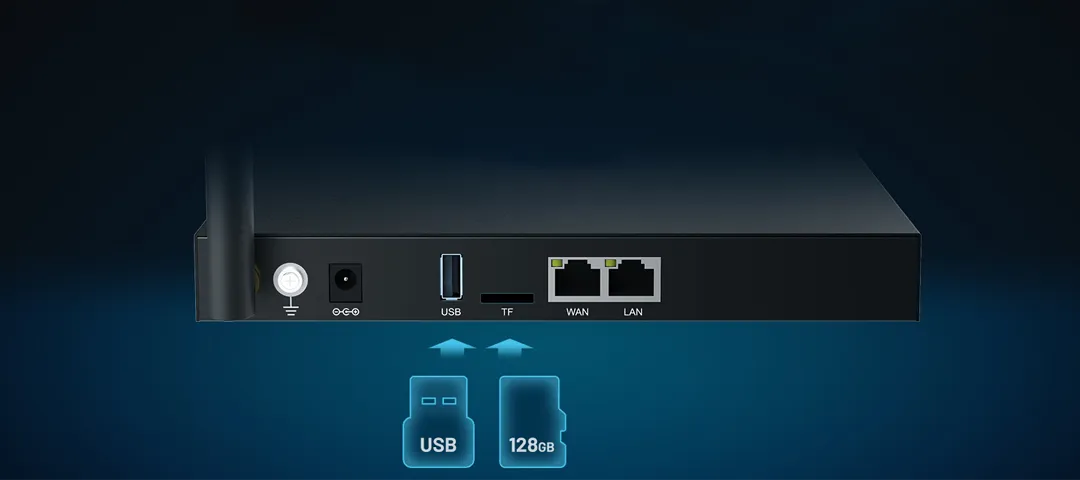
Expanded Storage and Upgrade Options: Equipped with a USB 2.0 interface and TF card slot, facilitating data storage (such as call recordings) and offline firmware upgrades, enhancing maintainability and scalability.
- Call Recording and Logging: Supports call recording functionality and allows users to view call logs initiated by both SIP devices and radios, enabling traceability and auditing of communication content.
- COR Signal Recognition: Features COR (Carrier Operated Relay) signal identification to ensure accurate detection of radio transmission status, optimizing communication synchronization.
- Voice Gain Customization: Allows users to adjust voice gain settings according to on-site environmental conditions, ensuring clear audio transmission even in noisy environments.
- Dual Network Port Redundancy: The dual 100M network ports provide redundant network transmission, improving system reliability and preventing communication interruptions due to single network failures.
ROIP Gateway Integration Modes with Softswitch Systems
The Becke-BW223 ROIP Gateway supports two flexible connection modes when integrating with SIP-based softswitch systems, catering to different scale and functional requirements:
- SIP User Registration Mode: This mode is widely adopted in most application scenarios due to its simple configuration and ease of operation. It is particularly suitable for small and medium-sized enterprises or scenarios with basic scheduling needs. Administrators only need to configure regular SIP users on the softswitch system and assign a unique SIP number to each port of the gateway. Once the gateway ports complete SIP registration with the corresponding numbers on the softswitch system, intercommunication between the two systems is achieved. The entire configuration process does not require complex professional skills, significantly lowering the technical threshold for users.
- Trunk Networking Mode: Designed for large-scale enterprise communication systems with high call volume and complex networking requirements. This mode requires professional configuration of SIP trunk parameters between the gateway and the softswitch system, making it ideal for interconnecting the entire communication system with external radio networks. It ensures stable communication for large-scale deployments and supports high-traffic transmission needs.
Both integration modes leverage the gateway’s native SIP protocol support, ensuring seamless compatibility with all mainstream softswitch systems on the market. The flexible connection options allow the Becke-BW223 to adapt to diverse network architectures and business scales, providing scalable integration solutions.
Diverse Application Scenarios of Becke Telcom’s Becke-BW223 ROIP Gateway
Thanks to its multi-standard compatibility, flexible deployment options, and rich functional features, the Becke-BW223 ROIP Gateway has a wide range of applications across various industries, meeting the audio fusion needs of different enterprises and institutions:
- Public Safety and Emergency Command: In police, fire fighting, and emergency rescue scenarios, the gateway can integrate professional digital radio systems (such as analog/DMR) with softswitch dispatch platforms. It enables unified scheduling between on-site rescue teams and backend command centers, ensuring the smooth transmission of emergency command information and enhancing response efficiency during critical situations.
- Transportation Industry: For aviation, maritime, and railway sectors, the gateway connects professional radios (including aviation and maritime radios operating in the UHF 400-470MHz band) with enterprise IPPBX systems. This facilitates communication between on-site operation personnel and office management teams, ensuring coordinated work across different departments.
- Industrial and Mining Sector: In coal mines, construction sites, and petrochemical plants, the Becke-BW223 adapts to harsh on-site environments with its robust hardware design and wide operating temperature range. It connects on-site analog/UHF radios with internal enterprise communication systems, enabling real-time communication between on-site teams and central control rooms to ensure operational safety.
- Logistics and Property Management: For logistics parks, property companies, and other scenarios with scattered personnel and multiple communication terminals, the flexible port configurations (1/2/3/4-port) support phased deployment of audio fusion systems. This reduces initial investment costs while meeting the growing communication needs of expanding teams.
Conclusion
The isolation between traditional two-way radio communication systems and IP-based softswitch, IPPBX, and dispatch systems has long been a pain point for enterprises seeking unified audio communication and scheduling. Becke Telcom’s Becke-BW223 ROIP Gateway perfectly addresses this industry challenge with its integrated ROIP and SIP technology, broad compatibility, and flexible deployment options. The gateway not only achieves seamless interoperability between radio terminals and IP communication devices but also preserves users’ existing radio equipment investments through its multi-standard compatibility, avoiding resource waste from large-scale equipment replacement.
With its compact design, multiple port configurations, robust hardware specifications, and rich functional features, the Becke-BW223 adapts to diverse application scenarios and on-site installation requirements. The simple SIP user registration mode and web-based management interface significantly reduce system integration and deployment complexity, allowing users to complete system transformation with a low technical threshold. Whether for daily enterprise internal communication or professional command dispatch in public safety, transportation, and industrial sectors, the Becke-W7BW223OIP Gateway delivers a stable, efficient, and cost-effective audio fusion solution, helping enterprises build a unified and intelligent audio communication and scheduling system.
In the future, as IP communication technology continues to evolve and the demand for unified dispatch grows across industries, Becke Telcom will continue to optimize the performance and functionality of the Becke-BW223 series. It will further enrich support for new radio standards and communication systems, providing more comprehensive and professional audio fusion solutions for global users.

 English
 Deutsch
 한국어
한국어 Русский
 Français
 日本語
日本語 لالعربية
 हिन्दी
 Español
 Português
 繁体中文
繁体中文 简体中文
简体中文